

By stewartb
The ‘Independent Water Commission Final Report’ (aka the Cunliffe report) published on July 21 has a lengthy section examining any possible relationship between water company ownership and performance outcomes.
British Labour Party politicians are at work with the mainstream media to allege poor performance of Scottish Water in order to convince the electorate that public ownership is ineffective and/or unnecessary. In this context, it’s worthwhile examining what the Commission’s report actually stated on this subject and worth assembling other relevant evidence to counter Labour’s talking down Scotland – again!
From the Water Commission’s report
From Para 693: ‘The Commission believes there is legitimate public interest in the ownership of water companies. While ownership model per se does not appear to be a good indicator of performance, that is not to say ownership is irrelevant. Rather, it is important because the business model of the owners plays a very important part in driving the behaviour of management and, more broadly, of the company.‘
In Chapter 6 of the report there is a sub-section entitled ‘Company ownership and performance’. In Para 673 the Commission identifies four main issues regarding the extent to which ownership model impacts company performance:
- profit in the provision of water and wastewater
- public listing versus ‘private’ (for example unlisted) ownership
- particular types of private investors and the investment vehicles they use
- Ofwat’s control and powers over water company ownership.
Do any of these issues arise and relevant to testing the efficacy of a public ownership model?
In Box 39 in the report, the Commission seeks to summarise ‘Performance of different ownership models’. However, it firstly sets out multiple caveats or limitations on what it has delivered before then concluding ‘Data across various metrics does not show any strong correlation between ownership model and performance’.
On the Commission’s caveats regarding its comparative assessment of links between ownership and performance outcomes, we learn this: ‘This comparison uses only metrics with consistent, comparable data across ownership models. Gathering data on comparable metrics across different jurisdictions is challenging.’
It then notes exclusions from its analysis: ‘Financial indicators and other key metrics like pollution were excluded due to inconsistent definitions, lack of reporting, or incompatibility across regulatory frameworks. In particular, while household bills are a key indicator, differences in what is included, subsidy levels and how water and wastewater costs are reported made recent, like-for-like comparisons across models unreliable. There are also no standardised metrics for pollution incidents across the models compared, as most other countries do not systematically monitor or publish data.’
Candidly, this seems like a very substantial set of exclusions and yet …. the Commission still feels justified in stating: ‘The Commission has compared outcomes in countries reasonably similar to England and Wales. This analysis has not demonstrated any one model is universally better than another.’ Arguably ‘universally better’ is a very high bar to set in any comparative assessment and especially so in such a complex area and with the multiple caveats/limitations raised!
On the different ownership models, the Commission describes Scotland’s thus: ‘Centralised nationalised model – In Scotland, the water industry is nationalised, with a single company – Scottish Water. Scottish Water is owned by the Scottish Government, and funded through customer bills, with volatility in revenues and investment being funded by government lending. Despite being nationalised, Scottish Water is still regulated; there has been a recent move to a more ‘ethical’ based model, which emphasises trust and collaboration between Scottish Water and the regulator. Water supply in Northern Ireland and Ireland is also nationalised though spending is mostly funded through taxpayers.’
Table 7 in the Commission’s report (reproduced below) provides a summary of performance metrics for different ownership models.
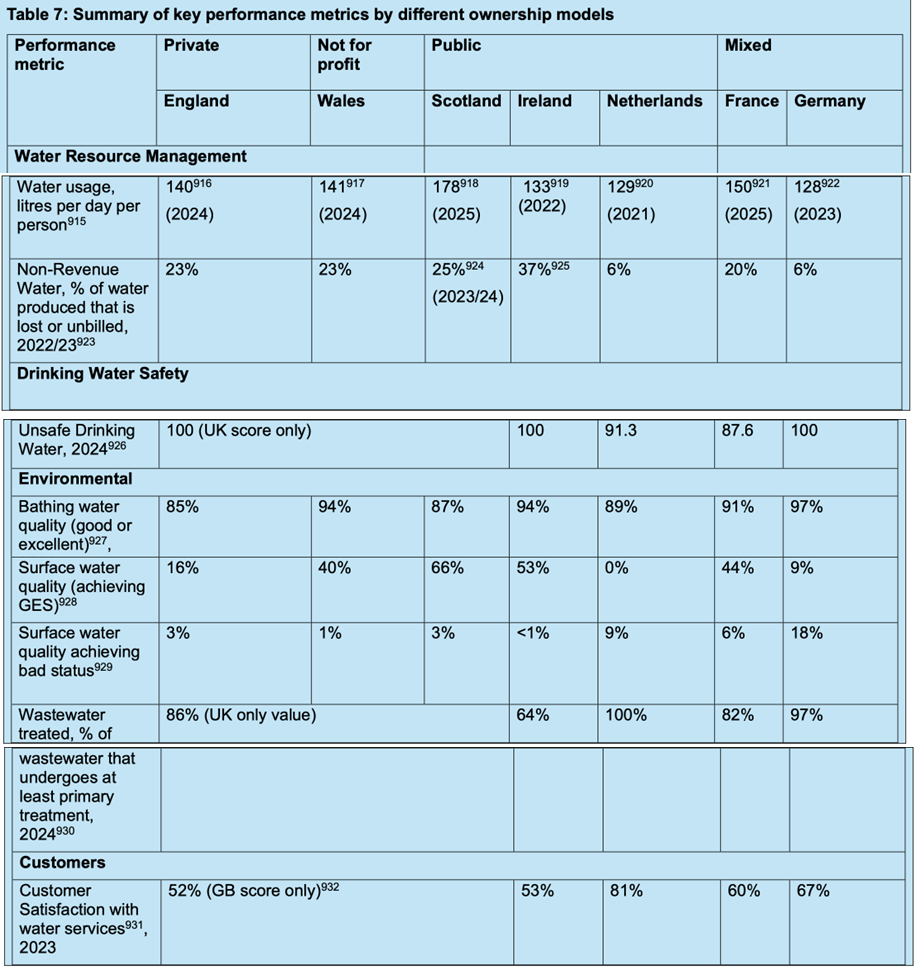
Is ‘water usage per day’ a fair metric of ownership model performance? Or is it a public/cultural response to longstanding abundance, quality of product and presently low public interest in installing domestic water meters? Moreover, I’d be amazed in ‘non safe drinking water’ is a differentiator across the UK.
Customer satisfaction
It is notable from Table 7 that on the key issue of ‘Customer Satisfaction’ the Commission ONLY quotes ‘GB scores’. From what follows one might consider this odd!
The Holyrood Parliament’s Net Zero, Energy and Transport Committee on April1, 2025 held a session to consider the latest Annual Report from Scottish Water (see https://www.parliament.scot/~/media/committ/10221/Clerk_Paper_1).
Written evidence from Scottish Water had this: ‘Strong public support is reflected in the findings of the January 2025 UK Customer Satisfaction Index (UKCSI), which is based on a survey of over 15,000 consumers, and found Scottish Water to be the most trusted water company in the UK and among the top performing utilities.’
Corroboration of satisfaction ratings?
Question: How do water companies in England, Scotland and Wales rate in terms of customer satisfaction, including in UKCSI data?
Extracts from ChatGPT’s responses:
UK Customer Satisfaction Index (Utilities Sector) – Water Companies:
- ‘Scottish Water (the only Scottish provider included) was cited in earlier UKCSI as the highest-rated water/sewerage provider in 2021’
- ‘Scottish Water is the sole provider, a public statutory corporation, and consistently rated highest among UK water companies in UKCSI benchmarks’ and ‘ … in Scotland; .. trust and satisfaction remain relatively higher than in England.’
- ‘UKCSI shows water sector satisfaction at 69.5/100 (July 2024), lower than energy for the first time. Scottish Water and historically Welsh Water rank highest nationally; but Dŵr Cymru still featured among lagging performers in recent Ofwat assessment cycles due to decline.’
Question: Where does Scottish Water rank in Ofwat data on customer satisfaction and on performance? Where does it rank in the UKCSI’s 2025 utilities sector report?
ChatGPT said: ‘Scottish Water is not rated by Ofwat, as it operates under a separate statutory framework regulated by the Water Industry Commission for Scotland (WICS)—not Ofwat. However, Scottish Water’s own Outcome Performance Assessment (OPA) by WICS shows it achieved 402 points in 2023–24 (just within its 395–410 target range)—very similar to previous years, reflecting consistently strong operational performance.’
Adding: ‘It also posted an excellent household Customer Experience Measure (hCEM) score of 86.6 in 2023–24 (target ≥ 85), well above regulatory expectations of Scottish Government. In short: while Ofwat provides no ranking, Scottish Water is regarded by WICS as performing excellently on service, customer experience, and operational metrics.’
Also from ChatGPT: ’The January 2025 UKCSI Utilities Sector report represents survey data up to September 2024. Scottish Water is among the top-rated utilities: …. Scottish Water is named explicitly as one of the highest rated organisations in the sector—alongside UK Power Networks, Octopus Energy, and Utility Warehouse. This places Scottish Water firmly in the top tier of UK utilities for customer satisfaction.’
ChatGPT also reveals: ‘British Water’s UK Water Company Performance Survey 2023, based on feedback from contractors and suppliers:
- Scottish Water – overall score 8.1/10, ranked 1st
- Northumbrian Water – 8.0
- Yorkshire Water – 7.6
- Dŵr Cymru Welsh Water – 7.4
- Severn Trent Water – 7.3
- United Utilities – 7.2
… down to Southern Water – 6.7 and Northern Ireland Water bottom at 6.2
ChatGPT concludes: ’This confirms Scottish Water is viewed by its supply chain as the best performer across the UK.’
Given the above evidence on ‘satisfaction’ ratings, why did the Independent Water Commission (in Table 7) provide ‘GB scores’ only? Odd!
 Talking-up Scotland
From all that I’ve read, Cunliffe’s report appears to have been politically directed to defend against increasing calls for nationalisation of water companies in England – As such it’s more a PR exercise than an independent appraisal.
LikeLike