

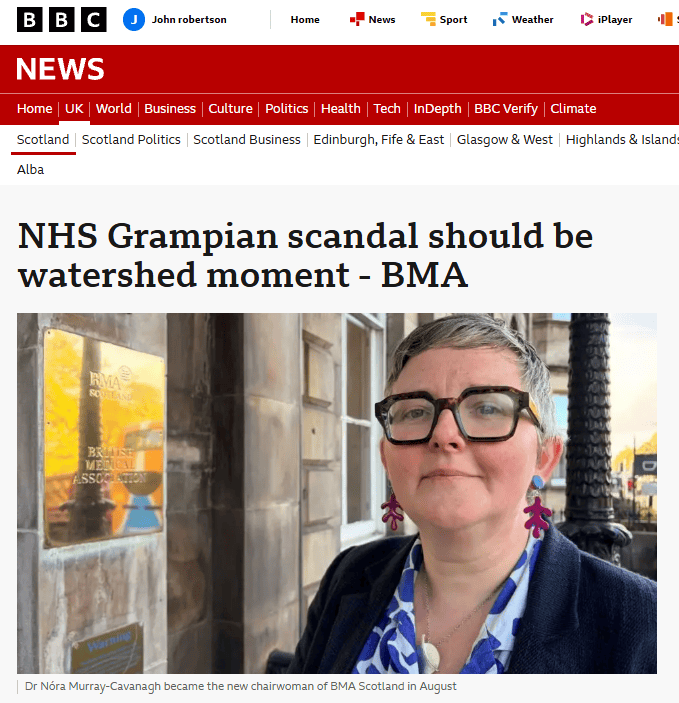
From BBC Scotland today, the above and:
A series of failures in patient care at NHS Grampian should be a watershed moment, the chairwoman of the BMA in Scotland has said. Dr Nóra Murray-Cavanagh said the public were “horrified” by the revelations at the health board but she hoped an independent review would uncover the truth of what happened.
Her comments came after a scathing report from the health watchdog Healthcare Improvement Scotland found “major deficiencies” in NHS Grampian’s leadership and culture. Then last week, a leaked report from 2022 then highlighted 19 avoidable deaths among 45 patients in liver and pancreatic surgery at Aberdeen Royal Infirmary (ARI).
and:
“With each headline and each revelation, people are horrified and upset and really worried about patients and really worried about their services,” she said.1
It’s at moments like these that you see that capable medics are not necessarily capable researchers or even readers of research.
The Healthcare Improvement Scotland report is very clear:
On page 18:
We did not see any harm documented in incidents reported relating to delays to triage.
and on page 21:
Evidence reviewed included incident reports completed by staff within the paediatric ward for the six months prior to our inspection. These highlighted occasions where the ward was staffed by one registered paediatric nurse whilst a second registered paediatric nurse provided support to an acutely unwell child in the emergency department. We did not observe any incidents describing any delays to care or patient harm due to this.
and on page 34:
NHS Grampian’s health and safety risk assessment for ward 4 states that all staff should be trained in basic life support, with all registered staff trained in immediate life support. Within evidence we observed that 69 % of staff are trained in basic life support and 82% of staff are trained in immediate life support in ward 4. Within incident reports reviewed we did not see any incidents of patient harm as a result of a failure to recognise a deteriorating patient or the availability of basic life support training.
The leaked report suggesting avoidable deaths among 45 patients in liver and pancreatic surgery, was into only one section of surgery accounting for only 1% of all procedures done in a typical year and less than that over the 6 years quoted. In 2019, when the ‘slaughterhouse’ was apparently operational (sorry) in Aberdeen Royal, 7 910 (7 374 in 2025) surgical procedures were carried out.2 At least 99% of all surgery practice is not being investigated. The public are only ‘horrified’ if they read the media nonsense on NHS Grampian amd because they have not been told the truth.
The ‘leaked report’, based no doubt on the thoughts of top medics is nevertheless bad research and has no informative value.
Dare I challenge these high-profile academics? Yes, on research methods. I taught research methods for decades, supervised PhDs, was Faculty Chair of Research Ethics and often met 'health profs' who wouldn't know a research method if it bit them on their gluteal region. They got to prof because of a history of practice, leadership or just management.
I’ve looked at what I can find of their original report. The full version seems to be confidential, unavasilable, so I cannot fully consider it.
I do know they reviewed only 45 cases of liver and pancreatic surgery at Aberdeen Royal Infirmary between 2015 and 2021. 31 of the 45 patients died. 19 of those deaths were judged to be from “avoidable consequences of surgery or intervention.”
It’s a very small sample over 6 years and crucially the 2022 Wigmore/Toogood review looked only at the 45 specific cases flagged by two whistle-blowers, Selected case reviews of this kind can over-represent problems, so the absolute numbers alone cannot prove a unit-wide catastrophe.
Can we check the raw data? No, the document was an internal expert review commissioned by NHS Grampian. It was released at the press conference by Aamer Anwar on 19 November 2026, but only high-level findings have been reported in the media. No full PDF, case-level tables, individual anonymised records, or complete raw dataset appears to have been published online.
By design the sample is selected for concern – ‘squeaky wheel’ research has little value. It is not a random sample, or a complete audit of all HPB operations performed in the period. This introduces selection bias and means the proportion of deaths judged avoidable cannot be extrapolated to the whole unit without further data.
The absolute numbers are modest (45 cases over 6 years). This seriously
Judgements of ‘avoidability’ are inherently retrospective and subjective, even when made by ‘independent experts’.
Sources:
- https://www.bbc.co.uk/news/articles/cw4gne8jp73qo?fbclid=IwY2xjawV2xxhleHRuA2FlbQIxMABwZG9mBWJyaWQRMXNUWFlZc2tPMjV4QkpENXZzcnRjBmFwcF9pZBAyMjIwMzkxNzg4MjAwODkyAAEfYQj8fYX25GUtipksAieDc1rSBZGJ0sF3-oLtAb6dB9dbok_9NApZyec5nuY_aem_e1IgLn40x79IyU53J-UWYA
- https://www.gov.scot/binaries/content/documents/govscot/publications/independent-report/2025/09/nhs-grampian-independent-review/documents/scottish-government-nhs-grampian-diagnostic/scottish-government-nhs-grampian-diagnostic/govscot%3Adocument/Scottish%2BGovernment%2B-%2BNHS%2BGrampian%2BDiagnostic.pdf
Discover more from
Subscribe to get the latest posts sent to your email.


Well said 100% on point as per usual 👏👏
LikeLike