

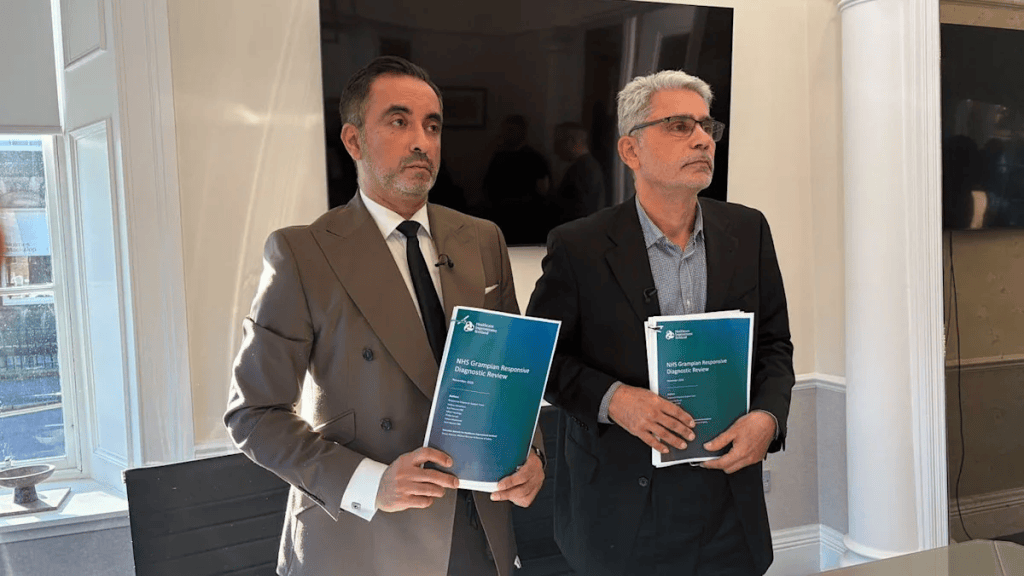
In the Guardian, yesterday:
A senior surgeon has called for a criminal investigation into a Scottish hospital after it emerged that at least 19 patients had died from avoidable complications due to surgery. Dr Mohammed Habib, a consultant at Aberdeen Royal Infirmary, said he had repeatedly reported concerns about the hospital’s liver and pancreatic surgery from 2021 onwards and believed dozens of patients may have died unnecessarily there.
and:
Two external experts who carried out the review in 2022, surgery professors at Edinburgh and Leeds universities, concluded the “extremely high” death rate at Aberdeen between 2017 and 2020 ran as high as 18% within liver and pancreatic surgery.
The internal report is the 2022 external expert review of liver and pancreatic (HPB) surgery at Aberdeen Royal Infirmary. It was commissioned by NHS Grampian, following concerns raised by Dr Mohammed Habib and a second whistle-blower and completed in September 2022 by Professor Stephen Wigmore (Regius Chair of Clinical Surgery, University of Edinburgh) and Professor Giles Toogood (HPB Surgery, University of Leeds). It had remained unpublished until Anwar released it at the press conference.
Dare I challenge these high-profile academics? Yes, on research methods. I taught research methods for decades, supervised PhDs, was Faculty Chair of Research Ethics and often met 'health profs' who wouldn't know a research method if it bit them on their gluteal region. They got to prof because of a history of practice, leadership or just management.
I’ve looked at what I can find of their original report. The full version seems to be confidential, unavasilable, so I cannot fully consider it.
I do know they reviewed only 45 cases of liver and pancreatic surgery at Aberdeen Royal Infirmary between 2015 and 2021. 31 of the 45 patients died. 19 of those deaths were judged to be from “avoidable consequences of surgery or intervention.”
It’s a very small sample over 6 years and crucially the 2022 Wigmore/Toogood review looked only at the 45 specific cases flagged by two whistle-blowers, Selected case reviews of this kind can over-represent problems, so the absolute numbers alone cannot prove a unit-wide catastrophe.
Can we check the raw data? No, the document was an internal expert review commissioned by NHS Grampian. It was released at the press conference by Aamer Anwar on 19 November 2026, but only high-level findings have been reported in the media. No full PDF, case-level tables, individual anonymised records, or complete raw dataset appears to have been published online.
By design the sample is selected for concern – ‘squeaky wheel’ research has little value. It is not a random sample, or a complete audit of all HPB operations performed in the period. This introduces selection bias and means the proportion of deaths judged avoidable cannot be extrapolated to the whole unit without further data.
The absolute numbers are modest (45 cases over 6 years). This seriously
Judgements of ‘avoidability’ are inherently retrospective and subjective, even when made by ‘independent experts’.
Is there any comparable evidence that the supposed problem has persisted to the present day?
The recent HIS diagnostic review of NHS Grampian focused more broadly on leadership and clinical governance and identified only one patient death linked to a serious adverse event in the material it highlighted.
More widely and not focusing on these two reviewers is there evidence that commissioning reviews of health units suspected of problems tends to predispose reviewers to find and perhaps to amplify these to justify their credibility as reviewers?
There is evidence of cognitive biases and structural features that can predispose external reviewers to identify and emphasise problems in units already under suspicion.
Reviews of clinical care are especially vulnerable.
Once an adverse outcome is known, reviewers overestimate how predictable it was and how obvious the “correct” course of action should have been. https://www.sciencedirect.com/science/article/abs/pii/S0952818024001788
Units or services are typically reviewed because of existing concerns, complaints or adverse events. Reviewers therefore see a non-random sample enriched for problems, as in Aberdeen. This creates a strong pull toward critical findings. https://www.cokergroup.com/insights/reducing-bias-in-physician-peer-review
Discover more from
Subscribe to get the latest posts sent to your email.

