

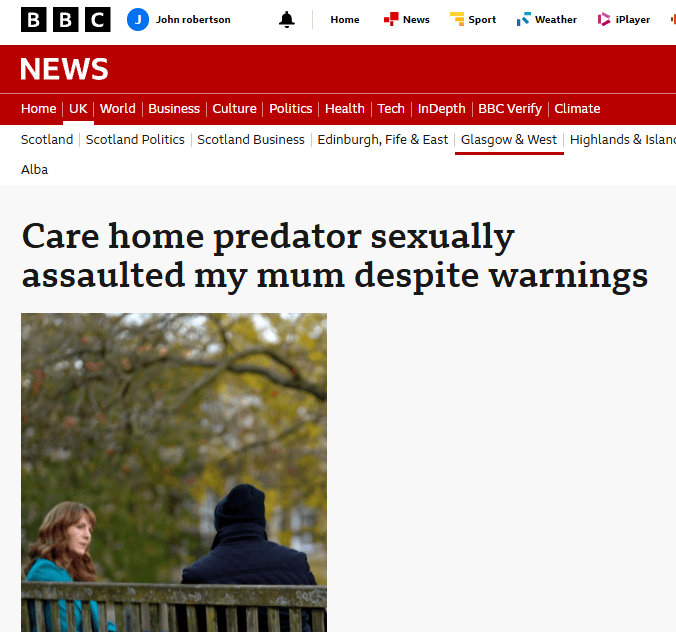
From BBC Scotland today the above and:
A man has told BBC News how his elderly mother, who was suffering from dementia, was sexually assaulted by a fellow resident in a care home in Inverclyde. The man – who we are calling John to protect his mother’s identity – said the “horrific” sex attack took place despite concerns previously being raised by staff about the behaviour of the attacker. John told the BBC he was speaking out after HC-One, which operates the Merino Court Care Home in Greenock, admitted liability and paid damages after a civil action. https://www.bbc.co.uk/news/articles/cw5y1r557j54o
‘HC-One‘ reminded me of this from May 2020 as Covid deaths surged:
By stewartb
HC-One has now published data on Covid-19 cases and related deaths in its care homes. These numbers are cumulative since the start of the UK COVID-19 outbreak. As of 12th May 2020:
4,747 suspected or confirmed cases of COVID-19 to date in HC-One homes
856 deaths with suspected or confirmed COVID-19 to date
(By my calculation: 18.0% of cases resulting in death.)
Candidly, its not absolutely clear from the company’s text whether the above figures are for its homes across the whole UK or just the rUK excluding Scotland.
In the same information release, it provides this separately for its homes in Scotland:
982 suspected or confirmed cases of COVID-19 to date
201 deaths with suspected or confirmed COVID-19 to date
(By my calculation: 20.5% of cases resulting in death.)
HC-One adds: “These numbers encompass confirmed tests and suspected cases in our homes, based on the clinical assessment of a GP, Community Matron or a member of our own clinical team.” It also states: “Please note we will not be providing home-level breakdowns.”
Source: https://hc-one.co.uk/Our-News/Corporate-News/HC-One-COVID-19-cases-and-loss-of-life.aspx
And in June that same year:
Are Scotland’s private care homes cash cows?
By stewartb
As certain care home owners continue to seek media profile for complaints against government, notably in Scotland but indeed elsewhere in the UK, it seems appropriate for the TuSC to continue to provide information on the nature of this commercial industry.
Despite ‘complaint’, the care home market in the UK still seems to be attractive to private sector investors. When looking at the longer term fundamentals of market demand and supply, it is probably not surprising!
According to specialist advisor One Touch Investment (OTI) : “the UK has an ageing population; care for the elderly already generates an income in excess of £14.5 billion for the UK economy every year, the majority being funded by the government.” (with my emphasis)
Source: https://www.onetouchinvestment.co.uk/news/care-home-investment/uk-care-home-market-worth-investing/
OTI sets out evidence on projected long term, sustained increase in demand for care homes in the UK. It explains how government is (arguably, has to be at least to a degree) committed to finance the care of those without financial assets. So we have a ‘market’ with increasing demand for critical services and a ‘public’ buyer with little choice but to pay to meet the demand: the commercial attraction becomes clear!
The same source provides this as further background: “The National Health Service in the UK has been reducing capital and seeking out private partners to develop and manage care homes. Virgin Care entered the market in 2010, and over the past six years has been awarded contracts worth more than £1billion and runs over 200 NHS services. So private companies are developing and managing the care homes. The government will pay the bills – where the people can’t afford to.”
(For some indication of Virgin Care’s share of the health and social care market in England see: https://virgincare.co.uk/services/ )
We are also told by OTI that: ‘High yielding, hands off investments like care homes and student accommodation investments have been very popular with overseas investors because they are fully-managed and pay regular income’ says investment director, Arran Kerkvliet, at One Touch Property; a specialist property broker in London that sources well-researched property developments for global investors seeking to diversify their income.’
Of course all parties to these care home investments – underpinned by the safety net of government paying residents’ bills – will be extracting value for their own benefit. And the value created is not only being extracted by UK residents but extracted often by overseas interests.
‘Helpfully’ the potential investor is alerted by OTI to the ‘risks’ in care home investment: “Nursing care, qualified nurse shortage. Inflation and minimum wages driving costs up. This is why those leases are only 8%Net.” Those bothersome minimum wages …!
Care home investments are now being viewed as an alternative to serviced apartments and holiday lets for individual investors. As OTI explains: “… AirBnB profits have plummeted significantly due to the Coronavirus pandemic leaving people unable to travel. Investors were previously attracted to the idea of serviced apartment investments due to the high yields they offer. Short term stays are able to command higher daily rental fees and this converts into higher rental yields. Although as we have seen, they are not immune to the change in the economic and daily landscape of the UK.”
“One alternative where the fundamentals are not affected by outbreaks or economic downturns are care home investments. The ageing population in the UK creates an underlying need for care home beds, and the government’s failure to provide an adequate supply means that there is a sustained demand for investors to plug the gap.” So in effect UK government policy has been creating an attractive commercial market which permits value extraction including by rentiers, and including ones based outside the UK!
And finally for now: “These (this class of care home investments) work similarly to serviced apartment investments in that they are classed as commercial property so no stamp duty is applicable under £150,000. They are generally bought on a 25-year commercial lease where a yearly return is underwritten in the contract. We (OTI) source care homes that are fully operational and have been successfully operating for years. We analyse the financials to decide whether the returns stack up. Often guests are self-funded although if they do not have enough capital to fund their stay then the government supports them, allowing for a constant rental income and occupancy.” Or to put this another way, the taxpayer via government mitigates the investors’ financial risk!
There must surely be better ways than this to look after the elderly and vulnerable! Of course we should expect commercial care home interests to marshall resources to resist change.
Discover more from
Subscribe to get the latest posts sent to your email.

