

In the Guardian today, the above and:
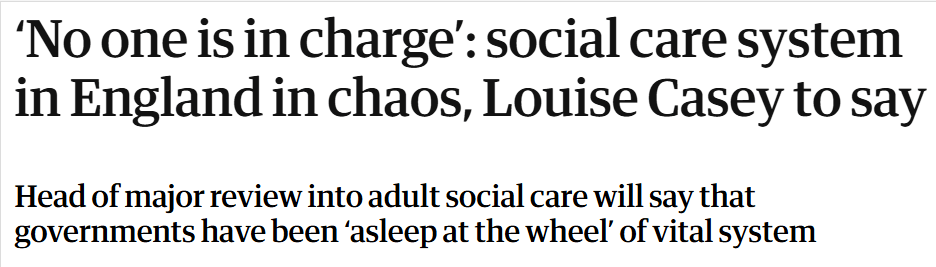
Successive governments in England have been “asleep at the wheel” on social care, leaving the system to grow as a chaotic patchwork of local services with no clear vision, Louise Casey, the head of the social care commission, is to warn.
Lady Casey, who is preparing proposals for a big review of adult social care, will say the result is that in effect “no one is in charge” of a system that provides vital services for millions of vulnerable people.
https://www.theguardian.com/society/2026/nov/11/louise-casey-england-social-care-system
Scotland has a clearer, more generous national approach to adult social care than the chaotic, under-stewarded system Louise Casey criticises in England.
Scotland’s free personal care model is the clearest structural difference and is frequently cited as a potential template for England’s National Care Service ambitions. It reduces the sharp “cliff-edge” means-test that forces many people in England to sell assets or pay full private rates. Research from The King’s Fund groups Scotland with countries offering universal access based on need (with means-testing mainly for contributions), while England is grouped with the small set of systems that exclude people entirely.https://www.kingsfund.org.uk/insight-and-analysis/press-releases/ncs-injustice-self-funders
Both systems remain under severe pressure from ageing, dementia, workforce shortages, funding constraints and integration challenges with the NHS. Scotland’s higher public commitment has not eliminated local budget crises, waiting times or quality variation. England’s problems of weak stewardship and private-market dominance are far more serious in Casey’s analysis.
So, Scotland’s system is more coherent and less punitive on personal care costs It tackles some of the core failures Casey highlights in England.
More detail
| Aspect | England (as criticised by Casey) | Scotland |
|---|---|---|
| Core funding/access | Strict means-test: assets over £23,250 generally mean full self-funding. Self-funders pay 40% more on average for the same care. England is an international outlier in using means-testing to exclude people entirely rather than just set co-payments. | Free personal care (and nursing care contribution) at home for assessed need, regardless of income/savings (since 2002 for over-65s, extended later). Aligns more with universal-need-based systems in many comparable countries. |
| System stewardship & consistency | Evolved through “increments and accidents”, with fragmented responsibilities across national/local government and 19,000 providers. There is no clear national oversight and a postcode lottery. The private sector dominates. | National policy direction on free personal care since 2002. Health and social care integration via Integration Joint Boards/partnerships. Still local delivery and some variation, but stronger national consistency on the free personal care entitlement. |
Discover more from
Subscribe to get the latest posts sent to your email.

