

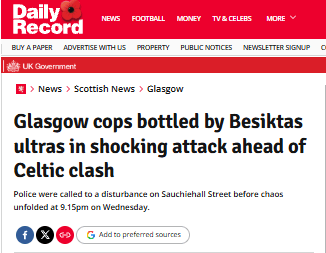
Did BBC Scotland cover the above? I can find not a mention in their reports in the last few days. Many did:

On 1 April 2026, they did mention them:
This year’s Bonfire Night will see police coping with two further challenges – both in Scotland’s biggest city. Celtic will take on Turkish side Beskitas in a Uefa Europa League match at Celtic Park. Officers say they are also aware of images circulating online, suggesting “planned protest activity” will take place in Glasgow the same night. https://www.bbc.co.uk/news/articles/cmgqwgpjpjngo
Why have they not returned to these dramatic reports of violence by Turkish football fans against police officers, the very fans requiring: ‘Additional public order vehicles and drivers are being brought in from 18 English and Welsh police forces under mutual aid arrangements?’
It can only be an editorial decision based on an agenda to keep undermining if they can the SNP city of Glasgow.
Discover more from
Subscribe to get the latest posts sent to your email.


MacPravda undermining an SNP Government? Help ma boab, whit nixt?
LikeLike
Perhaps no unionist party sent them a press release! After all, isn’t that where BBC Scotland gets most of its news?
LikeLike
Given the BBC’s lack of interest in broadcasting from the 2026 Commonwealth Games in Glasgow, I suppose one should be grateful that the Scotland page of the BBC News website did report (November 2) on the just released impact evaluation of the Games: ‘Glasgow 2026 generated £233m – is it a blueprint for future games?’ Especially since it’s a very positive evaluation!
See ‘GLASGOW 2026 COMMONWEALTH GAMES – IMPACT EVALUATION’ available at https://resources.cwg-qbr.pulselive.com/qbr-commonwealth-games/document/2026/11/03/95a50e5f-f895-4756-a72c-531e9b63bcd9/000_Glasgow-2026-Commonwealth-Games_Impact-Evaluation-Report_November-2026.pdf
The BBC piece notes: ‘More than a million people attended the Commonwealth Games in Glasgow this summer, and 510 million sports fans watched from around the world, according to a new report. The Glasgow 2026 impact evaluation also found that it generated £233m in economic activity across Scotland, with £158.6m of that in the host city itself.’
The article also explains: ‘Organisers promised it would cost the taxpayer nothing and the figures in the new report show they achieved this.’
But before anyone expresses surprise at a BBC Scotland journalist penning a straightforwardly positive report on a ‘good news’ story about Glasgow and Scotland, read to the end! The final part of the BBC article comes under the sub-heading ‘Analysis’. It’s written by the BBC Scotland ‘Scotland sports news correspondent’. What the latter contributes looks IMHO like an attempt – albeit quite subtly – to downplay the positives: indeed one remark even appears to imply that the methodology used to estimate economic impact is questionable. This is what the BBC Scotland ‘analyst’ writes:
‘This was a stopgap Games – an event that was designed to provide life support to an organisation fighting for survival and relevancy. This impact report makes a compelling case that it was mission accomplished BUT questions still remain from a local and global perspective.’ (my emphasis)
It goes on: ‘It’s always more difficult TO PROPERLY quantify the financial impact for the wider economy. Economic activity ISN’T THE SAME AS economic profit and headline figures often reflect SPENDING rather than long term financial GAIN.’ The BBC Scotland analysis makes no mention of ‘economic output’ nor of ‘gross value added (GVA)’ nor of employment impact; and what does the journalist mean by the non-standard term ‘economic profit’ in the context of an economic impact assessment?
The BBC analysis adds: ‘Local legacy is also something that can be difficult to determine. Glasgow 2014 left bricks and mortar in the form of new venues and housing. Glasgow 2026 can only leave a hope that the city can continue to attract global sporting events.’
Given this BBC analysis, what does the evaluation report actually claim? This is from page 68 of the report, prepared by independent consultants/researchers ‘Economic impact is reported through three measures: output (the total financial value of goods and services produced), gross value added (GVA, the economic value added contribution to GDP) and employment (full-time equivalent, or FTE, years supported). The full methodology, including the treatment of additionality, expenditure categories, data sources and input-output framework, is provided in the Appendix.’
Did the BBC Scotland ‘analyst’ who wrote about ‘economic activity’, ‘economic profit’, ‘spending’ (i.e. an input which finances activity) and ‘financial gain’ opt deliberately to ignore the findings on the key economic impact metric of ‘GVA’ ? Did they actually read the methodology section of the report? Perhaps an economy correspondent would have been a better choice to provide an ‘analysis’ of an impact evaluation!
The report’s Table 6.7 summarises economic contributions measured by gross output at the level of Scotland and the Glasgow City Region, AND gross value added (GVA) also measured at the same two levels. And from the evaluation report, page 66: ‘Glasgow 2026 generated £223.0 million of Gross Output (GO) across Scotland. Of this, £126.5 million was direct impact: net additional expenditure in Scotland by the Organising Company, its delivery partners and Games visitors. The remainder arose through indirect impacts, as suppliers purchased goods and services from their own supply chains, and induced impacts, as wages supported by this level of activity were spent in the wider economy.’
It estimates that the £223.0 million of gross economic output generated £117.3 million of Gross Value Added (GVA), the economic value added after netting off the cost of bought-in goods and services, and adds that the associated economic activity supported an estimated 2,400 Full-Time Equivalent (FTE) years of employment. And within Scotland, the Glasgow City Region accounted for most of the output and impact , with £176.0 million of gross output, £92.5 million of GVA and an estimated 2,100 FTE years of employment.
On ‘legacy’, the report explains that longer-term and legacy impacts fall outside the present phase of the impact evaluation and will require longitudinal evaluation. It recommends this is commissioned for future phases of evaluation work. However, the present evaluation report does include a number of case studies which explore selected programmes and initiatives in greater depth, including ones with potential for longer-term impact and legacy.
LikeLike