

By stewartb
A new Centre for Cities’ report provides welcome relief from sustained – and contrived – Unionist and especially Labour Party leadership negativity about governance and strategic economic development in Scotland.
The Centre for Cities (CfC), founded in 2007, has long been a notable think tank with a distinctive mission ‘to help the UK’s largest cities and towns realise their economic potential.’ Given the current attention at Westminster on English devolution and on economic growth within city regions, the CfC’s research output is especially relevant. Moreover, its body of work has the potential to provide a much needed objective basis on which to respond to the UK Prime Minister and other Unionist politicians’ urgings for Scotland to ape England’s governance, its metro-mayors and ‘Manchesterism’.
Source: Centre for Cities (October 27, 2026) Electrifying Britain: Lessons from Scottish Rail – Scotland’s electrification costs have fallen 26 per cent in recent years, and are now 20 per cent below England’s. (https://www.centreforcities.org/blog/electrifying-britain-lessons-from-scottish-rail/)
The CfC bemoans yet another example of the UK state’s weakness in delivering necessary transformation and modernisation of strategic infrastructure. The failings of the grand HS2 project are well known and so are failures to ensure an electricity grid fit for present and future need. The CfC notes that UK governments have had the ambition to electrify the rail network since the ‘1955 Modernisation Plan’, yet 70 years later, just c.39 per cent of Britain’s network has been converted. According to the CfC, this compares to 58 per cent across the EU.
But then the CfC goes on to express a value judgement that ensures its viewpoint will gain little or no mainstream media attention (and certainly not from a public service broadcaster!): ‘However, parts of the UK are making progress. Our recent research points to Scotland, where a devolved model has coincided with more consistent and cost-effective delivery – offering lessons for Britain’s railways and cities.’ (my emphasis)
Difference
For illustration of the contrast between Scotland and the rUK, the CfC describes the recent Maidenhead–Cardiff electrification scheme. It reports costs rising £1.7 billion above initial estimates and delays of up to three years. The CfC reports on the Shotts Line completed a year earlier and the fifth electrified project between Edinburgh and Glasgow. The report notes that despite the collapse of a major contractor, unexpected ground conditions and extensive bridge works, the Shotts Line electrification project met its timetable and at less than half the per-kilometre cost of Maidenhead–Cardiff.
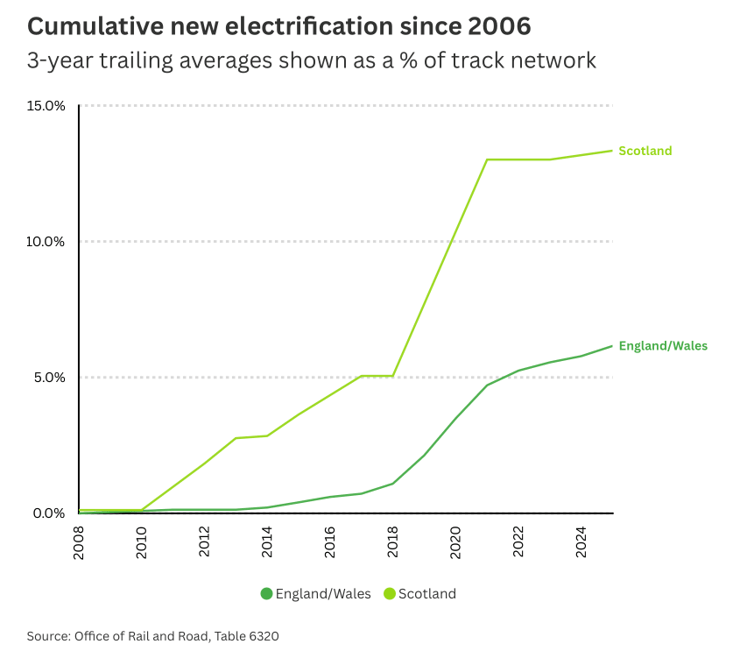
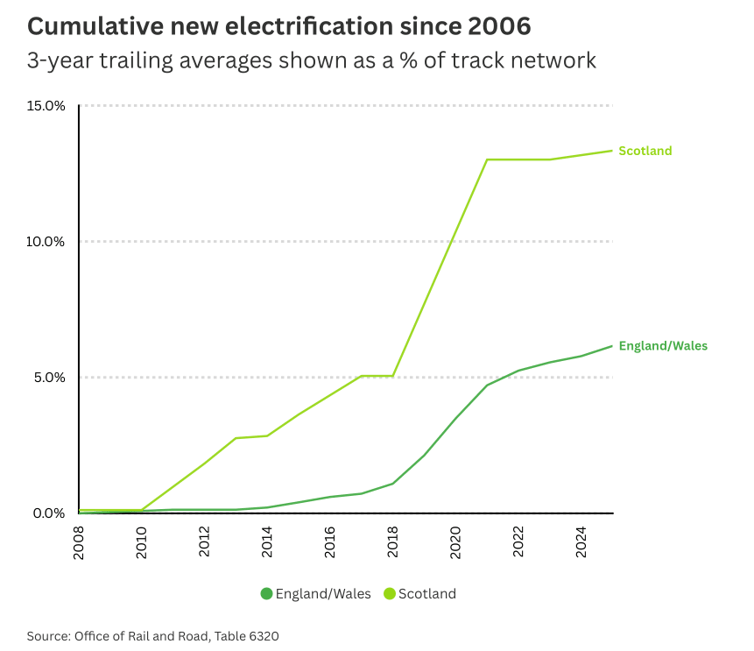
The CfC emphasises the significance of Scottish Government intervention: ‘One difference is that Scotland’s devolved model gives Ministers a dedicated rail investment strategy and budget, alongside responsibility for publicly owned ScotRail.’ It notes that Scotland’s electrification costs have fallen 26 per cent in recent years, and now are 20 per cent below England’s. It adds that ‘Even complex Scottish projects have generally been cheaper’. The CfC also explains that relatively lower project costs have coincided since 2010 with a larger share of the Scottish rail network undergoing electrification than in England.
The graph below is from the CfC: note the steep rise in progress in Scotland from 2010 onwards, following the first SNP government coming to power in 2007:
Reasons
The CfC assessment is that longer-term funding alone does not explain the difference in delivery as England and Wales have the same five-year funding cycle and infrastructure provider as Scotland. Also, crucially, the CfC states that Scotland’s performance cannot be attributed to more funding – ‘… it delivered 22 per cent of Britain’s new electrification between 2014 and 2024, with only 10 per cent of rail enhancement expenditure.’
The CfC focuses on one possible explanation, specifically on how the Scottish Government has exercised its devolved powers. It explains that following the transfer of rail powers in 2005, it was under SNP Scottish Ministers in 2012 that these powers were used to establish a continuous electrification programme, strengthening this further in 2017.
The CfC argues: ‘While devolution does not guarantee better delivery on its own, it can better align investment decisions with their wider economic returns and political accountability. Across a smaller geography, Scottish Ministers can better weigh competing policy priorities and, through ScotRail, the longer-term operating benefits. Reduced democratic distance also brings them closer to affected commuters and businesses, strengthening political incentives for successful delivery. These lessons could extend to more localised transport infrastructure, particularly as devolution advances at a city-region level south of the border.’ Scottish Government practices as an exemplar for devolution in England – how can this be Mr Burnham, Mr Alexander, Mr Marra?
This from the CfC offers a rather different perspective from that offered by Labour’s Michael Marra at the recent UK Labour Party conference – “too much power is centralised in Scotland” – part of co-ordinated negative messaging regarding governance in Scotland which is also expressed by the UK Prime Minister and the Secretary of State for Scotland.
What next?
While recommending that the Scottish Government establishes a Glasgow city-region authority, the CfC concludes that ‘the Scottish Government can be proud of its electrification record and there is scope to replicate the principles of its success at a more local level within Scotland itself.’
The CfC here seems unaware of the regional Strathclyde Partnership for Transport (SPT) – ‘… the largest of Scotland’s seven regional transport partnerships. Our aim is to bring together local authorities and other key regional stakeholders to strengthen the planning and delivery of regional transport, better serving the needs of people and businesses across the west of Scotland.’ And: ‘The Partnership consists of twenty elected members representing the twelve constituent unitary authorities in the West of Scotland and between seven and nine appointed members.’
As one example of the already in place ‘city-region’ dimension in Scotland that tends to be omitted in current commentary on Scotland’s governance by Westminster and by Unionist politicians: from the SPT’s website regarding the ‘Clyde Metro’ strategy: ’In November 2023 it was announced that SPT would act as the lead partner for development of the Case for Investment (CFI) for Clyde Metro. GCC, acting as a representative for the Glasgow City Region, is supporting SPT in delivery whilst TS is acting in a Project Assurance role.’
The CfC’s push for a Glasgow city-region authority seems derived in part at least from one issue it highlights: ‘In Glasgow, the absence of a Glasgow city-region authority has fragmented responsibilities and left Clyde Tunnel in a financing deadlock. With no ability to distribute costs among the eight constituent authorities, the City Council faces the entire £820,000 annual maintenance shortfall, 10 per cent of its entire budget.’
But as one indication that what Scotland – and Glasgow – needs and wants has no need for a Burnham-led and Alexander/Marra-enabled intervention, the CfC notes: ‘Glasgow’s (sic) councils have already begun exploring a city-region devolution deal.’
Meanwhile in England …
For context, the CfC – with no skin in Scotland’s national aspirations – also has this on what England’s model offers: ‘Mayors across England have big ambitions for expanding their urban transport networks. From Greater Manchester’s Metrolink extension to new Merseyrail stations in Liverpool City Region, places are thinking about the next stage of transport delivery to better connect their local economies.’
Source: Johnson and Moogan (2026) Licence to build – Delivering urban transport infrastructure through devolution. Centre for Cities.
The CfC report adds: ’But they face an uphill struggle. Building and maintaining transport infrastructure in England is expensive, slow to deliver and has struggled to respond to the growth of cities. It means that current assets deteriorate while future plans gather dust on the shelf, holding back urban connectivity as well as national investment and growth.’
Just what Scotland needs to replicate then?
Discover more from Talking-up Scotland
Subscribe to get the latest posts sent to your email.

