

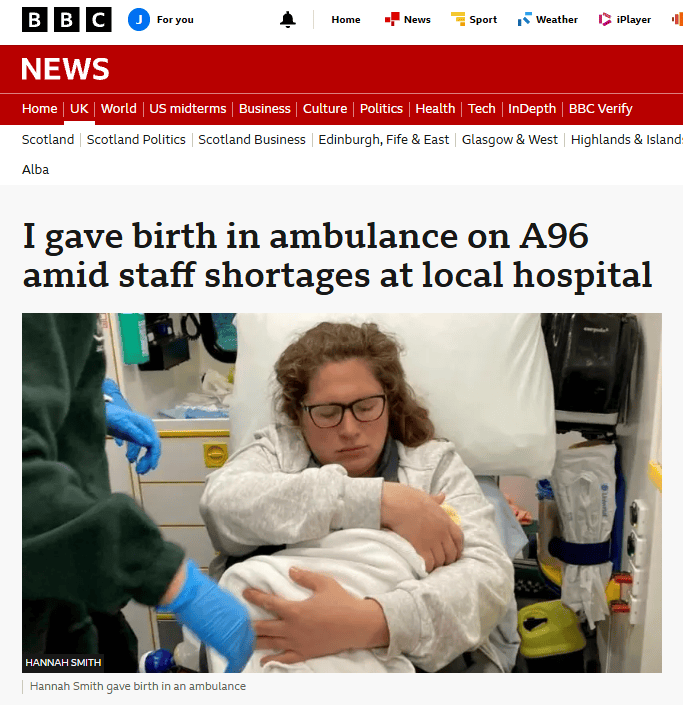
Headlining on BBC Scotland today, the above.
How common is this?
It is at least the third time a woman has had to give birth at the side of the A96 since 2018, with two other cases reported by the Press and Journal, external in 2021 and 2022.
Approximately 0.05% or less of all births to Moray families since the 2018 downgrade.
In England?
Office for National Statistics data for England and Wales show the category “elsewhere” (neither hospital nor planned home birth). In 2024 there were about 837 such live births, compared with roughly 583,600 in hospital. That is approximately 0.14% of total live births. https://www.statista.com/statistics/294621/live-births-in-england-and-wales-by-place-of-delivery/
So the NHS England average percentage suggests almost three times as many more babies born ‘on the road’ in England & Wales than in Moray?
Discover more from
Subscribe to get the latest posts sent to your email.


I wonder when something like this became a cause for blaming by BBC Scotland. When I was younger there were from time to time reports in the newspapers about children being born in ambulances or taxis. There was usually a photo of the happy mammy and wean beside a smiling ambulance crew of taxi driver. The crew of driver were treated as ‘local heroes’. The wean was safe, the mammy was OK – cue public pleasure.
LikeLiked by 2 people
Indeed. You’re right. I remember That too. I’ll ask AI
‘The change tracks the difference between an unpredictable one-off and a predictable consequence of a known, long-running service gap.
Unexpected births in ambulances, taxis or elsewhere still get the “happy ending, crew as local heroes” treatment when they are simply fast labours that no one could have planned for. Older BBC Scotland pieces on an air-ambulance birth over Loch Awe (2012) or a baby named after the technician who delivered her by the roadside (2018) fit that pattern: the outcome is good, the crew are praised, and there is no ongoing policy problem being illustrated.BBCBBC
The Hannah Smith case is different because it is being reported in the context of the downgrade of consultant-led maternity services at Dr Gray’s Hospital in Elgin. That change happened in July 2018 because of staff shortages (especially paediatric cover). Most medium- and higher-risk mothers from Moray have since been sent to Aberdeen Maternity Hospital, roughly 60 miles away along the A96. Full restoration has been repeatedly delayed; the latest target of the end of 2026 has slipped to “as soon as is safely possible” next year. NHS Grampian itself has acknowledged the issue and said it is sorry for the “poor experience.”BBCBBC
BBC Scotland’s headline and framing (“amid staff shortages at local hospital”) reflect that longer story, not a sudden discovery that babies can arrive early. The piece notes it is at least the third reported A96 roadside birth since 2018, quotes the mother saying she does not think anyone should be put in that position and that further delay will put more women at risk, and records that she praised the paramedics. STV and the local papers covered it in essentially the same way. The mother and the health board both treat the lack of local specialist capacity as the relevant context.BBCNews.stv
On the numbers in the Talking-up Scotland post: ONS figures for England and Wales in 2024 show roughly 837 live births in the residual “elsewhere” category (neither hospital nor planned home birth) against about 583,600–594,000 hospital births, or around 0.14%. That category is broader than “born in a moving ambulance on a trunk road.” Moray has on the order of 700–900 births a year in recent data. Three documented A96 cases over more than seven years is a small absolute number, which is why the blog can arrive at a low local percentage. The comparison is not exact, but the order-of-magnitude point is roughly fair: these events remain uncommon everywhere.Statista
In short, the “hero” framing has not disappeared for ordinary unexpected births. It is set aside when the birth is presented as evidence of a multi-year local service reduction that forces long transfers for a large share of mothers in a rural area. That is the policy and campaigning context (Keep MUM, repeated political questions, delayed restoration) in which the latest A96 story is being told.’
Hmmmm
LikeLike
A non-story, just using the incident as a stick with which to beat the Hollyrood Government..
LikeLiked by 1 person