

Thanks once more to Frances McKie for alerting us to this
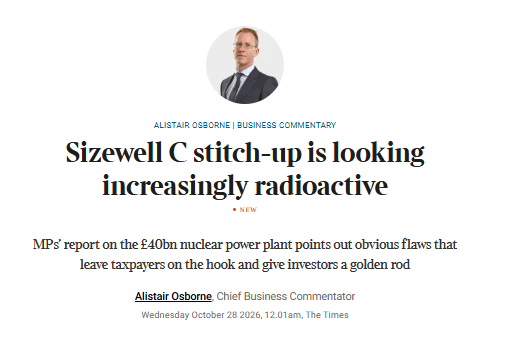
In the Times yesterday, the above and these key points:
The article (paywalled on The Times) critiques the Sizewell C nuclear project’s financing as a high-risk “terrible deal” for UK taxpayers and consumers, drawing on the House of Commons Public Accounts Committee (PAC) report
Under the Regulated Asset Base (RAB) model, consumers start paying via bill levies during construction. The government holds a 44.9% stake. Private investors are EDF 12.5%, Centrica 15%, La Caisse 20%, Amber Infrastructure 7.6% hold the majority equity. Most debt comes from government borrowing/loans, with some commercial/export-credit financing. https://www.ft.com/content/bc330ee4-f151-4552-88a8-8879a26d8fdd?syn-25a6b1a6=1
The PAC calls the structure a “terrible deal.” If costs reach the upper end, consumers could face an extra £9.8 billion during construction plus £12 billion over the operating life through higher bills. Private investors would contribute only about £30 million more in that scenario, while still expecting high returns. The public bears the bulk of overrun, delay, and other risks, despite minority control. The PAC describes the risk to taxpayers and consumers as “extraordinary” and says the model should not be repeated. https://www.bbc.co.uk/news/articles/cw0k0128dx55o
No comparable large nuclear plant has been built on time and to budget. The EPR design has a track record of major delays and cost overruns. The piece is highly critical of Energy Secretary Ed Miliband and Chancellor Rachel Reeves for the financing arrangements that produced this outcome, describing the result as ‘financially radioactive.’
Typically neglected in the above analysis, the health risks:
Researchers revisit study of Essex nuclear power station and breast cancer incidence among mature women nearby to find an even greater risk, only a short distance from new Sizewell C, and an ‘establishment bias and cover-up’
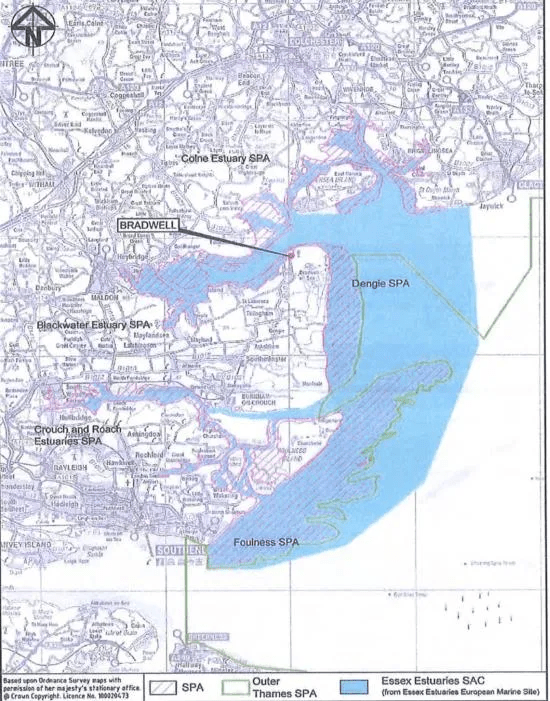
The Blackwater, Crouch, Roach and Colne Estuaries Marine Conservation Zone in Essex (see map below) was designated a MCZ in December 2013 on account, primarily, of its native oyster beds. The MCZ incorporates the Colne Estuary SPA (Colchester), the Blackwater SPA (Maldon) and the Crouch and Roach SPA (Burnham-on-Crouch/Rochford), as well as the Essex Estuaries Special Area of Conservation (SAC) and other SPA designations (Dengie and Foulness). At the head of the Blackwater Estuary lies the Bradwell Nuclear Power Station (its Magnox reactors are no longer operational, and it is the site for a proposed new build Chinese-designed nuclear reactor). https://www.marinet.org.uk/blackwater-estuary-mcz-faces-double-challenge-from-bradwell-nuclear-power-station
In March 2001, independent researchers, commissioned by local residents living near Bradwell nuclear power station, operational from 1962 to 2002, in Essex, published Cancer Mortality and Proximity to Bradwell Nuclear Power Station in Essex, 1995-99; Preliminary results showing:
substantial excess mortality risks, particularly from breast cancer in women who had lived in wards adjacent to the river Blackwater. This finding was similar to the findings of earlier studies on coastal populations near the Irish Sea and near the Hinkley Point nuclear site in Somerset.2
Soon after, local authority researchers criticised the above research and with access to statistics denied to the first group, insisted:
no evidence of any statistically significant increases in cancer in any ward in the study area and that the risks of cancer in populations living in annular areas described by circles around the nuclear site of radii 4, 10 and 17km around the plant showed no association with proximity to the plant.3
A year later, the first researchers revisited their findings and accepted some errors but stated:
there is no difference in the overall result, as we shall show.
Two results are immediate. First the corrected files make the estuary effect more apparent, since the Maldon wards now have more breast cancer deaths after the correction, and second, the effect is reinforced after the inclusion of the two extra years 2000 and 2001.4
and now claim:
Analysis of the corrected file for 1995-99 for the 26 ward area confirms the existence of significantly raised breast cancer mortality in wards which border the mud flats and creeks of the river Blackwater compared with wards which do not. This finding is reinforced slightly by the correction. Thus we see that the Blackwater estuary wards have (Table 4) 58% more breast cancer deaths than the non-Blackwater wards.5
In the full research report the authors reveal deliberate attempts by the local authority researchers to:
cover up a significant health problem and its source. 6
They conclude with damning comments which reinforce what I have written repeatedly about the importance of being deeply sceptical of official statements downplaying the risks of nuclear energy in Southern Scotland:
Ever since the 1983 discovery of the Sellafield (Seascale) leukaemia cluster it has become increasingly apparent to people living near nuclear sites that the epidemiological examination of radiation risk has been the subject of bias and cover-up at a very high level. It is also clear to these people that the reassurances they are given by the organisations who are paid to protect their health are worthless. If the truth about radiation and health is to be discovered, then accurate mortality and incidence data must be discovered, and statistical and epidemiological analysis should be undertaken by environmental groups funded by government, as well as by establishment groups. However, in recent years regional Cancer Registries have intensified restrictions on releasing incidence data, withholding figures which, according to their own Guidelines, ought to be available on request. The notable exception is that in 1995 the Wales Cancer Registry released its entire small area cancer incidence database to Green Audit – an event which was followed swiftly by closure of the WCR and a complex of data destruction and denial which COMARE signally failed to investigate in an even handed fashion.
There is not a level playing field in this debate. On one side there are small independent environmental research groups working under difficult conditions with inadequate information being attacked by the establishment and funded at a pathetic level by groups of local citizens. On the other side are the weighty government organisations with budgets of millions of pounds and departments full of qualified researchers.
It is to be welcomed that the opposition or ‘dialogical’ approach to examining risk in this area has now been accepted and partly put into practice in the new CERRIE committee. This approach has the capacity to deal with the scientific advice problem. However, the affair of breast cancer near Bradwell shows that there is a large trust deficit remaining in this area, associated with the internal operations of SAHSU, the Cancer Registries and COMARE. This is not an isolated affair: similar attacks, denials, cover-ups and shenanigans have occurred following Green Audit studies of cancer on the Welsh and Irish coasts and near Hinkley Point and Oldbury nuclear power stations. There is also the problem of the funding of citizen groups who wish to have an independent analysis of the situation, and the release of data to these groups to make such studies possible. The present situation is unacceptable.7
Sources:
- chrome-extension://efaidnbmnnnibpcajpcglclefindmkaj/https://llrc.org/llrc/health/subtopic/bradrep5.pdf
- ibid page 2
- ibid page 2
- ibid page 3
- ibid page 8
- ibid page 10
- ibid pages 10-11
Discover more from Talking-up Scotland
Subscribe to get the latest posts sent to your email.


In addition:
1. Will produce expensive electricity.
2. Damage to wetlands adjoining RSPB Minsmere nature reserve
3. Addition infrastructure, chiefly roads, have spoilt valuable agricultural land
4. Premium tourist area permanently despoiled.
LikeLike