

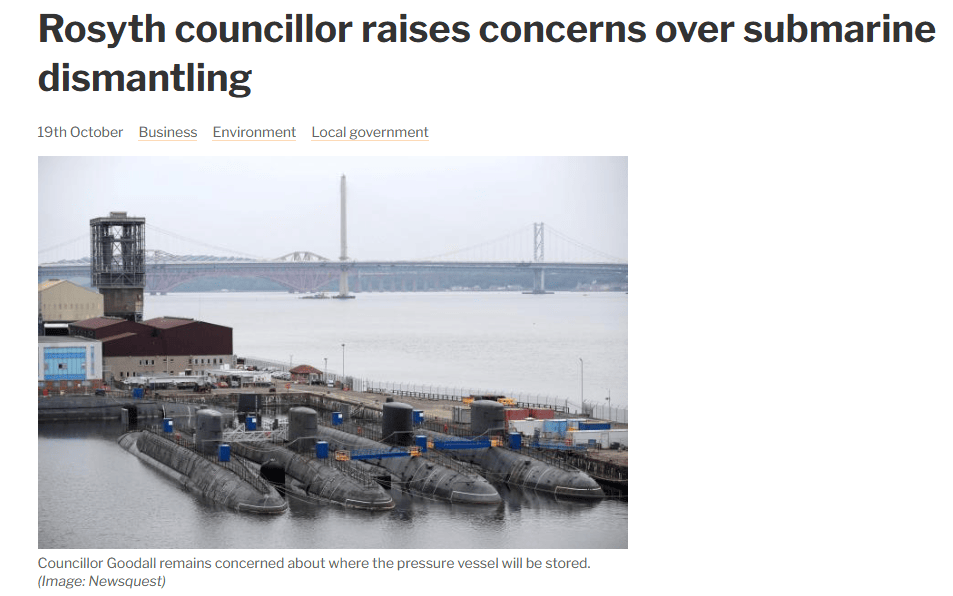
In the Dunfermline Press 19/10/26, the above, and:
FRESH concerns have been raised about nuclear submarine dismantling plans at Rosyth Dockyard.
Councillor Brian Goodall has voiced renewed opposition to the long-term storage of radioactive material in the town, following recent discussions at the SNP annual conference in Aberdeen.
At the political party gathering he quizzed Gareth Hedicker, Babcock International’s Marine Chief Operations Officer, on the plans for radioactive waste that’s being removed from the first of seven old nuclear subs that are laid up at the West Fife yard.
Cllr Goodall said: “I’ve still not had any response from Babcock on how long, and where, they intend to store the highly radioactive reactor pressure vessel that they intend to cut out of the decommissioned nuclear submarine, Swiftsure, over the next few weeks, as part of the ongoing Submarine Dismantling Demonstrator Project.”
He has good reason to be concerned. He’s why:
UK MoD plan to decommission at least 7 nuclear subs in Fife, with houses less than 1 mile away and downwind by methods 1 000 times more dangerous than US methods
From Brian Goodall, 23 October 2025, on Facebook:
Babcock’s and MOD asked to think again on nuclear submarine dismantling process at Rosyth Dockyard.
This morning at a meeting of the Rosyth Dockyard Local Liaison Committee in the Dockyard I repeated my long held view that the proposed second stage of the nuclear submarine dismantling demonstrator project, that is about to start, is a stage too far, and I ask for a rethink.
The next step will see Babcock cutting out the reactor pressure vessel from the reactor compartment of the decommissioned nuclear submarine Swiftsure, in an experimental process that has never been done anywhere in the world before. This part of the submarine dismantling project has required Babcock’s to seek an increase in the limits to the levels of radioactivity they are allowed to discharge into the environment around the area.
Full text at: https://www.facebook.com/groups/595098243953732/
What is the alternative to the method preferred by Babcock and the MOD?
From Grok AI:
US approach: The entire reactor compartment (including the RPV) is cut out intact, sealed, and buried as low-level waste at sites like Hanford, Washington.
How much safer is it?
The US approach—cutting out the entire reactor compartment (RC) intact and burying it as a sealed, low-level waste (LLW) package—is substantially safer than cutting out the reactor pressure vessel (RPV) alone from the compartment. Below is a quantitative and qualitative comparison of safety margins, risk reduction, and real-world outcomes.
| Metric | US Intact RC Removal | RPV-Only Cutting | Safety Advantage (US) |
|---|---|---|---|
| Criticality Risk | ~0 (geometry fixed, fuel removed) | 10⁻⁶ to 10⁻⁵ per cut (if geometry disrupted) | >1,000× lower |
| Worker Dose (mSv/year) | <2 mSv (remote, no cutting near core) | 5–20 mSv (close-in cutting, dust) | ~5–10× lower |
| Contamination Release Risk | <10⁻⁸ per operation | 10⁻⁴ to 10⁻³ (aerosols, coolant leaks) | >1,000× lower |
| Environmental Impact | Negligible (sealed burial) | Low but non-zero (potential leaks) | >100× lower |
| Operational Complexity | Low (one lift, seal, ship) | High (precision cuts, multiple steps) | ~3–5× simpler |
Bottom Line: The US method is ~1,000× safer in terms of criticality and release risk, 5–10× safer for worker exposure, and orders of magnitude simpler.
Why the US Method Is Safer
| Factor | US Intact RC Removal | RPV-Only Cutting (e.g., UK SDP, French) | Safety Impact |
|---|---|---|---|
| 1. No Cutting Near Activated Core | No cuts within 1–2 meters of RPV. All work is remote, outside shielding. | Requires close-in plasma/torch/mechanical cutting directly on or near RPV. | Eliminates aerosolized Co-60, Ni-63, Fe-55 (major dose contributors). |
| 2. Geometry Control | Reactor internals remain in safe, fixed geometry — no risk of reconfiguring fissile material. | Cutting can dislodge control rods, grid plates, risking local criticality if water present. | US method: criticality probability ≈ 0 post-fuel removal. |
| 3. Containment Integrity | RC is a robust, pre-engineered containment (6–12 inch steel + concrete shielding). | Cutting breaches multiple barriers; relies on temporary enclosures. | US: triple containment (RPV → RC → burial overpack). |
| 4. Dust & Airborne Contamination | Zero cutting in activated zone → no airborne particulates. | Cutting generates radioactive dust (requires HEPA filtration, respirators). | US avoids ALARA violations from inhalation hazards. |
| 5. Coolant & Residual Water | RC is drained and dried before lift; no liquid pathways. | Cutting may encounter trapped coolant, tritium, or activated corrosion products. | US eliminates tritium release and steam explosion risk. |
Sources:
https://www.energy.gov/sites/prod/files/2015/09/f26/NNPP_Reactor_Compartment_Disposal.pdf
https://www.hanford.gov/files.cfm/2023_Hanford_Annual_Report.pdf
https://www-pub.iaea.org/MTCD/Publications/PDF/TE-1793_web.pdf
What are the risks to the surrounding communities?
Official sources, of course, rate these negligible but the vested interests of researchers and public research bdies funded by the state must be set against other views.
One of the radioactive elements likely to be released into the air and thus easily spread on the wind, is Tritium.
This is extremely dangerous as we have already pointed out in reference to increased releases from the active submarines in the Clyde:
Radioactive tritium emissions around Clyde nuclear sub base which ‘smash into’ your DNA, DOUBLE as cancer cases surge yet smoking rates plummet
From the CND, in January 2025:
Radioactive air emissions have been increasing year-on-year at Coulport one of Britain’s nuclear submarine bases in Scotland. This development is of some concern as it would lead to increased health risks wherever the emissions were inhaled.
Investigations by The Ferret and The National newspaper found that emissions of radioactive tritiated water vapour had doubled at the Royal Navy’s nuclear weapons storage depot at Coulport on Loch Long between 2018 and 2023. According to the Scottish Pollution Release Inventory, tritiated water vapour emissions at Coulport were 1.7 billion becquerels (units of radioactivity) in 2018, rising steadily to 4.2 billion units in 2023. Tritiated water vapour is harmful when inhaled, ingested or absorbed through the skin as its radiation causes cancer and cardiovascular diseases including strokes.
The investigation also found that eight miles from Coulport at Faslane, where Britain’s nuclear submarines are based, tritiated water containing over 50 billion units of radioactivity had been dumped into the Gareloch. The level of dumping peaked in 2020, when 16.6 billion units were discharged.
The Ferret noted that in 2019, the Scottish Environment Protection Agency (SEPA) “changed the rules to allow certain tritium-contaminated effluents from nuclear submarines at Faslane to be discharged into the Gareloch.” Both SEPA and the MoD claim these emissions are within official safety limits.
However Dr Ian Fairlie, CND’s science advisor, states that these limits are unreliable, as official estimated doses from tritium contain “large uncertainties.”
CND General Secretary Sophie Bolt said:
“From faulty nuclear-armed subs on dangerously extended patrols to crumbling nuclear waste sites, Britain’s nuclear industry is putting us all at great risk. Instead of enforcing the highest levels of environmental standards, the government is just redefining what ‘acceptable risk’ means. All so it can allow the dumping of radioactive water, putting local people at greater risk of cancer. This is beyond reckless. It’s time to scrap Trident and its replacement, and decommission the nuclear industry.” https://cnduk.org/radioactive-pollution-is-increasing-at-britains-nuclear-bases/
Discover more from Talking-up Scotland
Subscribe to get the latest posts sent to your email.

