

By Mark E. Saunders of “The Scottish Minuteman” https://www.facebook.com/profile.php/?id=61575625542197
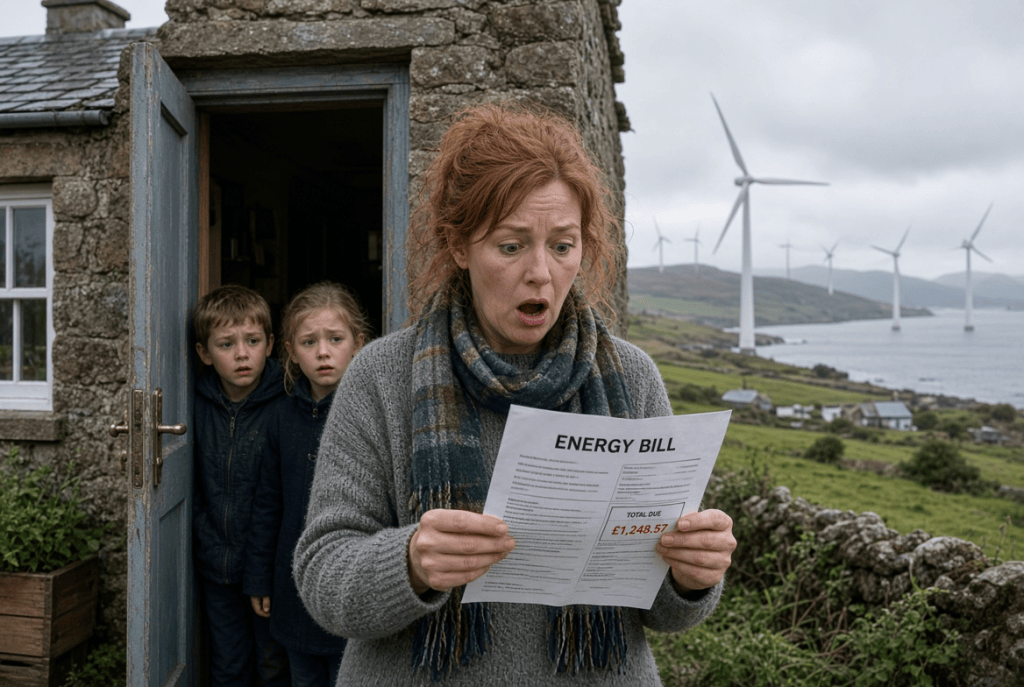
Politicians announce new energy projects, celebrate investment and promise jobs, energy security and economic growth. Then the red reminders arrive. The electricity bill. The rising direct debit. The shrinking household budget.
For people struggling to heat their homes, the question isn’t how many announcements smiling politicians can make. It’s how those smiles translate into a tangible difference to the bills people pay.
The UK Parliamentary Under-Secretary of State for Local Energy and Jobs has recently been promoting a community-owned energy project in Argyll expected to power 800 homes.
And only yesterday, the same minister welcomed approval for the Jackdaw gas field, saying it could increase UK energy security.
Yes, both projects may bring benefits. Community-owned renewables can generate income for local facilities. But that doesn’t necessarily mean cheaper energy for local households.
A community might gain a new facility while the families living there are still worrying about their next electricity direct debit.
Community benefit is not the same as household affordability.
Nor will producing more North Sea gas automatically lower Scottish household bills. UK gas prices are influenced by the wider international market.
More production isn’t the same thing as cheaper energy.
Scotland has oil and gas, wind, hydroelectric power and enormous potential for renewable electricity. Yet, as things stand constitutionally, having these resources does not guarantee that their financial benefits will reach ordinary Scots in ways that improve their lives.
This isn’t an argument against energy projects, investment or jobs. It’s an argument for giving a Scottish government the power to shape energy policy so that Scotland’s resources deliver for ordinary people.
An independent Scottish government could develop its own strategy to tackle fuel poverty, improve insulation, support community ownership and explore ways of helping consumers benefit more directly from their own national resources. It could also establish a national wealth fund, investing a share of Scotland’s energy wealth for the benefit of future generations.
Would independence abolish international energy markets or guarantee cheaper bills overnight? No. But it would give Scotland greater responsibility for its energy policies and how its resources serve its people.
Too much of Scotland’s energy wealth has been siphoned-off by decisions made in London, with the benefits too often flowing elsewhere rather than being directed towards Scotland’s needs.
Isn’t it time the Scottish people had the power to decide how their country’s resources are used, rather than leaving those decisions in the hands of distant decision-makers, carpetbaggers and shareholders?
Why shouldn’t Scotland have the power to use its energy wealth to pursue a more compassionate society?
The red letter days belong to the politicians and their announcements.
The red reminders belong to the people opening their post, checking their bank balances and wondering how much more they can afford.
Scotland has the energy. Scotland has the resources. Isn’t it time Scotland had the power to put them to work for its people today, and for generations to come?
Discover more from Talking-up Scotland
Subscribe to get the latest posts sent to your email.

