

In the Guardian today:
Thousands of children in England are experiencing some of the sharpest rises in waiting times for healthcare in the history of the NHS, a report has revealed.
While some adult waiting times have improved, children and young people are being “hit hardest” amid soaring demand and falling numbers of staff, according to the annual state of care report by the Care Quality Commission.
In community health services alone, 80,000 children and young people have been waiting more than a year for an appointment – almost 11 times the number of adults, the report said. Experts said that was “wholly unacceptable”. Children’s health conditions were getting worse and becoming harder to treat as a result, they added. https://www.theguardian.com/society/2026/oct/23/child-health-england-at-risk-sharp-rise-nhs-waiting-times
There are some obvious limits in comparison but there are clear signs our government does better.
First, Scotland does not publish community health waiting lists in the same format, broken down by children versus adults for waits over 52 weeks. Closest official data:
Public Health Scotland’s Stage of Treatment statistics cover consultant-led waits under the specialties “Community Child Health” and “Paediatrics”. At the 31 January 2026 census:
- Combined ongoing waits: 13,206
- Waits over 52 weeks: 433
- Waits over 78 weeks: 3
- Waits over 104 weeks: 0
(Individual figures: Community Child Health had 2,992 waits with 287 over 52 weeks; Paediatrics had 10,214 waits with 146 over 52 weeks.) Median waits were relatively short (around two months overall).https://www.parliament.scot/chamber-and-committees/questions-and-answers/question?ref=S6W-44472
This is far lower than the English community figure of 322 000 vs 13 206, even after adjusting for Scotland’s population being roughly one-tenth of England’s. https://www.cqc.org.uk/publications/major-report/state-care/2025-2026/pcs/community
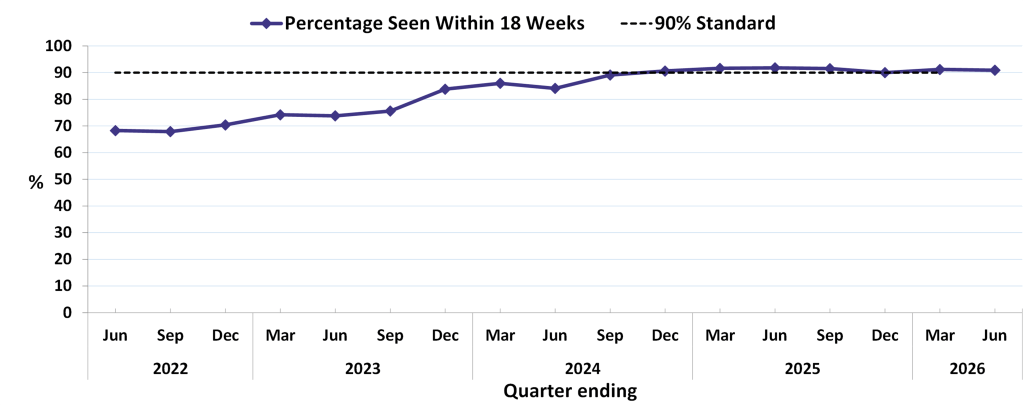
Second, Scotland has shown clearer recent progress on specialist CAMHS waiting-time standards and has reduced many of the longest waits there, helped by targeted staffing increases.
How does this compare with England?
England does not apply the same 18-week “start of treatment” target to community CAMHS. A proposed 4-week standard exists but remains experimental and is not formally in force.
Children’s Commissioner analysis of 2024–25 data: more than 1 million children had an active referral during the year; 35% were still waiting at year-end; more than 60,000 had waited over two years; median wait for those who received treatment was 35 days, but overall median (including those still waiting) was 128 days. * https://www.childrenscommissioner.gov.uk/news-and-blogs/press-notice-over-a-million-children-referred-to-mental-health-services-with-highest-annual-referrals-as-demand-rises-faster-than-systems-can-respond/
Bearing in mind the limits NHS England seems to be hitting only 65% with 35% still waiting at year-end.
In short, Scotland is currently delivering most CAMHS treatment starts within its 18-week standard and has a comparatively small waiting list. England shows higher absolute demand, a much larger open-referral caseload, and a substantial proportion of children facing waits measured in many months or years. Direct like-for-like percentages are limited by the different metrics, but the Scottish data indicate more consistent delivery against a defined treatment-start target. https://www.childrenscommissioner.gov.uk/news-and-blogs/press-notice-over-a-million-children-referred-to-mental-health-services-with-highest-annual-referrals-as-demand-rises-faster-than-systems-can-respond/
Discover more from Talking-up Scotland
Subscribe to get the latest posts sent to your email.

