

In the Guardian in December 2024:
The news that more than one in three children in the UK are now living in poverty should shock everyone but surprise no one. Nearly three years into the cost of living crisis, we know that young families and disabled people have been among those hit hardest by the biggest fall in UK living standards in half a century.
The latest estimates, by the non-partisan Social Metrics Commission, show that the number of people in poverty has risen to 16 million, or nearly one in four of the UK population – its highest level since records began in 2000. The findings use a broader definition of poverty, based on a household’s available resources, than the official one used by the government. Monday’s figures show that, under the latter measure, the number of people in deprivation – 12 million – is, at best, a huge underestimate. At worst, the official tally is in effect meaningless. https://www.theguardian.com/society/2024/nov/18/poverty-figures-render-uk-government-numbers-too-little-and-action-very-late
Looking at the data presented in the Social Metric Commission report we see that the percentage of children in poverty is 35% in England, 36% in Wales and 30% in Scotland:
The SNP Government is to be warmly praised for what they have done. Despite limited control over their revenue and no powers to borrow, they have, relative to England and Wales, kept thousands of children out of poverty by building more affordable homes, keeping rents below the UK levels, compensating for the bedroom tax, providing free prescriptions and, most important by providing the transformative and internationally recognised Child Payment. No other major party in the UK can match this.
However, 30% remains far too high and because everything depends on eradicating child poverty, the Scottish Government must pull out all the stops to do so.
Saying that children are our future is not just a cliché, it’s a fact of overwhelming significance. Eradicating child poverty fully will cost billions but, in the years that follow, it will all be paid back and more in savings across public services, from policing to health and education, and in increased wealth generation from greater numbers of skilled, creative, industrious young workers with a vested interest in a shared world.
The research to prove this claim is long-established and irrefutable.
First, from Edinburgh University researchers in 2022:
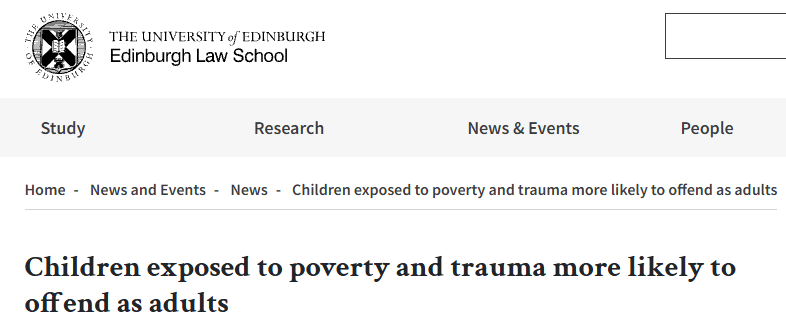
People who have suffered extreme difficulties in childhood are more likely to commit crimes as adults than those who have not, a study suggests. Childhood experiences such as poverty, maltreatment, school exclusion and police contact are associated with serious offending and frequent criminal convictions in adulthood, the report found.1
Second, from the Mental Health Foundation in 2010:
Children and adults living in households in the lowest 20% income bracket in Great Britain are two to three times more likely to develop mental health problems than those in the highest.
In 2004, evidence from the Child and Adolescent Mental Health Survey found that the prevalence of severe mental health problems was around three times higher among children in the bottom quintile of family income than among those in the top quintile.
Analysis of data from the Millennium Cohort Study in 2012 found children in the lowest income quintile to be 4.5 times more likely to experience severe mental health problems than those in the highest, suggesting that the income gradient in young people’s mental health has worsened considerably over the past decade.2
Third, from the Royal College of Paediatrics and Child Health in 2022:
Children living in poverty are more likely to have poorer health outcomes including higher risk of mortality, poor physical health, and mental health problems.3
Fourth, from the Nuffield Trust in 2022:
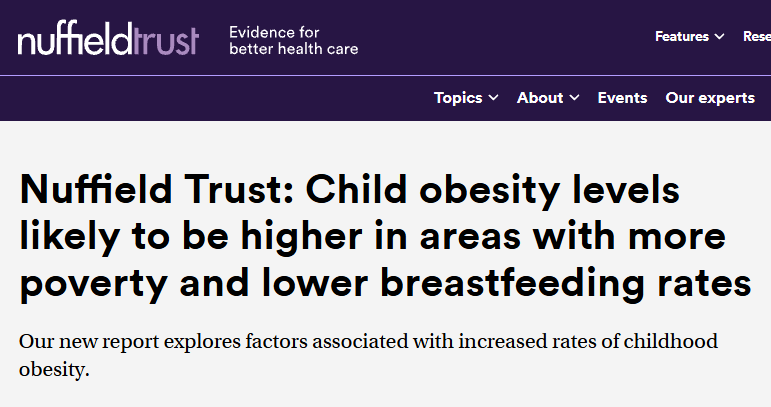
Children are more likely to be obese or overweight in areas of England where there is more childhood poverty, lower breastfeeding rates and where fewer adults undertake physical exercise.4
Fifth, from BJPsych Open in 2022:
Poverty in adolescence is associated with later drug use.5
Sixth, from the Child Poverty Action Group in 2022:
The causal relationship between child poverty and educational outcomes is well established, with children from lower-income households less likely to achieve than their more affluent peers. This results in unequal life chances and futures, with children growing up in poverty earning less as adults.6
Seventh, from UK Government researchers in 2014:
Children from low-income backgrounds are less likely to progress in education and attend higher education institutions and disadvantaged children who start out as high-attainers are overtaken by their better-off peers who were initially average-attainers.7
Eighth, from the Lancet in 2022:
Children in care face adverse health outcomes throughout their life course compared with their peers. In England, over the past decade, the stark rise in the number of cared-for children has coincided with rising child poverty, a key risk factor for children entering care. We report evidence that rising child poverty rates might be contributing to an increase in children entering care. Children’s exposure to poverty creates and compounds adversity, driving poor health and social outcomes in later life. National anti-poverty policies are key to tackling adverse trends in children’s care entry in England.8
Think how much we might save if the above was far less true. Think of how much wealth would be generated by the thousands liberated and given a meaningful stake in a shared world.
I could go on. It’s endless. Being born into poverty makes everything more difficult, everything good less likely but eradicating child poverty, as a priority above all others, will pay off for all of us in creating a better society in all the places that matter.
Sources:
- https://www.law.ed.ac.uk/news-events/news/children-exposed-poverty-and-trauma-more-likely-offend-adults#:~:text=Childhood%20experiences%20such%20as%20poverty,in%20adulthood%2C%20the%20report%20found.
- https://www.mentalhealth.org.uk/explore-mental-health/statistics/poverty-statistics
- https://www.rcpch.ac.uk/resources/child-health-inequalities-position-statement
- https://www.nuffieldtrust.org.uk/news-item/nuffield-trust-child-obesity-levels-likely-to-be-higher-in-areas-with-more-poverty-and-lower-breastfeeding-rates
- https://www.cambridge.org/core/journals/bjpsych-open/article/poverty-in-adolescence-and-later-drug-use-disorders-understanding-the-mediation-and-interaction-effects-of-other-psychiatric-disorders/8522FB4CBD952B94F85A6161E47670EE
- https://cpag.org.uk/news/there-only-so-much-we-can-do-school-staff-england#:~:text=The%20causal%20relationship%20between%20child,poverty%20earning%20less%20as%20adults.
- https://www.gov.uk/government/news/smcpc-research-on-attainment-of-disadvantaged-children#:~:text=Disadvantaged%20children%20who%20start%20out,of%20the%20least%20deprived%20children.
- https://www.thelancet.com/journals/lanpub/article/PIIS2468-2667%2822%2900065-2/fulltext

