

By stewartb
The Covid Inquiry report on care homes identifies multiple, alleged ‘failings’ by government bodies and ministers. But whilst it makes clear the invidious decisions and trade-offs that faced the authorities, it seems to avoid drawing what is – perhaps to the lay person – the obvious conclusion that there was no ideal, harm-free approach to mitigating risks to care home residents AND the wider public needing hospitalisation available to governments across the UK as the pandemic took hold.
In terms of mitigating the risks from discharges from hospitals to care homes, this from the Covid Inquiry report is once again relatively favourable (arguably) to decision- making and mitigations in Scotland:
Firstly on the UK as a whole: ‘.. when the expedited discharge policies were rolled out in March 2020, isolation of all those discharged untested from hospital was not advised.
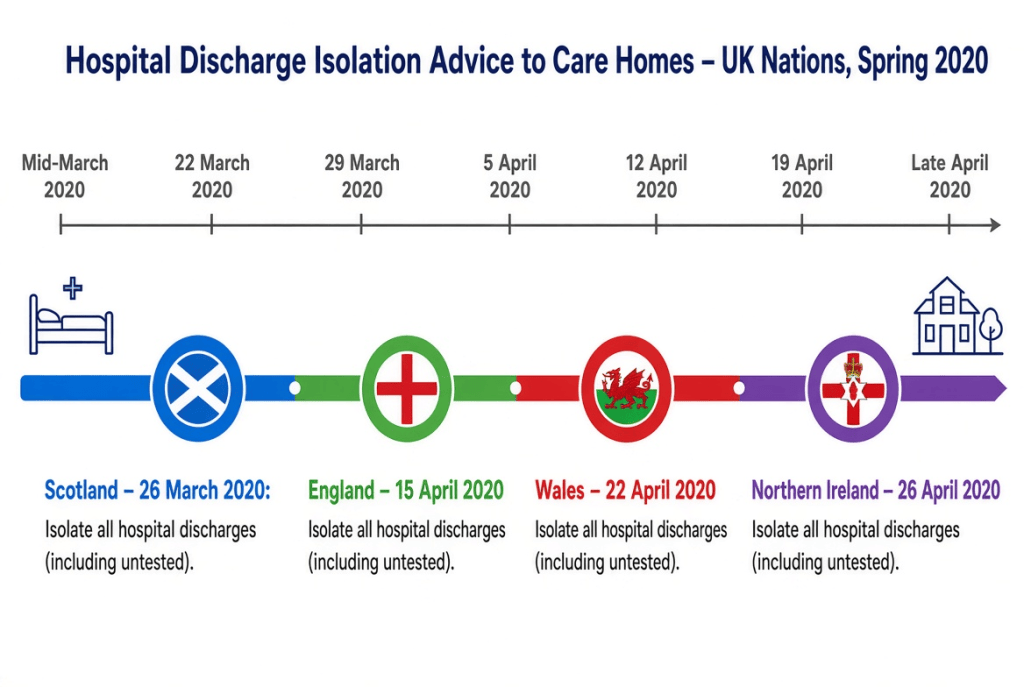
‘Scotland was the first nation to advise isolation of all people discharged from hospital and admitted to care homes, including those who had not been tested (see Table 3). Following a meeting on 18 March 2020 with Dr Donald Macaskill (Chief Executive of Scottish Care, a membership body representing independent social care providers in Scotland) and advice from Professor Graham Ellis (Deputy Chief Medical Officer for Scotland from September 2021), Ms Freeman agreed that all new admissions to care homes should be isolated. This was reflected in Scottish Government guidance on 26 March 2020.’
So the Inquiry acknowledges that isolation of ALL NEW ADMISSIONS was mandated in Scotland from 26 March 2020.
And elsewhere in the UK? ‘Isolation of people admitted from hospital was not advised until 15 April 2020 in England, not communicated until 22 April in Wales and not advised in Northern Ireland until 26 April.’ So all c. 3 weeks later than in Scotland.
And: ‘When commenting on why isolation for all people admitted to care homes was not introduced sooner, Public Health England said that when the March 2020 hospital discharge policy was introduced, asymptomatic transmission was not considered to pose a sufficiently high risk to justify that kind of quarantine and that it was important to weigh up the benefits and harms of isolation, which came with risks for vulnerable people.’
I am mindful that family members of care home residents have raged against policies of isolation of residents in care homes for safety reasons: was Public Health England right then to delay imposing isolation as a mitigation of risk of transmission? Was its much earlier introduction in Scotland a good thing – to address the risks associated with hospital discharge to care homes – or a bad thing as isolation brings its own harms? Or would BBC Scotland and Dame Jackie Baillie claim a ‘scandal’ regardless?
Source: https://covid19.public-inquiry.uk/wp-content/uploads/2026/10/19064857/M6_Report_Accessible.pdf
Ed: While there is no reported figure for lives lost due to a failure to isolate, by mid-April, when in England isolation was first advised, nearly 3 000 lives had already been lost:  https://questions-statements.parliament.uk/written-questions/detail/2020-09-25/HL8494?utm_source=chatgpt.com

What proportion were lost because of a failure to isolate properly, is unknown.
Discover more from Talking-up Scotland
Subscribe to get the latest posts sent to your email.

