

Again, I’ve lost track of how many times I’ve countered that myth about hospital discharges causing care home outbreaks but, one more time quickly:
- There is no evidence at all that any of the discharges of hospital cases into care homes caused any of the outbreaks in those homes.
- There are repeated research reports showing that agency staff working in more than one of the, especially, larger corporate-owned homes did, unwittingly, cause the outbreaks.
Here’s the evidence again:
- The charitable MHA with a presence in Scotland did research into its own homes and discovered this: Large numbers of staff could have been unknowingly spreading coronavirus through care homes, according to the UK’s largest charitable care home provider. Data from MHA shows 42% of its staff members who recently tested positive were not displaying symptoms. Nearly 45% of residents who had a positive test were also asymptomatic. The MHA Chief Executive said: I think it’s very difficult not to see that the only real way that this can have come into our homes is through staff picking it up, just through the community contacts they would have had. I think that is what is so hard for all our staff, because they care. But if they don’t know they’ve contracted the virus, how can you manage this?https://www.bbc.co.uk/news/health-52912538
- We know from BBC Scotland’s own report that the Skye care home outbreak was associated with ‘a large dependency on agency staff‘: https://www.bbc.co.uk/news/uk-scotland-highlands-islands-52546673
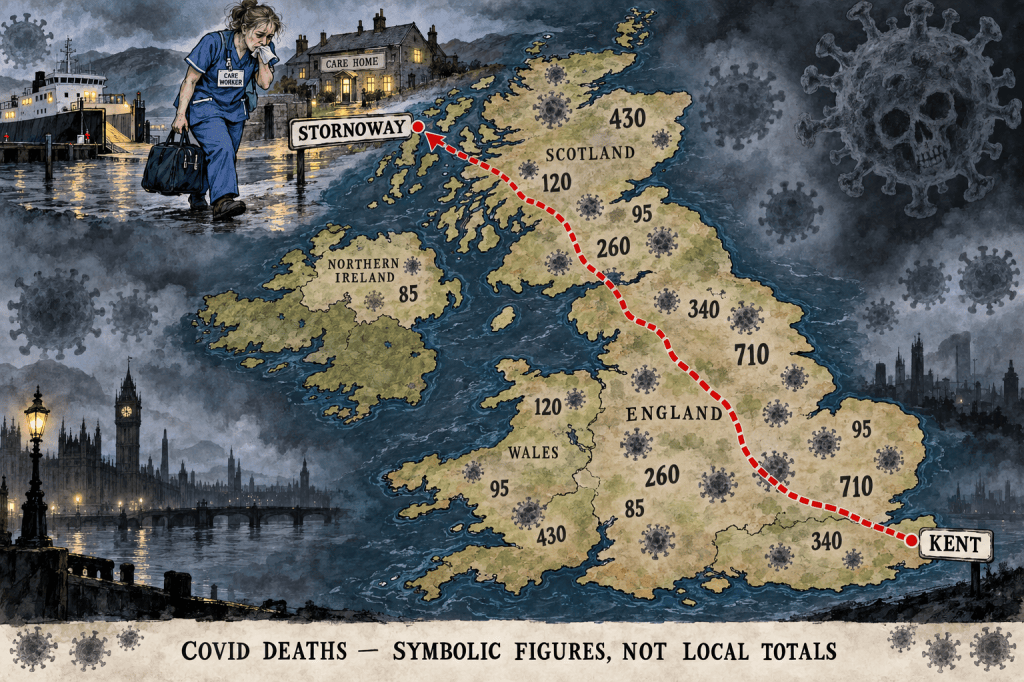
- Former BBC Scotland Head of News, John Boothman, now at the Times, wrote: HC-One, Britain’s largest care home chain and the operator of Home Farm, faces allegations that it paid insufficient heed to the [Scottish] government’s lockdown by parachuting workers in from as far away as Kent, 645 miles away, to plug staff shortages in a sector where pay is notoriously poor.https://www.thetimes.co.uk/article/coronavirus-kills-six-and-leaves-dozens-seriously-ill-at-skye-care-home-3g70vxbf6
- An ONS study of 9 081 care homes in England found this: These emerging findings reveal some common factors in care homes with higher levels of infections amongst residents.These include prevalence of infection in staff, some care home practices such as more frequent use of bank or agency nurses or carers, and some regional differences (such as higher infection levels within care homes in London and the West Midlands). There is some evidence that in care homes where staff receive sick pay, there are lower levels of infection in residents. https://www.ons.gov.uk/peoplepopulationandcommunity/healthandsocialcare/conditionsanddiseases/articles/impactofcoronavirusincarehomesinenglandvivaldi/26mayto19june2020#main-points
- There’s a Welsh report saying the same thing but you’ve probably had enough.
Discover more from Talking-up Scotland
Subscribe to get the latest posts sent to your email.


The Covid Inquiry report on care homes identifies multiple, alleged ‘failings’ by government bodies and ministers. But whilst it makes clear the invidious decisions and trade-offs that faced the authorities, it seems to avoid drawing what is – perhaps to the lay person – the obvious conclusion that there was no ideal, harm-free approach to mitigating risks to care home residents AND the wider public needing hospitalisation available to governments across the UK as the pandemic took hold.
In terms of mitigating the risks from discharges from hospitals to care homes, this from the Covid Inquiry report is once again relatively favourable (arguably) to decision- making and mitigations in Scotland:
Firstly on the UK as a whole: ‘.. when the expedited discharge policies were rolled out in March 2020, isolation of all those discharged untested from hospital was not advised.
‘Scotland was the first nation to advise isolation of all people discharged from hospital and admitted to care homes, including those who had not been tested (see Table 3). Following a meeting on 18 March 2020 with Dr Donald Macaskill (Chief Executive of Scottish Care, a membership body representing independent social care providers in Scotland) and advice from Professor Graham Ellis (Deputy Chief Medical Officer for Scotland from September 2021), Ms Freeman agreed that all new admissions to care homes should be isolated. This was reflected in Scottish Government guidance on 26 March 2020.’
So the Inquiry acknowledges that isolation of ALL NEW ADMISSIONS was mandated in Scotland from 26 March 2020.
And elsewhere in the UK? ‘Isolation of people admitted from hospital was not advised until 15 April 2020 in England, not communicated until 22 April in Wales and not advised in Northern Ireland until 26 April.’ So all c. 3 weeks later than in Scotland.
And: ‘When commenting on why isolation for all people admitted to care homes was not introduced sooner, Public Health England said that when the March 2020 hospital discharge policy was introduced, asymptomatic transmission was not considered to pose a sufficiently high risk to justify that kind of quarantine and that it was important to weigh up the benefits and harms of isolation, which came with risks for vulnerable people.’
I am mindful that family members of care home residents have raged against policies of isolation of residents in care homes for safety reasons: was Public Health England right then to delay imposing isolation as a mitigation of risk of transmission? Was its much earlier introduction in Scotland a good thing – to address the risks associated with hospital discharge to care homes – or a bad thing as isolation brings its own harms? Or would BBC Scotland and Dame Jackie Baillie claim a ‘scandal’ regardless?
LikeLike