




From Nation Cymru, yesterday:
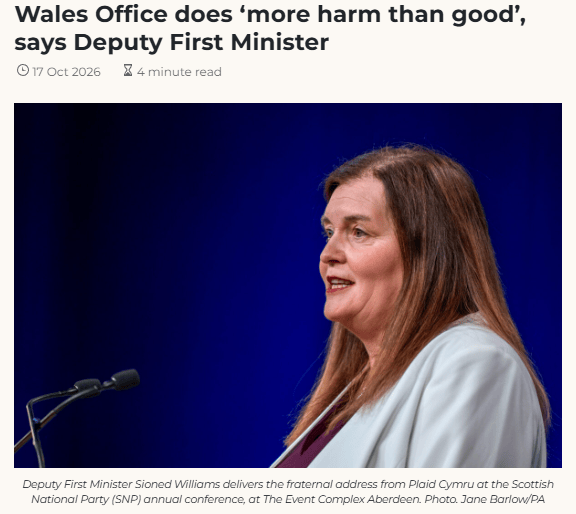
Deputy First Minister Sioned Williams has called for the Wales Office to be scrapped, saying it often does “more harm than good” and reinforces Westminster’s position rather than challenging it. Speaking to The National Podcast at the SNP conference in Aberdeen, Ms Williams said devolution had removed the need for the role. “Over 27 years of devolution we have come to a maturity, I would say obviously in Scotland but equally in Wales, where we don’t need that position anymore,” she said.
“What we get is resistance, and that has been true of Welsh Secretaries of both persuasions that we’ve had so far, Tories and Labour, so we don’t really see the advantage of it and what it does for us is bolster that Westminster perspective rather than challenge it.” https://nation.cymru/news/wales-office-does-more-harm-than-good-says-deputy-first-minister/
SNP criticism?
Independent of the Welsh comments, the Scotland Office has faced similar criticisms for years, mainly from the SNP and some other quarters:
- It has repeatedly been labelled a “propaganda outfit,” “PR wing of broken Britain,” or “Tory/Labour propaganda unit” that promotes the UK Government’s line in Scotland rather than acting as an effective advocate for Scottish interests inside Whitehall.
- Spending on communications/spin has drawn scrutiny (e.g., rises in the cost of communications staff).
- Older criticisms include the Taxpayers’ Alliance calling it a “pointless relic” of the pre-devolution era (around 2007) and a 2019 Commons Scottish Affairs Committee report questioning whether it still had a meaningful role, given that much intergovernmental work happens directly between the Scottish Government and relevant Whitehall departments.
- SNP politicians have argued it fails to “stand up for Scotland” on specific issues (e.g., winter fuel support, industrial closures such as Grangemouth, or energy policy).
Independent academic research evidence?
Dr Marc Collinson (Bangor University, political historian)1 has written on the Wales Office (with explicit parallels to the Scotland Office). He frames the post-1999 territorial offices as classic examples of Richard Rose’s concept of policy inheritance.2 Institutions that persist because they already exist rather than because they are optimally designed for current needs. In a mature multi-level system, he argues they appear “inherited and peripheral” to the actual management of intergovernmental relations. He notes the absence of equivalent territorial ministries in comparable Westminster systems (Canada and Australia) and suggests further analysis of whether such offices hinder or help the devolved settlements.
Sources:
- https://acss.org.uk/is-the-wales-office-necessary-policy-inheritance-and-intergovernmentalism-in-the-age-of-devolution/
- https://www.jstor.org/stable/j.ctt32bkr3
Discover more from Talking-up Scotland
Subscribe to get the latest posts sent to your email.

