

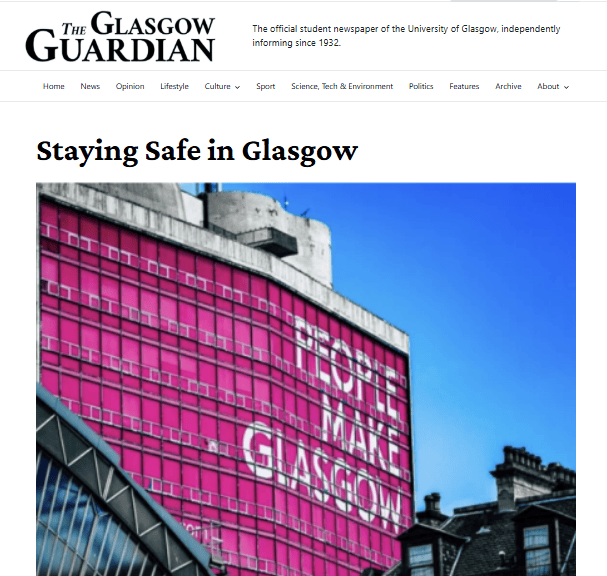
Having just see their lame, mainstream account of drug deaths in Scotland, I wondered if they had ever shared important findings on safety from crime in Glasgow.
I could only find, recently, the above, and:
In June, the BBC reported that the number of sexual crimes that occur in Scotland has increased by 3% in the last year – the highest it has been since 1971. This is a staggering and terrifying statistic, leaving many in Glasgow worrying about their own safety in the city. Learning how to stay safe, especially if you are new in Glasgow, is extremely important. Knowledge is power in unsafe situations, and knowing what to do if something does happen can give peace of mind.
https://glasgowguardian.co.uk/2025/10/21/staying-safe-in-glasgow/
The author uses the word ‘reported’ three times but does not explain the complexity of any suggestion that the police ‘reported’ crimes can be understood in such a simplistic manner – staggering. I won’t do a tutorial on that here. Have a word with a sociology student. Year 1 should be fine.
My headline? Evidence? Here it is:
These are city-wide figures and not just those for campus areas.
From How safe is your city? in the Complete University Guide for 2025, the Cities with the lowest violent crime:
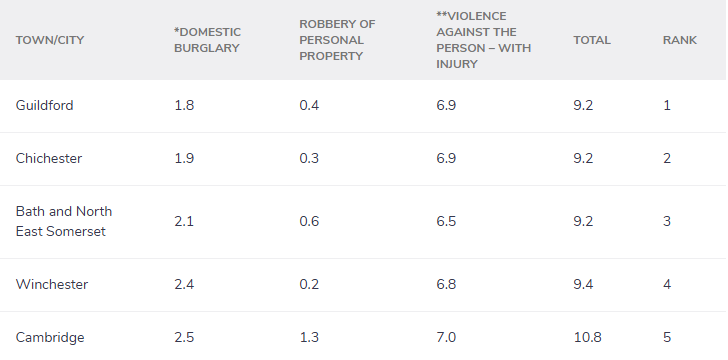
Bath the lowest at 6.5 attacks per 1 000 population, per year.
The sites with the highest violent crime levels:
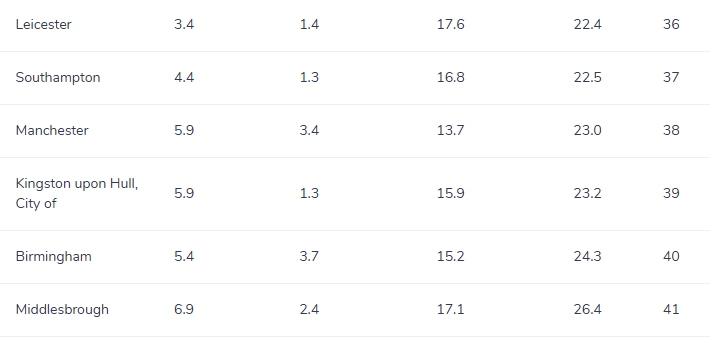
Up to 17.6 violent attacks per 1 000 students per year in Leicester!
And in Scotland, after near 20 years of plummeting crime:
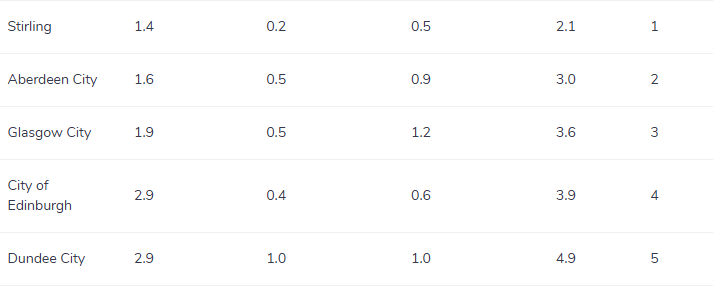
Even Glasgow, the highest in Scotland, it’s only 1.2 per 1 000 per year. In Leicester you’re 15 times and in Bath, you’re 5 times, more likely to be attacked.
I haven’t see this reported anywhere revealing the shameful bias of ‘our’ media.
Source: https://www.thecompleteuniversityguide.co.uk/student-advice/where-to-study/how-safe-is-your-city
Discover more from Talking-up Scotland
Subscribe to get the latest posts sent to your email.


Despite Glasgow’s reputation of being a left wing city, the politics of the student body has, especially in the past, tended to be more on the right of the political spectrum. For those of us who attended Glasgow University during the 1960s, when Strathclyde was still a mewling 2 year old, the proportion of students in the city was much smaller than it is now and a relatively high proportion of them came from the private sector. There was still selection in all Scottish secondary schools at the time and around 65% of the school population was deemed to have ‘failed their Qualy’ and left school at 15 years of age.
Of those who passed their Qualy and went on to secondary education and passed sufficient Higher Grades to be able to apply to university it was only with the more generous provision of grants and the payment of fees by the Harold Wilson Government that many were able to attend university. There had been bursaries and scholarships available prior to that, but the legislation enabled more young people from less affluent backgrounds to go to university.
So, in the 60s the student population was still disproportionately from the more affluent social classes and from the private education sector.
Their politics tended to be ‘conservative’. For example the University Union at Glasgow was men only. And this position was strongly defended by many male students. I recall a conversation with one who went on to be a Cabinet Minister, that it was a ‘gentleman’s club,’ and should remain so.
Thus the student newspaper, The Glasgow Guardian tended to be staffed by people of conservative views. A number of them were protégés of journalists for the Herald, Express, etc. So the radical student politics of the 1960s which was sweeping through universities in Europe and North America was treated with somewhat languid disdain and opposition by the Guardian. Amongst its leading lights at the time was one Andrew S. Neil. There were others who got ‘billets’ at the Daily Telegraph.
It was not a fan of Red Clydeside.
LikeLike