

From National Mission on Drugs: annual report 2025 to 2026, published today and to zero media attention:
On 20 January 2021, the former First Minister Nicola Sturgeon made a statement to Parliament which set out a National Mission to reduce drug deaths and improve lives through a range of improvements to treatment, recovery and other support services.
This fifth and final National Mission annual report sets out the progress made from 1 April 2025 to 31 March 2026 against the National Mission Plan. Annual analytical reports monitoring the progress of the National Mission are published separately.
https://www.gov.scot/publications/national-mission-drugs-annual-report-2025-2026/pages/2/
This is an extensive document but two outcomes where the Scottish Government has made major achievements in the face of UK Government limits on action and the plague of English County Lines gangs invading Scotland.
First, Outcome 2: Risk is reduced for people who take harmful drugs
People have a right to support that reduces the harms associated with drug use regardless of where they are on their recovery journey. This includes promoting safer drug consumption practices, preventing overdoses, and reducing the risks and harms associated with drug use.
Progress continued in 2025/26, aimed at expanding both the scale and accessibility of naloxone across Scotland. At the end of 2025/26, the ‘reach’ of the National Naloxone programme (percentage of people at risk of opioid overdose who have been supplied with take home naloxone) was estimated to be 89.9%.
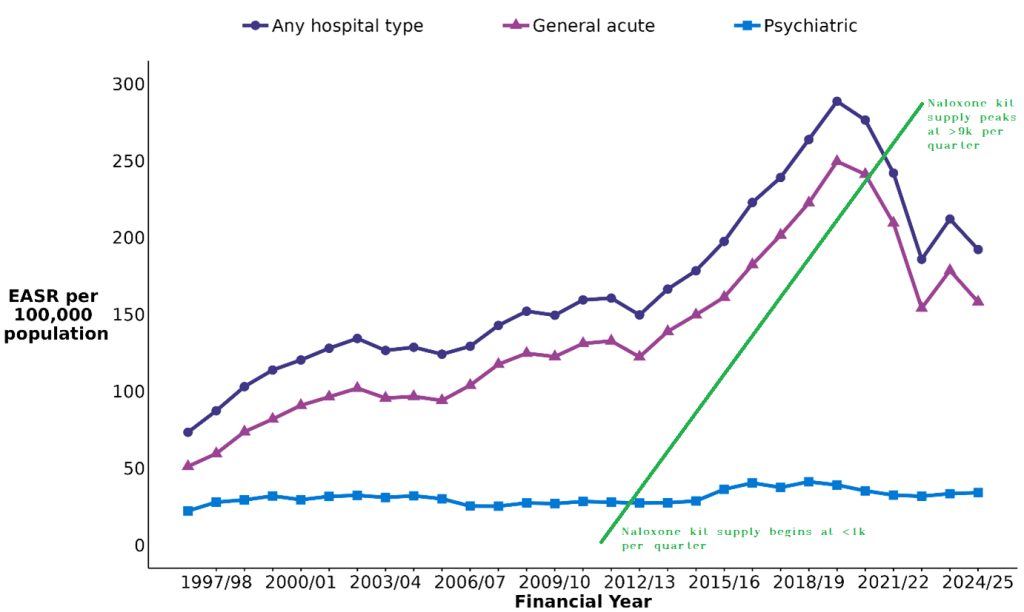
A clear, striking piece of evidence for the above element in the strategy can be seen in the graph above revealing plummeting levels of Drug-related stay rates by hospital type.
The Naloxone scheme may not be the only contributory factor but given the dominance of opioid overdose deaths in the statistics, and the close correlation of kit supply trend with subsequent fall in stays, it seems certain to be the main one.
https://www.publichealthscotland.scot/media/37282/chart.png
Second, Outcomes 3 & 4: People at most risk have access to treatment and recovery & people receive high-quality treatment and recovery services
In just one three-month period, 3 784 (96%) of 3 993 referred drug-users began treatment within three weeks and one third of them in only one week.
From National drug and alcohol treatment waiting times 1 April 2026 to 30 June 2026, published today:
11,290 referrals were made to community-based specialist drug and alcohol treatment services – broadly similar to the previous quarter (11,408). Of these, 5,452 (48.3%) were for problematic use of alcohol, 3,993 (35.4%) for problematic use of drugs, and 1,845 (16.3%) for problematic use of both alcohol and drugs. Nationally, the Standard was met for referrals to community-based services, with 93.6% (6,643) of referrals starting treatment within three weeks, compared with 93.0% in the previous quarter. By substance type, the Standard was met for problematic use of drugs (96.2%), both alcohol and drugs (92.8%) and alcohol (92.1%).
Discover more from Talking-up Scotland
Subscribe to get the latest posts sent to your email.


