

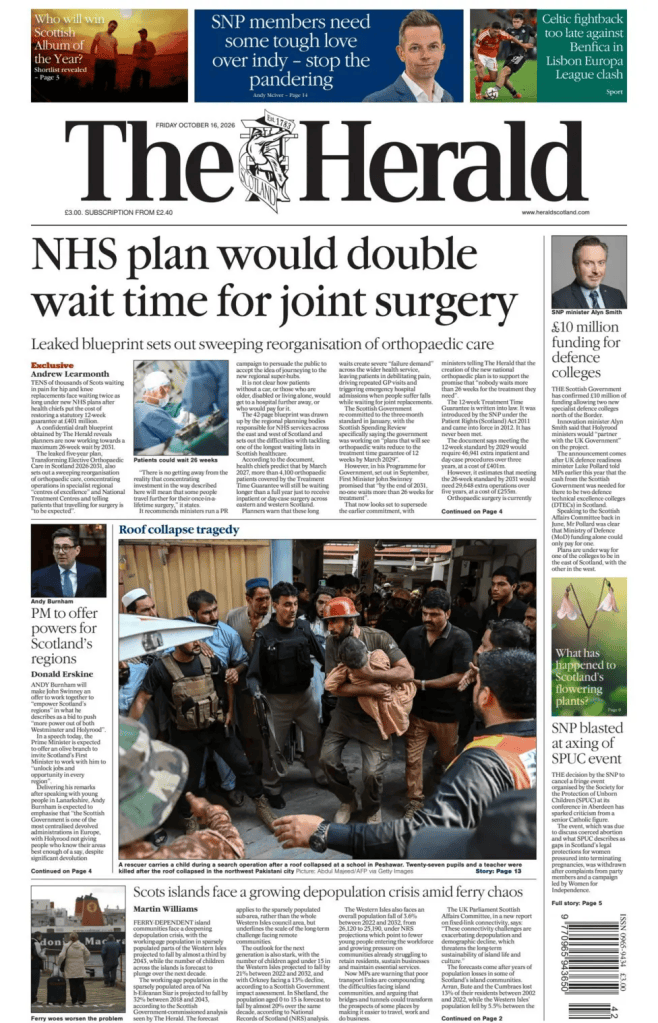
Typically dishonest, gutter-level journalism from the Herald today. Moving the formal maximum target from an unmet 12 weeks to a 26-week aim by 2031 is a relaxation of ambition relative to the old legal standard, but it does not mean the plan is to increase waits to twice what people experience today. For a large number of current long-waiters it would still represent an improvement if achieved.
Like many health service targets, our aging, less active yet more expectant population, living in a world of de-regulated food production and made addicts to hyper-processed non-food by global corporations, cannot be met. If we doubled the NHS spend, we would not clear the ‘backlog.’
We do what we can and, in Scotland, we do better.
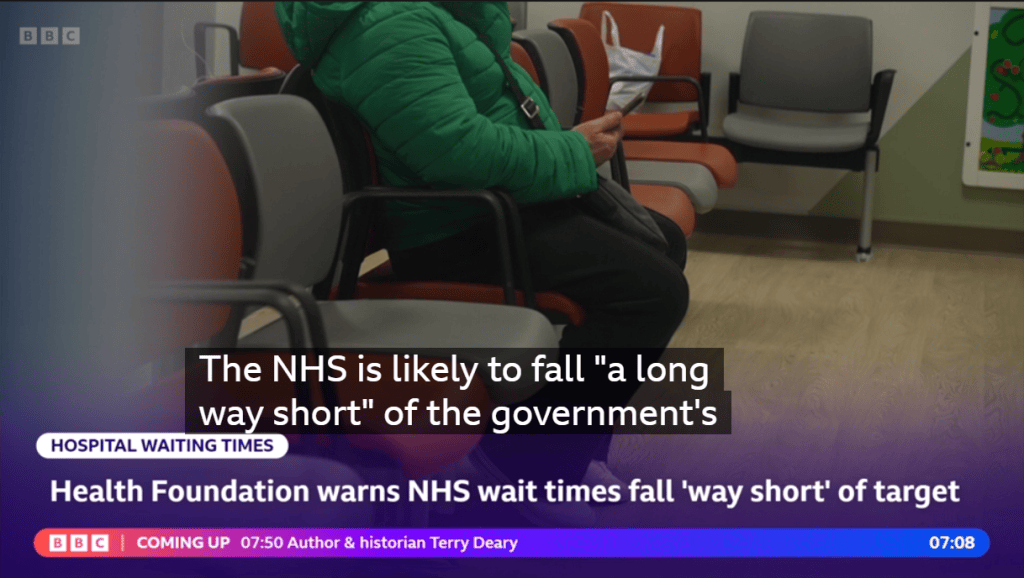
Across the BBC and in the Telegraph, the above and:
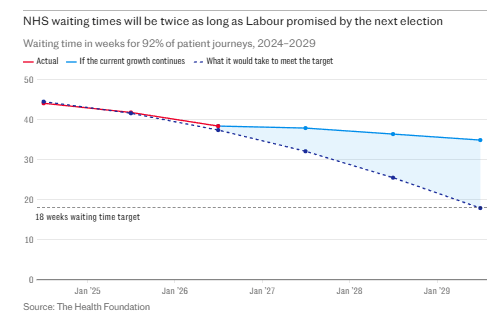
NHS waiting times will be twice as long as Labour promised by the next election, new analysis shows.
The health service will fail to meet the 18-week waiting target that had been a flagship pledge of Sir Keir Starmer’s premiership, a report by the Health Foundation think tank predicts.
Instead, it says, based on the rate of progress in Labour’s first two years in power, patients will still be waiting an average 35 weeks in 2029 – almost twice as long as promised.
The Government will have barely moved the needle on the overall NHS backlog either, with 7.1 million people forecast to still be on a waiting list. https://www.telegraph.co.uk/news/2026/10/08/nhs-wait-times-be-twice-as-long-as-labour-promised-2029/?msockid=040f0c0f8f6f69bb36d418948ed46872
Since the end of 2024, NHS Scotland has moved to a more demanding 12-week target but at that point, it treated 67.6% within 18 weeks1 while NHS England only treated 59%.2
In March 2026, NHS Scotland treated 59.2% by 12 weeks. However, the trend is an improving one.3
12-week figures are not published by NHS England but can be extracted but from the data files, tucked away, in Consultant-led Referral to Treatment Waiting Times Data 2026-274. There we see the intriguing phrase, not a percentage figure:

50%? Significantly worse than NHS Scotland at 59.2%. NHS Scotland treating 20% more in 12 weeks.
Sources:
- https://publichealthscotland.scot/publications/nhs-waiting-times-18-weeks-referral-to-treatment/nhs-waiting-times-18-weeks-referral-to-treatment-quarter-ending-30-september-2024/
- https://www.bbc.co.uk/news/articles/ckgxqnr8yw4o
- https://publichealthscotland.scot/publications/stage-of-treatment-waiting-times/stage-of-treatment-waiting-times-new-outpatients-inpatients-and-day-cases-28-april-2026/
- https://www.england.nhs.uk/statistics/statistical-work-areas/rtt-waiting-times/rtt-data-2026-27/
Discover more from Talking-up Scotland
Subscribe to get the latest posts sent to your email.


I have to agree with your remarks on food products, we are almost totally fresh produce now and stay clear of fast food and what a difference we both feel
LikeLiked by 1 person
The policy of ending business/non-domestic rates relief (2022 in Scotland) – via variance in charitable status and imposing VAT on most ‘private’ schools in Scotland is on course to cost the Scottish taxpayer money as the sector progressively shuts down (would be interested in Professor Robertson’s views on the sector). Meantime my incomplete understanding is that NHS hospitals etc. pay business/non-domestic rates but ‘private’ hospitals do not nor is VAT applied to the fees they charge since they are charities 🤣. And, of course, the majority (not all) of ‘private’ medical and surgical services are supplied by NHS Consultants (a significant minority – most are opposed) ‘moonlighting’ from the day job. In their own time, of course, since private sector inpatients never develop complications during NHS Consultant working hours 🤣 nor does ‘private’ work conflict with or diminish their support for the NHS 🤣🤣. And increasingly many other healthcare professionals have followed this example with similar detriment to services. What is the thinking behind all of this? At the very least apply the same financial standards across both the above ‘private’ sectors.
LikeLike
Forgot to mention the NHS picking up the pieces when ‘private’ sector work develops significant complications, though again it must be emphasised that such complications never occur during NHS Consultant working hours 🤣
LikeLike
And finally…during my career I encountered many of the ‘top brass’ in NHS management in various health boards and rarely failed to be horrified. The only reason the management system functions at all is that there is a critical level of middle to senior management, often with initial clinical experience, who smooth the interaction between clinical representation and the ‘top brass’. They simply know how to get things done. When that critical minority disappears with the proposed health board restructuring from 14 to 2 there will be hell to pay. Especially for us patients.
LikeLike
And finally finally…the above may help explain why I rail against the wholly inappropriate pejorative treatment of Scottish A&E Consultants/RCEM in TUS. As clinical leaders of the most frontline of NHS services they have nowhere to hide either medically or politically. Their leaders represent the speciality unpaid and in their own time, such as there is of it. They speak in absolute terms e.g. get ‘corridor care’ from 7% to zero, not in comparative terms and they do try to be apolitical. There is no market in Scotland for private A&E and if the NHS is to thrive again the A&E medics will provide the ethical template. Please stop tearing them down, when they and their flickering flame of true medicine has gone, so has the NHS itself.
LikeLike