

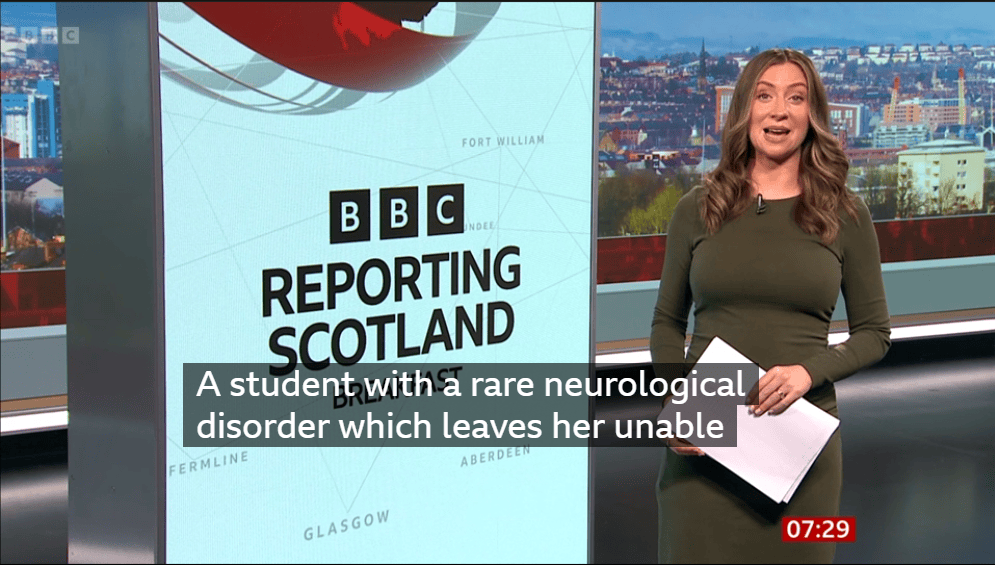
to move has had her request for special measures turned down by Scotland’s exam body. Romi Loffler, who communicates by blinking, asked Qualifications Scotland if she could sit her Nat 5 history exam question at a time over weeks. It said no, despite exam boards in England making similar accommodations.
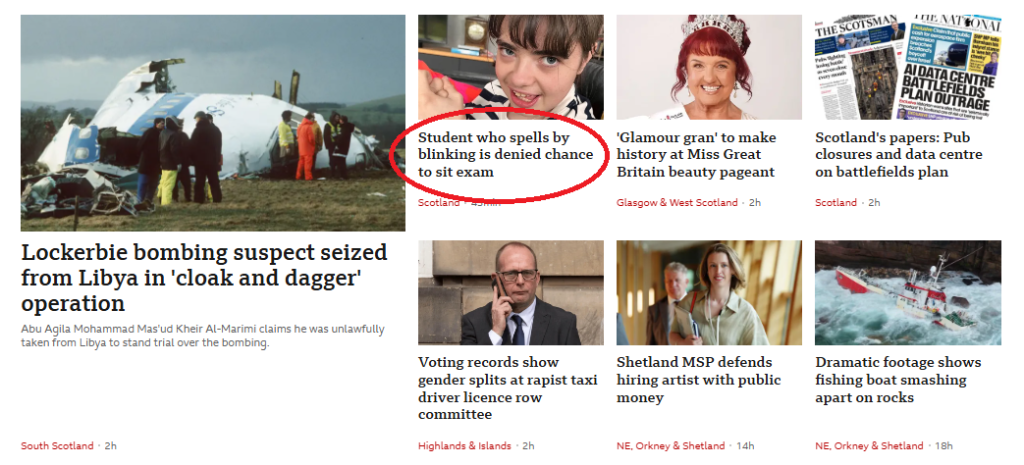
Headlining on BBC Scotland’s insert in BBC Breakfast today, one of the latter’s common attempts to portray Scotland in a less favourable light than England. This time, it’s in the emotive context of disabled access to exams.
It’s dishonest.
First and less of a concern, the exam ‘boards‘ plural.
Qualifications Scotland (QS) said no despite two children using eye gaze technology to sit GCSE exams in England earlier this year.
That link leads to a report of a single student in Macclesfield:
Qualifications Scotland (QS) said no despite two children using eye gaze technology to sit GCSE exams in England earlier this year.
However, the deceit is far greater on this, in the ninth paragraph:
Her parents also asked if she could use a “bank” of pre-agreed relevant words that would mean she would not have to spell out every letter.
There is no mention of such in the English case. Any Education correspondent would know this is a very significant matter.
Why does it matter?
In short, a word bank is not merely a faster way to type. By supplying relevant vocabulary in advance, it changes the balance between recalling/producing knowledge and selecting from given options, which is why bodies concerned with qualification integrity are reluctant to approve it.
A pre-agreed word bank changes the assessment by reducing (or removing) the independent generation of language that other candidates must produce unaided. In the Romi case, the request was for a bank of pre-agreed relevant words so she would not have to spell every letter via eye-gaze. That sounds like a pure access tool, but it alters what is being tested.
How it differs from standard conditions
In a normal National 5 History exam (or equivalent GCSE), candidates must:
- Recall and select appropriate historical vocabulary, concepts, and phrasing from memory.
- Construct sentences and arguments without prompts.
- Do this under timed, closed conditions.
Qualifications Scotland allows many adjustments—extra time, rest breaks, scribes, assistive technology, separate rooms—precisely because they remove a physical or sensory barrier without changing the underlying demand of the qualification. A content-related word bank is different. It risks changing the standard of the assessment itself. Guidance for Scottish National Qualifications is explicit that adjustments must not alter the competences being assessed or the marking criteria. https://www.sqa.org.uk/sqa/64698.html
Finally, the student in England did not sit History.
Discover more from Talking-up Scotland
Subscribe to get the latest posts sent to your email.

