


Mark Smith, today, once more revealing his little knowledge of Scotland, tries to drag us into the wider world of state brutality, as the US plans a public execution by firing squad, with ill-researched work on the history of capital punishment in Scotland and in the wider UK.
He quickly tells us of Scotland’s last hanging in 1963:
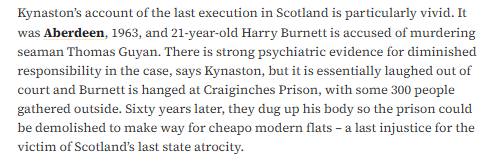
but ignores this key information:
Scotland historically applied the death penalty far less often than England, mainly because of differences in legal tradition after the 1707 Act of Union. Scotland kept its own courts, criminal procedure, and much of its substantive law and a smaller set of capital statutes.https://link.springer.com/chapter/10.1007/978-3-319-62018-3_2
Contemporary observers noted the contrast clearly:
- Viscount Stair (1681) remarked that Scots were “happy in so few and clear statutes.”
- Sir Archibald Alison, in his early-19th-century work on the criminal law of Scotland, stated that while England had over 200 (later cited near 300) capital crimes, Scotland had fewer than 50, and more than half of those had originated with the British Parliament rather than native Scots law.https://api.parliament.uk/historic-hansard/commons/1851/may/22/capital-punishment
Alison and others attributed this to the greater scope of the common law in Scotland. English law for serious offences relied heavily on specific statutes, limiting judicial flexibility. Scottish judges had more room to treat offences under common law and exercise discretion in sentencing. Prosecution was also more centralised and professional (Lord Advocate and procurator fiscals building cases), rather than depending primarily on private prosecutions as in England.https://figshare.le.ac.uk/ndownloader/files/18275693
Lower numbers of sentences and executions
Quantitative data supports the difference:
- Between 1740 and 1834 in Scotland, 797 people were sentenced to death. Of these, 505 were executed and 292 were pardoned, usually on condition of transportation, imprisonment, or banishment. Murder accounted for a substantial share, around 32%, of the executions. Property offences were less dominant than under England’s Bloody Code.https://www.ncbi.nlm.nih.gov/books/NBK481736/
- By comparison, England and Wales alone saw roughly 6,444 civilian executions between 1735 and 1799 (6,069 men and 375 women), with many more in the early 19th century before reforms reduced capital offences. Overall figures from 1735–1964 show England and Wales accounting for the large majority of British executions.https://capitalpunishmentuk.org/the-history-of-judicial-hanging-in-britain-1735-1964/
- Regional studies of property-crime executions in the mid-to-late 18th century show much lower rates in Scotland. https://academic.oup.com/past/article/228/1/159/1464229
In the 19th century, Scotland continued to hang fewer people. For example, there were 273 public hangings in Scotland from 1800 to 1868, mostly for murder, housebreaking, robbery, etc., with substantial numbers of death sentences still reprieved. Executions remained uncommon relative to England.https://capitalpunishmentuk.org/scotland-executions-1800-1899/
Reprieves, discretion, and later convergence
By the mid-to-late 19th century the systems converged on the main capital offences, primarily murder after reforms such as the 1861 consolidations in England and the Criminal Procedure (Scotland) Act 1887, which largely restricted the death penalty in Scots law to murder, treason, and a few other residual cases. The practical difference in volume of executions persisted longer, however, and Scotland’s total 20th-century executions were very low.
Scotland had 34 executions in the 20th century (1900–1963). England and Wales had 762 (1900–1964), roughly twice as many per head. https://capitalpunishmentuk.org/the-history-of-judicial-hanging-in-britain-1735-1964/
In short, the historical gap reflected Scotland’s distinct legal culture with a greater reliance on common law and judicial discretion, fewer capital statutes, and higher relative use of reprieves.
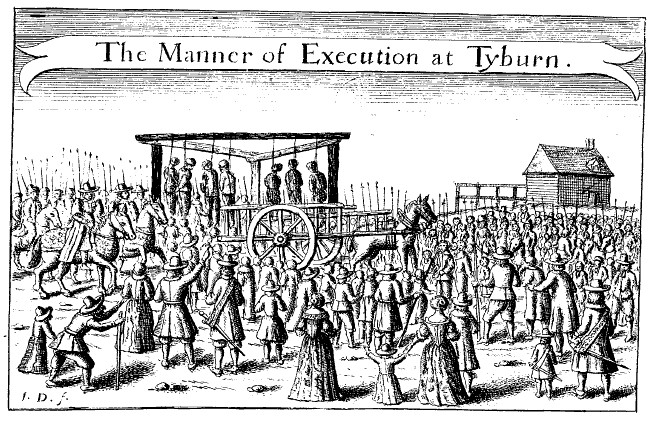
Finally, there is no clear, confirmed evidence of any Scottish child under about 16 actually being hanged for theft, or any other crime. Between 1674 and 1750 at Tyburn alone, records show at least 44 juveniles, mostly boys aged 13–16, hanged for property crimes in England. https://resolve.cambridge.org/core/journals/continuity-and-change/article/children-juveniles-and-crime-in-early-modern-london-old-bailey-trials-16741750/25C044DCA8BD9F982ED745BE7809B36C
Discover more from Talking-up Scotland
Subscribe to get the latest posts sent to your email.

