


Cadmium? One of the main effects of cadmium poisoning is weak and brittle bones. The bones become soft (osteomalacia), lose bone mineral density (osteoporosis), and become weaker. This results in joint and back pain, and increases the risk of fractures. Spinal and leg pain is common, and a waddling gait often develops due to bone deformities caused by the long-term cadmium exposure. The pain eventually becomes debilitating, with fractures becoming more common as the bone weakens. Permanent deformation in bones can occur. In extreme cases of cadmium poisoning, mere body weight can cause a fracture.
The Times on 24 November 2019, reported the above headline. It says that, according to the Scottish Environment Protection Agency, more than 40 pollutants from Shieldhall were discharged into the Clyde estuary in 2016 and 2017. The amounts it gives are almost 800 tonnes of ammonia, 1.9 tonnes of copper, 197 kg of cyanides, 80 kg of arsenic and 16 kg of cadmium. It also says data for 2018 had not yet been published. Scottish Water is quoted as saying discharges were strictly regulated and did not pose a threat to human health.
Ammonia is also a normal product of domestic sewage. Copper, cyanide, arsenic and cadmium are more typical of industrial, commercial or hospital inputs. The mix is consistent with some non-domestic waste surviving treatment.
Sending industrial and commercial wastewater into ordinary sewage works is a long-standing legal system, not something that started recently. In Scotland it dates back to the Sewerage (Scotland) Act 1968. Scottish Water, and the regional water authorities before it, can agree to receive trade effluent and must control it with a consent or letter of authorisation.
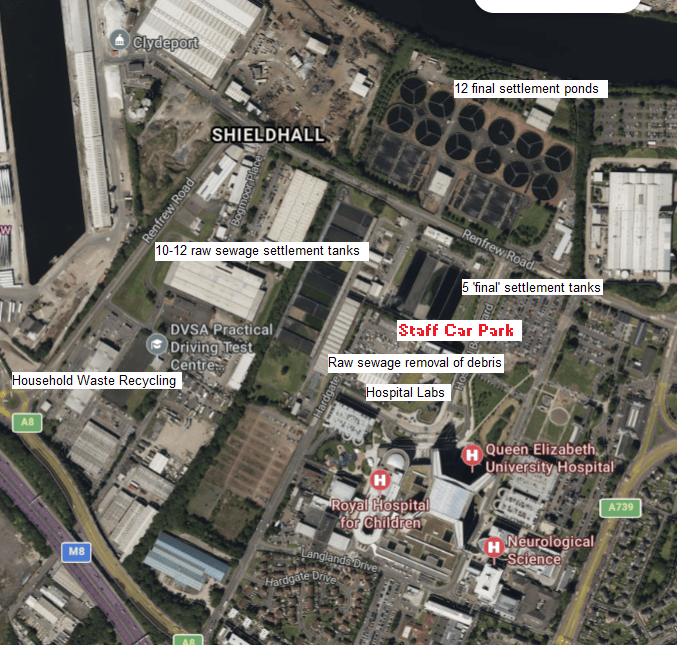
The first stage of separation in the sanitation works at Shieldhall, is preliminary treatment with screens and grit removal. Raw sewage is agitated there, often by mechanical raking or hosing, and that is one of the stronger aerosol sources on a works. Inquiry evidence on Shieldhall already treats screening as capable of generating aerosols from untreated sewage, and notes that this is done in buildings on the site. Published wastewater-plant studies likewise find the highest respirable fractions around screens, aeration and sludge handling, not at the final outfall. The staff car park is only 5 metres away.
Due east of that stage, the car park is downwind when the wind is from the west, which is a common direction in Glasgow.
Consequences for those arriving in the car park daily:
Breathing
Surface aerators throw droplets and particles into the air. Close to the ponds those levels are at their peak. Anyone standing or walking in the car park for even a few minutes will inhale some of that aerosol, especially when the wind is blowing from the ponds toward the cars. That is ordinary outdoor exposure at a short distance, not a sealed indoor space, carrying it in.
Particles also settle on:
- clothes, hair and shoes
- car bodywork, door handles and interiors when doors are opened
- bags and wheelchairs
Those people then walk into the hospital. Some of what landed on them can come off again indoors. This is the same kind of transfer that happens with ordinary outdoor dust, pollen or traffic particles — except here a fraction of it originated in sewage.It is not the same as walking through a visible spray of untreated sewage. Concentrations drop with even a short extra distance and with rain (common in south-west Scotland), and most particles that stick to clothing are not highly concentrated live pathogens. But “very near the raw ponds” is exactly where you would expect both inhalation and some contamination of clothing and vehicles.
Practical implications:
- Staff and regular visitors who park there get repeated short outdoor exposures.
- Opening car doors and then entering the building creates a small pathway from the pond-side air into the hospital.
- Filtration inside the hospital reduces what stays airborne indoors; it does not stop what arrives on people and belongings.
A car park immediately beside surface-aerated raw ponds is a poor location if the aim is to keep sewage-related aerosols away from patients and staff. Moving parking farther downwind or putting a buffer (distance, planting, a building in between) would cut that pathway more than any attempt to make the hospital itself airtight.
Crowdfunder - https://www.crowdfunder.co.uk/p/help-talking-up-scotland-keep-going
Bank transfer - JOHN WATSON ROBERTSON Sort Code – 08-91-04 Account 12266421
Discover more from Talking-up Scotland
Subscribe to get the latest posts sent to your email.

