

Across the BBC this morning and in the Telegraph, the above and:
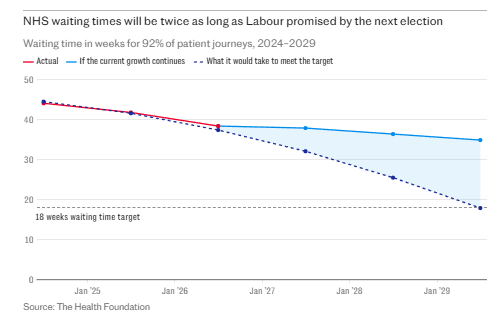
NHS waiting times will be twice as long as Labour promised by the next election, new analysis shows.
The health service will fail to meet the 18-week waiting target that had been a flagship pledge of Sir Keir Starmer’s premiership, a report by the Health Foundation think tank predicts.
Instead, it says, based on the rate of progress in Labour’s first two years in power, patients will still be waiting an average 35 weeks in 2029 – almost twice as long as promised.
The Government will have barely moved the needle on the overall NHS backlog either, with 7.1 million people forecast to still be on a waiting list.
Since the end of 2024, NHS Scotland has moved to a more demanding 12-week target but at that point, it treated 67.6% within 18 weeks1 while NHS England only treated 59%.2
In March 2026, NHS Scotland treated 59.2% by 12 weeks. However, the trend is an improving one.3
12-week figures are not published by NHS England but can be extracted but from the data files, tucked away, in Consultant-led Referral to Treatment Waiting Times Data 2026-274. There we see the intriguing phrase, not a percentage figure:

50%? Significantly worse than NHS Scotland at 59.2%. NHS Scotland treating 20% more in 12 weeks.
Sources:
- https://publichealthscotland.scot/publications/nhs-waiting-times-18-weeks-referral-to-treatment/nhs-waiting-times-18-weeks-referral-to-treatment-quarter-ending-30-september-2024/
- https://www.bbc.co.uk/news/articles/ckgxqnr8yw4o
- https://publichealthscotland.scot/publications/stage-of-treatment-waiting-times/stage-of-treatment-waiting-times-new-outpatients-inpatients-and-day-cases-28-april-2026/
- https://www.england.nhs.uk/statistics/statistical-work-areas/rtt-waiting-times/rtt-data-2026-27/
Crowdfunder - https://www.crowdfunder.co.uk/p/help-talking-up-scotland-keep-going
Bank transfer - JOHN WATSON ROBERTSON Sort Code – 08-91-04 Account 12266421
Discover more from Talking-up Scotland
Subscribe to get the latest posts sent to your email.


What these article show is that ‘targets’, while having a laudable intent, have become instruments of blame for the media.
The original purpose of targets – to chart a way to improvements in public services, for the common good – has been displaced.
Blaming is an end in itself for the media. It is a strategy to divert attention away from the rent seeking behaviour of financial organisations. They take the money for the benefit of shareholders while those of us – that it, the majority – who use public services face deteriorating services or services which are not improving quickly enough to meet demand, particularly in an ageing population. Public servants, including elected politicians, are the ones whom the media hound, despite doing the best they can in straitened circumstances.
LikeLiked by 1 person
Are comparisons between the constituent parts of the UK only deemed newsworthy by the editors of public service broadcasters when they can be framed as unfavourable to Scotland? Beyond the news of health service delivery in Scotland – as reported by BBC Scotland and on the front pages of the Unionist press that are aggregated and amplified daily on the Scotland page of the BBC News website – what do we find is the reality?
An NHS Scotland that on many performance metrics operates more effectively and more efficiently to the benefit of patients than its peers in the rUK. An NHS Scotland which on most metrics performs very much better than its most closely comparable peers in the north of Ireland and in Wales. Yes still not good enough: still much more for NHS Scotland and the Scottish Government to improve! But how?
We also have an NHS England which continues to struggle to meet its own performance targets – and this is forecast to continue by independent experts . And this struggling NHS England is now the responsibility of a Labour government in Westminster yet it continues to experience what occurred under recent Tory governments, post COVID.
I think it reasonable to conclude that different health ministers, senior civil servants in different health ministries, and senior managers and clinicians in different NHS bodies across the UK will have been actively looking for some considerable time now at ways to improve effectiveness and efficiency on behalf of patients and staff in the parts of the NHS for which they have responsibility. Differences in performance in different parts of the UK – as indicated earlier – are evident, though arguably sometimes marginal. Do seep rooted and widespread problems exist with the UK’s ‘system’? It would seem so, though the intense politicisation by the MSM of the NHS in Scotland seems intent on keeping voters here ill-informed about UK context and perspective.
Comparisons between the NHS in England, the north of Ireland, Scotland and Wales are important. But more than that, the NHS performance shortfalls and the differences need to be placed in the context of the powers that the responsible governments have to resource a ‘fix’ for the NHS in England and elsewhere across the UK.
The persisting failure to fix the performance of NHS England – under both Tory and now Labour governments in Westminster – is arguably of a different order from what can be levelled at those responsible for publicly-funded health services in the north of Ireland, Scotland and Wales. Only NHS England has as its responsible government one with ALL the powers – all the agency over resources and their allocation – of a currency-issuing, independent nation-state. If Westminster is finding the problems of NHS England intractable – as it clearly is – how can governments with severely limited devolved powers over resourcing make more than marginal improvements?
Even with a Labour government in Westminster – one arguably more committed to the NHS than its Tory predecessors – NHS England continues to struggle. No ready solution to entrenched problems facing the NHS (and social care) across the UK appears to be available from the ‘Union’ upon which we outside of England have to rely. Of course, that context – the reality of that dependency – will never be properly exposed by BBC Scotland and the Unionist press!
LikeLike