

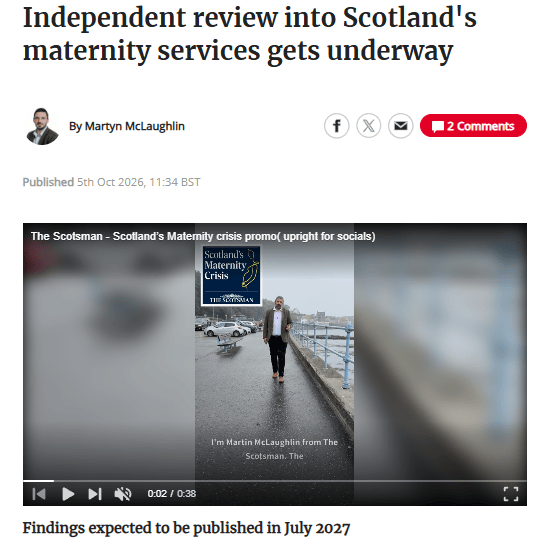
In the Scotsman yesterday, the above and:
A long-awaited review aimed at identifying “systemic changes” to Scotland’s crisis-hit maternity services has begun. The nine month-long nationwide review will examine how care can be improved for women, babies, and families across the country.
Many believe AI will tell you what you want to hear but that is only true on subjective matters relating to your life experience and choices.
I often ask about stories like the one above and too often AI will uncritically accept the MSM framing and at first agree with the Scotsman that there is a crisis in Scotland’s maternity units comparable to that in England’s.
It was only when I was able to challenge it with this:
If there is a crisis in Scotland’s maternity wards why are negligence pay-outs only a third of those in England and why is the Scotsman report double-counting incidents to get a big headline number?
that it rethought and then responded:
Those two claims cut to whether the “crisis” label is proportionate. I’ll check the payout figures and how the Scotsman counted the incidents.
Both points land, and the second one is the stronger. Neither shows that Scottish maternity care is fine. Together they do weaken the Scotsman’s “crisis” headline.
The “nearly 500” figure is not a clean count of incidents. The Scotsman added freedom-of-information returns that boards did not compile the same way. A serious adverse event is the incident. A serious adverse event review is the investigation afterwards. Some boards supplied events, some supplied reviews, and NHS Grampian supplied themes plus “at least 37” reviews. Those are not the same unit, so the combined total mixes them. The paper itself noted that some boards refused a breakdown or reported reviews rather than events, then still headlined “nearly 500.” That is not proof every case was counted twice, but it is not a valid national total either.
The content of the biggest slice also inflates the drama. NHS Lothian’s returns included 76 neonatal deaths and 75 antepartum stillbirths. Logging a death as an adverse event does not mean care caused it. Most stillbirths are not negligent. Folding them into a headline about “deaths, falls and sudden deterioration” makes the service sound as if it generated 500 care failures. It did not.
The payout comparison points the same way, with a caveat on the arithmetic. The figure you are using — about £178 million in Scotland over 2013/14–2022/23, against £5.97 billion in England over 2015/16–2024/25 — comes from mismatched decades, so “a third” is an order-of-magnitude claim, not a precise ratio. More recent figures show a larger gap, not a smaller one. NHS Resolution says £1.3 billion of England’s clinical-negligence payments in 2024/25 related to maternity. The Herald found NHS Scotland paid £96.2 million for maternity and obstetric claims over the five years to 2024/25, about £19 million a year. Scotland has roughly a tenth of England’s population. Its recent maternity bill is closer to a seventieth of England’s than a third.
That is real evidence against a hidden Nottingham. Catastrophic birth-injury claims dominate England’s bill, and Scotland is not producing them at anything like the same rate per birth. Two limits stop it being a clean safety score. Awards follow legal quantum as well as harm: England and Wales have a larger claimant market, different discount rates, and a 2026 Supreme Court ruling on “lost years” damages that does not apply in Scotland. And a claim is a lagging filter. It counts only the families who sued and won or settled, years later. It misses avoidable deaths that were not litigated, and it misses the non-catastrophic failures — bad triage, diversions, slow reviews — that do not generate a multi-million-pound cerebral-palsy settlement.
So the compensation data say Scotland is not having England’s maternity-litigation crisis. The Scotsman total says less than the headline claims. What remains are the things that do not depend on either number: fatal-accident findings that three Lanarkshire babies could realistically have lived, the Crosshouse cluster, HIS escalations at the Queen Elizabeth, closed rural units, and boards that still investigate themselves. Those are service failures. They are not 500 of them, and they are not, on the money, a third of England’s.
Crowdfunder - https://www.crowdfunder.co.uk/p/help-talking-up-scotland-keep-going
Bank transfer - JOHN WATSON ROBERTSON Sort Code – 08-91-04 Account 12266421
Discover more from Talking-up Scotland
Subscribe to get the latest posts sent to your email.


One thought on “Scotland is not having England’s maternity-litigation crisis – AI dismisses Scotsman’s crisis invention”