

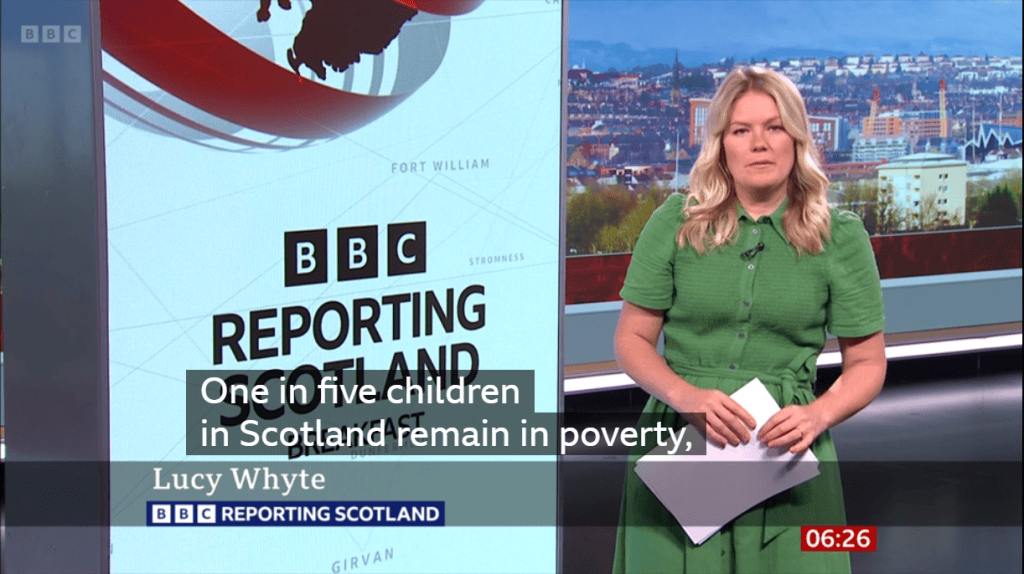
and the Scottish Government’s on course to miss legally binding targets to cut poverty ‘by a wide margin.’ That’s come from the Joseph Rowntree Foundation’s annual report.
Child Poverty is not headlining on any of the other BBC News websites. Only James Cook is on it.
The Joseph Rowntree Foundation has not reported separately on child poverty this year in any of the other UK nations despite it having been much higher in all of them other than Scotland and with little prospect of falling in them. In January 2026, the JRF (different authors) said:
Child poverty rates in Scotland (23%) remain much lower than those in England (31%) and Wales (31%), similar to levels in Northern Ireland (24%). This is likely to be due, at least in part, to the Scottish Child Payment. This highlights the effect benefits can have in reducing poverty. Another driver of lower child poverty rates in Scotland and Northern Ireland are lower housing costs. https://www.jrf.org.uk/understanding-poverty/uk-poverty-2026-the-essential-guide-to-understanding-poverty-in-the-uk#_-poverty-across-the-uk
BBC Scotland today, hides the shame of England with this tiny reference in paragraphs 5 and 6 of its report:
In 2017, MSPs passed a law requiring ministers to hit four targets, external, including pushing the share of children in relative poverty below 10% by 2030. But the JRF’s Poverty in Scotland report, external found the figure remained stubbornly high, averaging 21% from 2022 to 2025. The UK average is 28%. https://www.bbc.co.uk/news/articles/cw073e915j93o
This JRF report today only makes one reference to England in a grudging comment on the Scottish Government:
We have previously shown that the greater relative strength of the social housing sector in Scotland has helped Scotland have lower child poverty rates than England and Wales (Congreve, 2019). Housing investment is driven by local government in Scotland and, while subsidised by the Scottish Government, the majority of housing funding comes from councils, housing associations and their tenants. https://www.jrf.org.uk/understanding-poverty/poverty-in-scotland-2026
Grudging? Well, it is at least £4.1 billion (20-36 000 homes), over four years, given in grant to the local authorities by the Scottish Government. https://www.parliament.scot/chamber-and-committees/research-prepared-for-parliament/research-briefings/2026/8/24/sb-2658
What future for the 4 UK nations has the JRF predicted?
The most detailed published forecast by nation is still the Joseph Rowntree Foundation analysis released with UK Poverty 2025 in January 2025. It uses central Office for Budget Responsibility growth assumptions and no further policy change beyond what was then in place, including Scotland-specific social security.
Projected child poverty rates by January 2029:
| Nation | Then-current rate used | Projected by Jan 2029 |
|---|---|---|
| Scotland | 23.7% | 21.8% |
| England | 30.8% | 31.5% |
| Wales | 32.3% | 34.4% |
| Northern Ireland | 25.5% | 26.2% |
On that run, Scotland was the only nation expected to fall. The gap with England and Wales was projected to widen from about 7 percentage points to about 10, leaving Scotland at roughly 70% of England’s rate, closer to 1 in 5 children in poverty against almost 1 in 3 in England. None of the nine English regions was modelled to fall between 2024 and 2029. JRF attributed Scotland’s different path mainly to the Scottish Child Payment. https://www.jrf.org.uk/work/economic-and-employment-growth-alone-will-not-be-enough-to-reduce-poverty-levels
Is the above mentioned in today’s JRF Scotland report or the BBC Scotland reporting on it?
No.
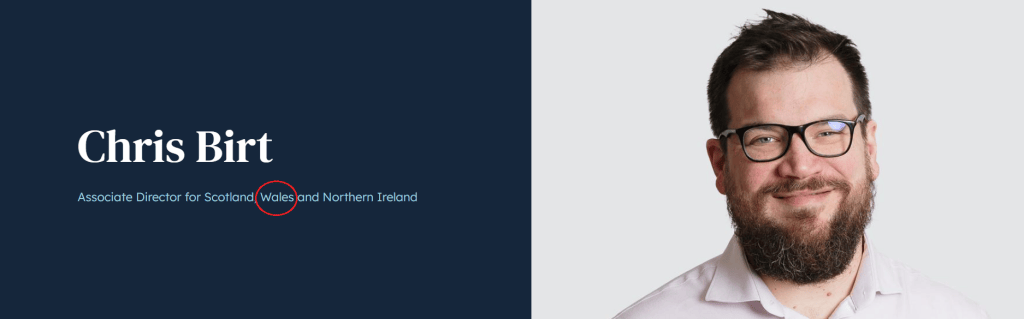
That prediction for Wales makes you wonder about this guy’s priorities:
Crowdfunder - https://www.crowdfunder.co.uk/p/help-talking-up-scotland-keep-going
Bank transfer - JOHN WATSON ROBERTSON Sort Code – 08-91-04 Account 12266421
Discover more from Talking-up Scotland
Subscribe to get the latest posts sent to your email.


Absolute and relative poverty.
Absolute poverty is even lower.
SNP Gov still leading the way
LikeLiked by 1 person
If James Cook needs a character reference following the next round of BBC Scotland redundancies, I would be most happy to provide one.
Stephen McKenzie
LikeLiked by 2 people
“If James Cook needs a character reference” ?
As in a “Character assassination” ?
I’ll contribute to that .
Liz S
LikeLike