

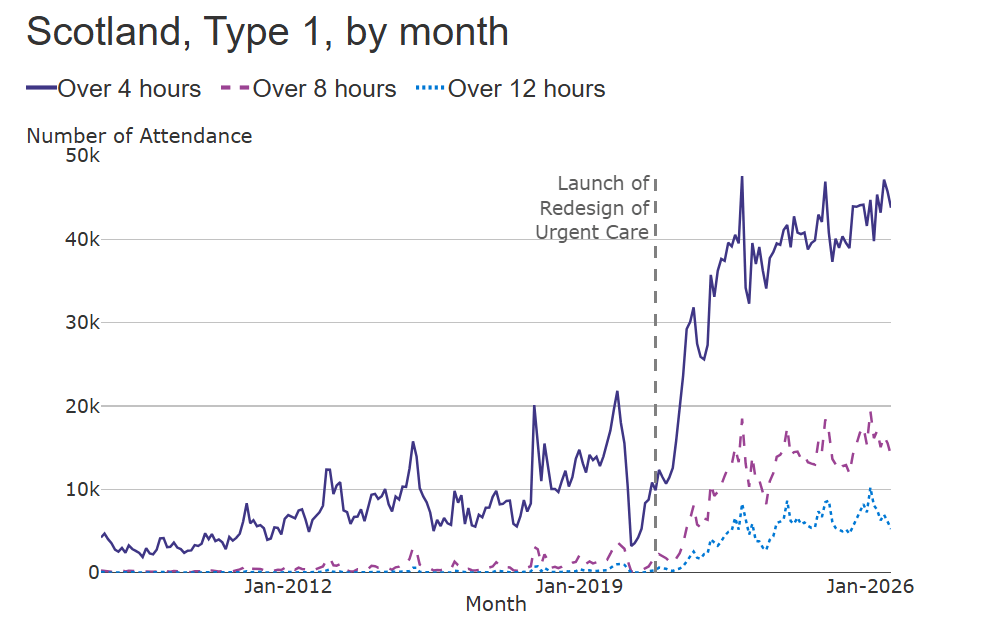
The above graphs show a steep rise in the number waiting longer than the 4, 8 and 12 hour targets, in full emergency departments in Scotland, after the pandemic and then stabilising around the same seasonal peaks and dips since then. 1
While there are, always multiple explanations of the same phenomenon, globally, independent academic researchers (links below) have identified the ‘differences that make a difference:’
Pandemic after-effects locked the system into a worse equilibrium. Staff sickness, burnout and vacancies remained high even where headcount later rose. Infection-control steps, testing and cohorting slowed flow and some of that friction persisted. Hospitals that already ran with almost no spare capacity had no buffer once respiratory viruses returned alongside COVID. Extra staff and scanners have not produced proportionate gains in waiting times, which is what the National Audit Office found in England: resources increased, but bed occupancy and discharge delays continued to dominate. High occupancy makes waits highly non-linear—adding a few percent of staff or beds does not restore pre-pandemic flow if the hospital is still full.2, 3, 4, 5
Scotland on Sunday has this below:

and in particular:
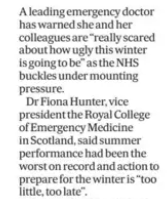
July 2026 saw 43 770 waiting over 4 hours while July 2025 had only 38 921.
However, the number attending in July 2026 was124 958 while in July 2025 it was only 119 116.
Also Summer 2026 featured multiple heatwaves, with inevitably increased outdoor activities in rivers and lochs and increased outdoor alcohol consumption (statistics not in yet).
Common assault which includes alcohol/heatwave-fuelled fights, went up by around 4 000 in just the period up to end June 2026. 6
Sources:
- https://www.publichealthscotland.scot/healthcare-system/urgent-and-unscheduled-care/accident-and-emergency/interactive-charts/how-long-people-spend-in-ae/
- Waiting times in emergency departments: exploring the factors associated with longer patient waits for emergency care in England using routinely collected daily datahttps://emj.bmj.com/content/37/12/781
- Mathematical Modeling of the Impact of Hospital Occupancy: When Do Dwindling Hospital Beds Cause ED Gridlock?https://doi.org/10.1155/2014/904807
- Impact of patient isolation on emergency department length of stay: a retrospective cohort study using the Registry for Emergency Carehttps://pmc.ncbi.nlm.nih.gov/articles/PMC7461400
- Role of hospital strain in determining outcomes for people hospitalised with COVID-19 in Englandhttps://doi.org/10.1136/emermed-2023-213329
- https://www.gov.scot/publications/recorded-crime-scotland-year-ending-june-2026/pages/main-findings/
Crowdfunder - https://www.crowdfunder.co.uk/p/help-talking-up-scotland-keep-going
Bank transfer - JOHN WATSON ROBERTSON Sort Code – 08-91-04 Account 12266421
Discover more from Talking-up Scotland
Subscribe to get the latest posts sent to your email.


NHS A&E Consultants work only in the NHS. For all of us. No ‘private practice’ for them! (If anyone can find an exception please let me know). Long hours. Especially the Consultants. “This is the way”. The immense skill, developed over many years of training, sometimes exercised in split second decisions. Training the next generation to be the same or better. And they elect from among their own those who will further the cause publicly and politically. Unpaid. In their own time. The best of the best.
Leaders of the RCEM In Scotland: Dr Fiona Hunter and Dr Jayne McLaren. 7% corridor care in Scottish A&Es is not acceptable for them. It must be zero. And then? Betcha they campaign even harder to reduce the accidents in the first place.
The issue appears to be that this website compares Scotland to England and rightly criticises the bias and lies of mainstream media. However the Doctors speak in absolute terms and wish only to be the very best…for all of us. A&E medicine is not profitable and should be the starting point to clean up the NHS in Scotland and get rid of appalling ‘private practice’ largely subsidised by the state in taxation and moonlighting terms
LikeLike