

Crowdfunder - https://www.crowdfunder.co.uk/p/help-talking-up-scotland-keep-going
Bank transfer - JOHN WATSON ROBERTSON Sort Code – 08-91-04 Account 12266421
The Herald, you have to feel for the wee souls, dragging up another scare story from the sump of their files.
The Guardian in January 2026 had:
Helen Lambert borrowed £57,000 to go to university and began repaying her student loan in 2021 after starting work as an NHS nurse. Since then she has repaid more than £5,000, typically having about £145 a month taken from her pay packet. But everything she hands over is dwarfed by the £400-plus of interest that is added to her debt every month, thanks to rates that have been as high as 8%.
Her total outstanding debt had ballooned to more than £77,000 by the end of November, and it is set to get a lot bigger as there are another 25 years left of the 30-year repayment period. Lambert does not think her studies should have been free, but she says: “It is so disheartening to have this level of debt hanging over you with no achievable way to clear it or even reduce it while they add on upwards of £400 a month in interest.” https://www.theguardian.com/money/2026/jan/23/student-loans-graduates-plan-2-interest-rates
Nurse training IS free AND attracts a bursary in Scotland so how is that affecting levels?
The Scotsman in February 2025 was front-paging Alarm over fresh drop in applicants for nurses course based on a 2% reduction in applications, from 4 650 to 4 560, six months before ‘clearing’ processes in the week and months before courses start, can fill the missing places.
The ‘alarm’ is from a union rep and, evidence-free, the fall in applications is explained by poor working conditions, which in turn, is based upon a small sample, self-selecting (squeaky wheel) survey.
Not mentioned, of course, is how this level of nurse training compares with other parts of the UK.
So, if Scotland is training 4 560 how many might NHS England be expected to be training? At ten times the population, around 45 000?
It’s 26 3301, not much over half the number you might expect they’d need.
Why is this?
From the British journal of Nursing in April 2024:
This UCAS data are more than just numbers; they reflect the changing dynamics in healthcare education and broader societal trends. The decrease in applications and acceptances could be attributed to various factors, including the intense pressures that health professionals have faced during the pandemic, which might deter potential applicants. The psychological and physical toll of the pandemic on healthcare workers has been widely publicised, possibly influencing the decision-making of those considering the profession.2
What is the Scottish Government doing to encourage applications?
Only in Scotland:
The Scottish Government will pay your tuition fees. Graduates may need to check if the government will pay their fees. The bursary is £10,000, which isn’t means-tested. Funding covers the whole year (52 weeks). If you’re studying an honours degree, you’ll get 75% of the bursary in your fourth year. The bursary includes £5 for daily travel but you can claim for placement expenses above this. You’re expected to use the cheapest public transport. (In Scotland, bus travel is free for Scottish residents under 22 years old). If costs are more than £30 per day, you should stay in local accommodation if possible. In your first year, there’s also a £60 initial expenses allowance.
Additional allowances include: Dependents Allowances – if you have a partner or spouse with a low income; Single Parents’ Allowance; Childcare Allowance – for registered childcare costs; Disabled Students’ Allowance. A discretionary fund is available for students in severe financial hardship.3
Sources:
- https://www.britishjournalofnursing.com/content/regulars/trends-in-nursing-applications#:~:text=Some%2026%20330%20applicants%20were%20accepted%20onto%20undergraduate,landscape%20and%20perhaps%20a%20higher%20calibre%20of%20applicants.
- https://www.britishjournalofnursing.com/content/regulars/trends-in-nursing-applications#:~:text=Some%2026%20330%20applicants%20were%20accepted%20onto%20undergraduate,landscape%20and%20perhaps%20a%20higher%20calibre%20of%20applicants.
- https://www.thecompleteuniversityguide.co.uk/student-advice/finance/nhs-bursary#ParamedicNursingandMidwiferyStudentBursaryinScotland
Doctor training?
The 2025/2026 intake (not just quota)
England – 8 775
Scotland 1 575
Per head of population, England has 10.6 times the population, so you think Scotland might only manage just over a tenth, 900 or so, but we recruited 1 575, 75% more!
How is the level of training in Scotland then helping with the overall position in Scotland’s hospitals?
With 50% more registered nurses, no Scottish health board has scarily high mortality rates due to use of unqualified staff increasingly common in NHS England
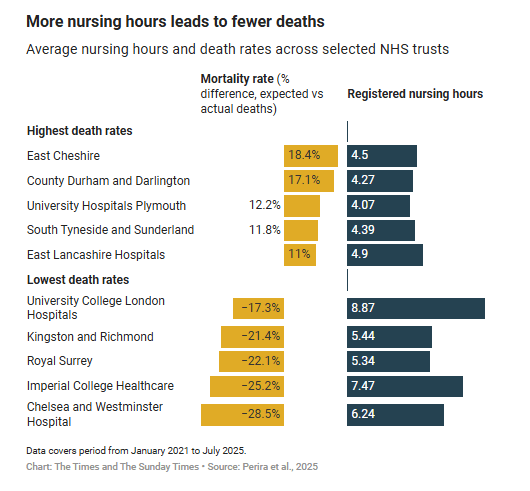
From the Times, three days ago, the above graph reveals that those health trusts in England which are increasingly using less qualified staff rather than fully registered nurses to care for patients, have been responsible for higher death rates than they should have, in clear contrast to those trusts which have not done so.
Hospitals which have cut registered nurses or replaced them with lower-paid staff have seen a surge in death rates, a major study has revealed. The research, which analysed staffing at 122 NHS trusts over four years, revealed dangerous variations.
Nicola Ranger, chief executive of the Royal College of Nursing, said it proved degree-educated registered nurses were essential to patients’ safety and she called for NHS England to investigate trusts where deaths had risen. She demanded the government boost nurses’ pay and career progression, warning “the clock is ticking” for ministers to act.
The study showed a trend where hospitals that cut nursing care since 2020 experienced an increase in deaths. Other trusts which invested in nurses saw death rates fall. Where hospitals tried to plug nursing gaps with lower-paid staff they still saw higher deaths.
Directly comparable data with Scotland is not available, as far as I can see but these are and they matter in the same way:
NHS England has 8.2 nurses per 1 000 population but Scotland has 12.3, a shocking 50% more.1
Consequences? Returning to the table at the top and comparing with NHS Scotland data, no large Scottish board (excluding tiny statistically outlying areas like the Western and Northern Isles), only NHS Lanarkshire at 8% and Lothian at 4%, had more deaths than predicted. All of the others had fewer.2
Sources:
- https://www.ons.gov.uk/peoplepopulationandcommunity/healthandsocialcare/healthcaresystem/articles/thehealthcareworkforceacrosstheuk/2024
- https://www.publichealthscotland.scot/publications/hospital-standardised-mortality-ratios/hospital-standardised-mortality-ratios-july-2024-to-june-2025/
Is there a retirement crisis in NHS England then? No media coverage.
Discover more from Talking-up Scotland
Subscribe to get the latest posts sent to your email.


I have unsubscribed but continue follow you on X, I’d like too take this opportunity to thank for the work you put it, its appreciated.
Colin
>
LikeLike
Also in respect to the Scottish NHS:
In an exclusive interview with the Daily Record, published on 20 June 2023, Dr Andreangeli, Senior Lecturer in European Law at the Law School, “shared the impact that leaving the European Union is having on the Scottish National Health Service”.
“Dr Andreangeli contributed to the Nuffield Report in 2020 which examined the lack of awareness about the potential impact of Brexit on health care policy and on the functioning of the NHS across the whole of the United Kingdom”
“One of the repercussions of Brexit include patients being denied access to treatments that are unavailable in the UK but available in the EU, including those who have been on waiting lists for year”.
“No longer being part of the EU also restricts the free movement of goods, including medication and it is also expected that the approval process for new drugs will be slower in the UK than the rest of Europe. The UK is now responsible for creating its own import deals with other countries which may result in it taking longer for new drugs to be available in the UK”.
“The NHS in Scotland and also across the other UK nations is currently facing staffing pressures as the service struggles to attract staff and experts from abroad. With new rules around visas and a complicated process around being granted settled status, it has resulted in many international workers heading home or moving elsewhere”.
“Dr Andreangeli told the Daily Record: “Even though there are exceptions to the rules in relation to visas and immigration for highly skilled individuals the process is far more cumbersome. I am not surprised that providers are already seeing significant problems in recruiting medical professionals.”
So even although the Daily Record did an interview with this person in 2023 to establish the negative impact Brexit had on our Scottish NHS, then still in 2026, they continue to headline negative articles about the Scottish NHS that mentioned “Chronic staff shortages” and “record high waiting times”.
In fact in 2024 they , the Daily Record, attributed blame to the SNP in headlining that the “failing SNP have to quickly sort out NHS crisis” this was based on a report by Audit Scotland on the supposed “state of our (Scottish) health service”.
Funny how some actual impartial experts mention the factors that contribute to negatives within our Scottish NHS through no fault of the SNP as the Scottish government, like say the Tory Brexit, and then also the Labour UK Brexit, yet other so called ‘experts’ who are not as impartial (i.e. they are infamous for being biased and partisan), choose to completely ignore these same factors (Brexit) and instead they just declare #SNPBAD every single time.
As do the UK politicians declare it to be #SNPBAD as well, as in those who are also opponents of the SNP, hence why they deliberately neglect to mention Brexit as being a significant negative factor in how it, as a UK government policy, has impacted our Scottish NHS in such a detrimental way.
Though who needs the facts and the truth when you can use propaganda instead (most of which, as propaganda, is promoted by the various client media that exists within the UK State , whose main task, as a UK media, seems to be one where they will only always seek to serve the various different pro UK political parties that they support).
Liz S
LikeLiked by 1 person