

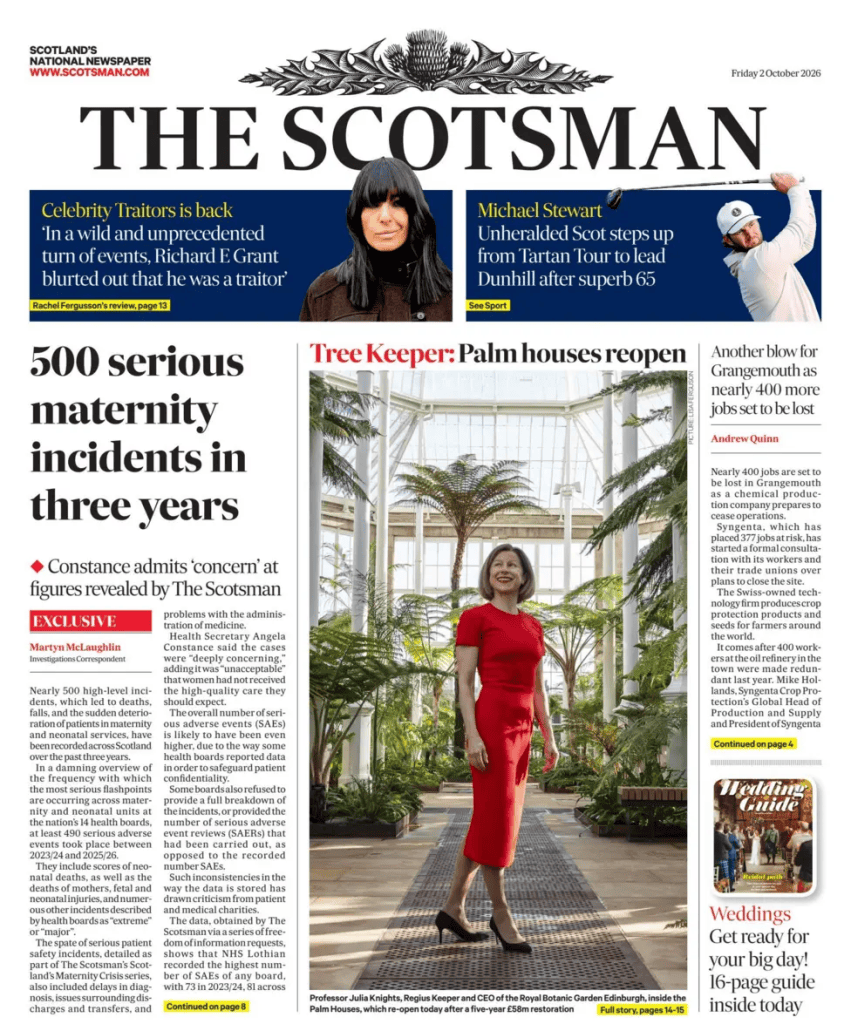
The Scotsman is desperately trying to build a reputation on death and despair in maternity wards. So far, it’s shoddy, fail, do not resubmit, leave the course.
In classic churnalist mode, they’ve just added up incidents treating unlike things as if they were the same type of incident because the boards themselves do not use one shared set of terms, to get a big number for the headline. A serious (or significant) adverse event is the incident itself: something that could have caused, or did cause, harm. A serious/significant adverse event review (SAER) is the investigation commissioned afterwards. The article’s headline total of “nearly 500 serious adverse events” includes both so is often double-counting incidents. Some boards gave event counts; others gave the number of reviews completed. NHS Grampian, for example, only disclosed themes and said at least 37 SAE reviews were completed. Those are not interchangeable, so the combined figure is not a clean count of incidents.
Notably, as often before, we don’t get to see what the trend is. Commonly, such media reports conceal the trend and focus on the scary total, because the trend was a major disappointment to them and would have been encouraging for us – down.
There is, however, a more credible and reliable metric – the cost of settling negligence lawsuits.
From our 4 July 2026 report:
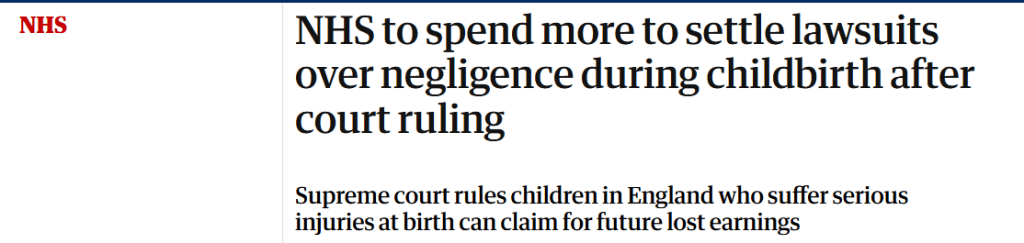
In the Guardian 19 February 2026, the above and:
The NHS will have to spend more money settling lawsuits involving negligence during childbirth after a supreme court ruling that lawyers said puts right a “historic injustice”. The court ruled on Wednesday that children in England who suffer catastrophic injuries while they are being born can claim damages for future earnings they would otherwise have had.
The ruling on “lost years damages” means that children whose life expectancy is shortened can recover compensation for being unable to work. It comes amid mounting concern at the rising cost of medical negligence to the NHS in England – its liabilities have hit £60bn – much of which is due to errors made during childbirth. https://www.theguardian.com/society/2026/feb/18/nhs-spend-more-settle-lawsuits-negligence-childbirth-supreme-court
From 2015/16 to 2024/2025, NHS England paid out out £5.97bn for maternity negligence.4
With a tenth of the population but the same troubles in maternity services, Scotland would have paid out £597m.
For the, I appreciate slightly different ten year period, 2013/14 to 2022/23 (the only comparable study I can find), it was £177.89m5, less than one third.
Using two slightly varying (2 years-off) sets of data would be problematic if the difference was small but at more than 3 times higher we can be confident that the contrast is reliable.
Sources:
- https://www.healthcareimprovementscotland.scot/publications/media-release-inspection-report-royal-infirmary-of-edinburgh-nhs-lothian/
- https://x.com/i/grok?conversation=1983476698260623709
- https://www.cwj.co.uk/site/newsandevents/legalnews/costs_of_NHS_maternity_care_claims_revealed.html
- https://www.medrxiv.org/content/10.64898/2026.05.01.26352218v1.full.pdf
- https://www.nss.nhs.scot/media/4788/cnoris-annual-report-2022-2023.pdf
How bad are things in NHS England’s maternity units for such a difference in pay-outs to settle negligence.
Surely it cannot be any worse than the problems Anas Sarwar has found at the QEUH?
Just last week, on BBC Breakfast, we hear of a joint BBC News/New Statesman, external investigation into maternity care at University Hospitals Sussex NHS Foundation Trust (UH Sussex) which has found:
- At least 55 babies who died may have survived with better care between 2019 and 2023
- A review of nine stillbirths in 2021 and 2022 found missed opportunities in all cases
- External investigators warned that a “normal birth” culture (one that seeks to promote vaginal delivery with minimal medical intervention) was causing concern
- Payments for maternity errors at the trust were the highest in England last year
No government nor former government minister is associated, in the BBC Health report, with these horrific figures. https://www.bbc.co.uk/news/articles/ckg2n644l44o
Crowdfunder - https://www.crowdfunder.co.uk/p/help-talking-up-scotland-keep-going
Bank transfer - JOHN WATSON ROBERTSON Sort Code – 08-91-04 Account 12266421
Discover more from Talking-up Scotland
Subscribe to get the latest posts sent to your email.


Yes, it is a misuse of the term ‘serious’. As you indicate, in the data tables there is not a lot of nuance in the term. Most of the things which are recorded can, potentially, have ramifications, but are almost always resolved on the spot.
When my daughter was being born, there was the usual range of equipment monitoring the baby’s heart rate. As my wife strained in labour, she accidentally dislodged a plug from the monitoring equipment, which resulted in an alarm sounding. The only person who actually saw the plug falling out was I. When the alarm sounded, the staff went into well practised routines until I caught their attention and pointed to the plug. So, after about 15 seconds the ‘serious’ incident was resolved.
The midwife said, that because the heart rate had immediately flat lined they knew it was an equipment issue not a baby one.
LikeLike