

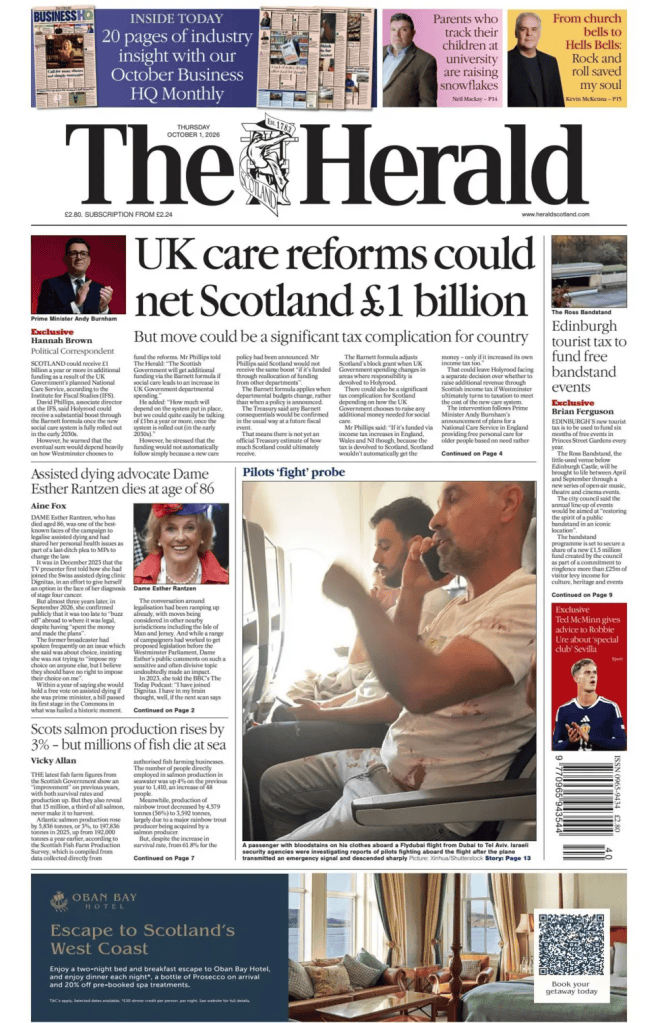
Here’s the Herald just passively accepting another wee London-based thinktank commentator’s claim that the Barnett formula will compensate us for loss of the triple lock pension to sort England’s care service and to generate another Andy-friendly headline.
First, says who?
David Phillips, a ‘leading’ economist with the IFS.
To get a job as a university lecturer in Economics, you’d need a PhD and one or two research-based papers in reasonable impact peer-reviewed journals. To get to Senior Lecturer, you’d need at least 10 and have supervised PhD students to completion. To get to Professor and be described as a ‘top economist‘, you’d need 30 or more and they’d have to be, most of them, sole-authored in ‘high impact’ journals.
What is a high impact factor?
I had to push AI to get details for David above but could only find one sole-authored paper:
His contribution to “The distribution of public service spending” (as part of the IFS Deaton Review on inequality), published in Oxford Open Economics, 2024, Volume 3(Supplement_1), pp. i1209–i1261. (This is an open-access, peer-reviewed economics journal/supplement.)
The impact factor for the above is ‘not available’ ie too low to mention and easy to get into: https://research.com/journal/oxford-open-economics
and three co-authored and not that recent:
“35 years of reforms: A panel analysis of the incidence of, and employee and employer responses to, social security contributions in the UK” (co-authored with Stuart Adam and Barra Roantree), Journal of Public Economics, 2019, Volume 171, pp. 29–50. (This is a top-tier field journal in public economics.)
Impact factor – 2.2 – very low compared with going rate of 10 for high impact.
“Frictions and taxpayer responses: evidence from bunching at personal tax thresholds” (co-authored with Stuart Adam, James Browne, and Barra Roantree), International Tax and Public Finance, 2021, Volume 28(3), pp. 612–653. (Published version of earlier IFS working paper.)
Impact factor – 1.79!
“The redistributive power of cash transfers vs VAT exemptions: A multi-country study” (co-authored with Ross Warwick, Tom Harris, Maya Goldman, Jon Jellema, Gabriela Inchauste, and Karolina Goraus-Tańska), World Development, 2022, Volume 151, 105742.
Impact factor 6.9 – better but 7 authors!
On that basis, he might get a lectureship but is so far away from being a ‘top economist.’
To sum up:
His IFS profile lists dozens of outputs (reports, explainers, comments, presentations, etc.), many from 2025–2026 on topics like Scottish/Welsh budgets, council tax reform, local government funding, and devolved fiscal frameworks—but none are flagged as peer-reviewed journals. No full CV or dedicated Google Scholar profile for this specific David Phillips (distinct from others, e.g., at University of Notre Dame)
Grok, is he a ‘top economist’ in the sense that university professors of economics might be?
Seconds later:
No, David Phillips (Associate Director at the Institute for Fiscal Studies, specializing in devolved/local government finance and tax policy in developing countries) is not typically considered a “top economist” in the same sense as many university professors of economics.
Top university economists (e.g., those at leading institutions like LSE, Oxford, UCL, Harvard, or Chicago) are usually evaluated on criteria such as:
- A substantial portfolio of publications in the very highest-impact peer-reviewed journals (e.g., American Economic Review, Quarterly Journal of Economics, Journal of Political Economy, Econometrica.
- High citation counts (often thousands, with h-index in the 20s–50+ for established professors).
- Leadership in academic research (e.g., grants from major funders like NSF/ESRC, editorial roles, awards like the John Bates Clark Medal or fellowships in elite societies like the Econometric Society or British Academy).
- Teaching/supervision of PhD students and building academic careers.
It’s not quite as bad as saying Dr Iain Kennedy, Highland GP PT is a ‘top doctor!’
Second, is it certain that the Barnett formula would be applied to increase the Scottish block grant given that the UK government can based on other factors of its own choosing simply reduce it?
That outcome depends on Treasury classification and political choice. The UK government could, in principle, classify the spending differently, fund it in a way that does not trigger consequentials, or make an offsetting cut elsewhere.
So, they can present an addition to the block grant as a Barnett consequential to directly compensate Scotland but they could then ‘make an offsetting cut elsewhere.’
Has it done this before?
Yes — not usually as a labelled “clawback of this specific consequential”, but the Treasury has repeatedly used tools that have the same effect: extra money in one comparable English programme is cancelled out by less money in another, or the extra money is simply kept outside Barnett.
Examples:
1. Netting at departmental / spending-review level
Barnett is applied to the net change in a UK department’s budget, not to each announcement in isolation. Extra English social-care spending can be offset by a cut (or smaller increase) elsewhere in the same department or across comparable services. Scotland then only sees the net figure. That is normal Treasury practice, not a rare trick. https://www.gov.scot/publications/foi-202400404500/
2. Formula bypass (money given without consequentials)
The classic case is the extra £1bn for Northern Ireland after the 2017 Conservative–DUP confidence-and-supply deal. Scotland and Wales got nothing. City deals, some levelling-up pots and other one-off packages have also been allocated outside Barnett. https://www.instituteforgovernment.org.uk/article/explainer/barnett-formula
3. Classification
Treasury decides whether a line is “comparable” (triggers Barnett) or reserved / UK-wide (does not). Disputes have happened — for example over 2012 Olympics regeneration spending. If new care spending were classified as something other than straightforward England-only social care, consequentials could shrink or vanish. https://www.instituteforgovernment.org.uk/article/explainer/barnett-formula
4. Offsetting through the fiscal framework
If the extra English care spending were funded by a reserved tax rise that does apply in Scotland, or by changes that enlarge Scotland’s block-grant deduction (the BGA for devolved taxes), the net Scottish gain can be smaller than the raw Barnett figure. That is a different mechanism, but it can cancel part of the uplift. https://fraserofallander.org/funding-a-rise-in-social-care-spending-england-implications-for-the-scottish-budget/
So, the UK government has previously arranged funding so that extra English spending did not produce a matching, lasting rise in the Scottish block grant. It could do so again. It is not the default for a large, obvious England-only care programme, but it is within the Treasury’s existing toolkit.
Crowdfunder - https://www.crowdfunder.co.uk/p/help-talking-up-scotland-keep-going
Bank transfer - JOHN WATSON ROBERTSON Sort Code – 08-91-04 Account 12266421
Discover more from Talking-up Scotland
Subscribe to get the latest posts sent to your email.


Aye, that’s that Trusted Journalism from the Herald in action again. 🙂
Hand’s up anyone who believes them, anyone, even a bit?
Stephen McKenzie
LikeLiked by 2 people
o/t From Energy Voice today on rising cost of the UK’s management of legacy nuclear waste:
‘Sellafield has awarded a £3.6 billion contract to improve spent fuel handling and decommissioning activities.’
So to improve on the outcomes from what has already been spent and from what is currently being spent and from what was already committed in terms of future spend? So this is extra?
‘The framework will run for an initial 9 years with an option for a further 6 years, through to 2041.’
Nice work for one German-based construction and infrastructure manager Hochtief which was awarded one of two lots associated with the award. The other went to a joint venture involving US headquartered Amentum and a UK partner.
LikeLiked by 2 people
O/T
BBC Website
“Hundreds of jobs under threat at Grangemouth chemical plant”
“Hundreds of jobs are under threat in Grangemouth after an agricultural chemical firm (Syngenta) announced plans to cease operations at the site”
“A total of 377 workers are set to be affected by the move. It comes over a year after Syngenta was awarded £2.2m from Scottish Enterprise to expand production at the site”
Scottish government Minister Stephen Flynn said:
“The Scottish government had “strongly opposed” Syngenta’s plans”
“He said he would continue to press the UK government on the £200m funding pot ” (The UK government, under then-Prime Minister Sir Keir Starmer had pledged an additional £200 million in funding for Grangemouth from the ‘National’ wealth Fund – ‘National’ ?).
Syngenta also have other UK plants, so currently are they also at risk just now or is just Grangemouth that is considered to be the one that they , the company, says “remains significantly more expensive to operate than other production sites”.
TBF Syngenta was reported as having “cut its UK-based wheat breeding activities after 35 years, focusing activity on the continent. In 2025 Syngenta shut down it’s seeds research and development site in Whittlesford, Cambridgeshire to then relocate it into mainland Europe” (However While the Whittlesford R&D facility closed, Syngenta relocated its core UK commercial operations to Granta Park also in Cambridge).
In March 2026 Syngenta’s Huddersfield plant announced “it would cease global production of the controversial herbicide paraquat by June 2026. This decision resulted in the shutdown of its specialized paraquat manufacturing unit and a small-scale multi-product production unit at the Huddersfield site , however, the broader Huddersfield facility remains open to focus on alternative technologies“.
(So is there no “alternative technologies” that could be “focused on” at the Grangemouth site ?)
So the one thing that the BBC article failed to note in their article on the Grangemouth plant potential closure was this:
“Regulatory and Post-Brexit Expenses: UK agricultural and plant-breeding divisions have separately faced steep cost increases, business uncertainty, and extensive logistical delays when registering new crop varieties since leaving the European Union”
Now Brexit is down to a former Tory UK government instigating Brexit and then a subsequent UK government , Labour, endorsing it and so then supposedly “respecting the voting decision that was (wrongly and badly) made in 2016”.
So yet another blow for Grangemouth and also for Scotland, as in yet more Scottish jobs to be lost in what is supposed to be a UK State, or as Andy B states “the Union” , that was meant to provide “broad shoulders” for Scotland to supposedly benefit from being part of a larger economy that shares financial risks and “pools resources” .
When exactly ? (as so far all that Scotland can see is UK governments saving English based industries while abandoning and betraying the Scottish ones).
Liz S
LikeLiked by 1 person
Westminster funds decommissioning nuclear £13Billion a year.
Scotland in surplus in fuel and energy pays more. The energy companies would charge Scotland less. Westminster will not let them.
Westminster borrows and spends £100Miliion in the rest of the UK. Scotland has to make loan repayments. 4Billion a year. Trident dumped in Scotland. Kennedy and McMillian. Without permission.
Brexit costs Scotland £Billions. Scotland did not vote for it.
LikeLike