


With only 3 days left, support Talking-up Scotland's work to counter the lies and get you the facts, daily, at:

Crowdfunder at: https://www.crowdfunder.co.uk/p/help-talking-up-scotland-keep-going

Or by direct bank transfer to: JOHN WATSON ROBERTSON Sort Code – 08-91-04 Account – 12266421
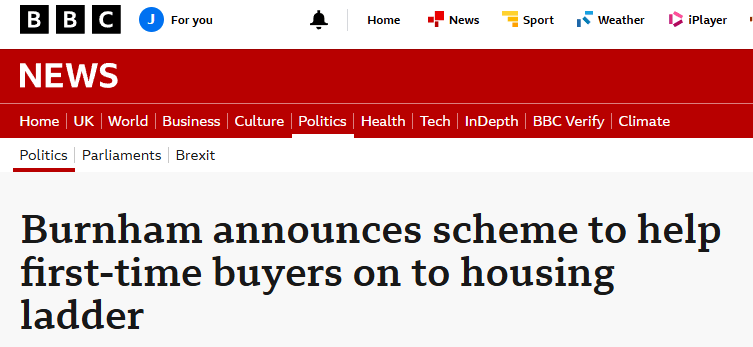
From BBC Politics today, the above and:
Prime Minister Andy Burnham is to introduce a new scheme to try to help people “who have given up hope of ever having a home to call their own” get on the property ladder.
The “Your First Home” scheme would be open to first-time buyers in England with a deposit of 2.5%. It would provide them with a loan worth 20% of their new build property’s value to help pay for the purchase.
and, of course:
Funding for the scheme is expected to come from reprioritising existing budgets, but housing developers will pay towards the running costs.
Source: https://www.bbc.co.uk/news/articles/cv8e33gdw17no
There are earlier Scottish Government schemes but based on a more modest and affordable flat-rate £10 000 contribution compared with the UK Government’s proposed 20% government equity loan.
What are the latter two points likely to mean?
Damage to social and affordable housebuilding, already far weaker in England than in Scotland because they often compete for the same housing budget, and that budget is already tight.
Your First Home is to be paid for by “reprioritising existing budgets.” Officials have not said whether that money comes from the housebuilding pot or from cuts elsewhere. If it comes from MHCLG / Homes England programmes, social and affordable grant is the obvious place it can come from. https://www.theguardian.com/politics/2026/sep/26/andy-burnham-announces-new-scheme-for-first-time-home-buyers-england
That programme is already under strain:
- The flagship Social and Affordable Homes Programme (SAHP) is £39bn over 10 years, aiming for about 300,000 homes, with at least 60% social rent. https://www.gov.uk/government/publications/the-social-and-affordable-homes-programme-and-the-reinvigoration-of-council-housebuilding/the-social-and-affordable-homes-programme-and-the-reinvigoration-of-council-housebuilding
- Housing associations have already been told to cut early-year bids. The National Housing Federation warned that could mean 17,000 fewer starts in the next three years; many providers are delaying or scaling back. https://www.ft.com/content/cb785f07-45e8-4467-a213-927c4521e0ce?syn-25a6b1a6=1
- Burnham has already softened his earlier line that the whole £39bn should go to council / social-rent homes. The first £10bn wave kept the 60% social-rent split and left more money for later council allocations. https://www.theguardian.com/society/2026/aug/24/andy-burnham-social-homes-backtrack
Social-rent homes need more grant per home than shared ownership or affordable rent. Any raid on that envelope either cuts the number of social homes or pushes the mix toward cheaper-to-subsidise tenures.
Social housing delivery is already being slowed by how the £39bn is being drip-fed. A new equity-loan scheme paid from “existing budgets,” with no published size, can easily become another claim on that same money. The October Budget will show whether social-rent grant is protected or is the thing being “reprioritised.”
With only 3 days left, support Talking-up Scotland's work to counter the lies and get you the facts, daily, at:

Crowdfunder at: https://www.crowdfunder.co.uk/p/help-talking-up-scotland-keep-going

Or by direct bank transfer to: JOHN WATSON ROBERTSON Sort Code – 08-91-04 Account – 12266421
Are there precedents for such effect on existing socially important budgets?
Yes. England has done this several times: a new demand-side or home-ownership scheme is paid for, or politically prioritised, while grant for social rent is cut, diluted, or replaced by a cheaper “affordable” product.
- 2010–15: grant for social homes collapsed as Help to Buy was built up – After 2010 the coalition slashed capital grant for affordable housing. One CIH-based figure often cited is investment falling from about £4.2bn in 2009/10 to £483m in 2016/17. The 2011–15 Affordable Homes Programme cut grant per home to about a third of the previous rate and pushed landlords onto Affordable Rent (up to 80% of market) plus more borrowing. Social-rent building fell sharply. From 2013, Help to Buy equity loans became the big new housing spend. Those two moves happened in the same fiscal squeeze: less grant to build cheap rented homes, more capital for private new-build sales. https://www.mirror.co.uk/news/politics/first-time-buyers-left-high-13050005
- Treasury steered the 2016 Affordable Homes Programme toward ownership – The NAO later found that at the 2015 Spending Review the department was made to nearly double the home-ownership target versus its original plan. The 2016 programme was publicly committed to 153,000 homes, 145,000 for ownership, on £4.7bn. Homes England at first could only allocate for far fewer ownership homes. That is a documented case of an existing socially important budget being rewritten to favour first-time-buyer products. https://www.nao.org.uk/wp-content/uploads/2022/09/The-Affordable-Homes-Programme-since-2015.pdf
- Right to Buy: stock sold faster than it was replaced – Since 1980 more than two million social homes have been sold. Replacement has never kept up. In 2024/25 there were 9,236 sales but only 3,593 starts or acquisitions counted as replacements. Labour now calls the failure to replace sold homes a cause of today’s shortage. That is the longest-running example of a home-ownership policy eating the social-rent stock. https://commonslibrary.parliament.uk/research-briefings/cbp-12193/
- The argument was made in public about Help to Buy itself – A 2022 House of Lords committee said Help to Buy inflated prices by more than the subsidy and that the money “would be better spent on increasing housing supply” and replenishing social housing. Independent work (LSE and others) found little extra building in tight markets and higher new-build prices. The official 2026 evaluation is more positive on supply and net value for money, but still finds weak help in already expensive areas. The political choice — loans for buyers versus grant for social rent — was explicit. https://www.theguardian.com/society/ng-interactive/2024/jun/21/help-to-buy-how-a-disastrous-tory-policy-blew-up-the-housing-market
- The wider 40-year shift – From the 1980s the state moved subsidy from building social homes to housing benefit paid to private landlords. Social-rent stock fell by about 1.4 million from 1979 to the early 2020s. Housing benefit became one of the largest “housing” budgets. That is the same pattern at national scale: demand-side support grows; the capital budget for social building shrinks. https://www.lloydsbankinggroup.com/assets/pdfs/who-we-are/public-affairs-policy/2023-24/social-housing-investment-white-paper-digital.pdf
The above show a repeated UK [English] habit. When money is tight, home-ownership schemes get protected or expanded and social-rent grant is the item that is cut, delayed, or redefined as “affordable rent / shared ownership.”That is the relevant precedent for a scheme funded by “reprioritising existing budgets” while social-housing starts are already being scaled back in the early years of SAHP.
With only 3 days left, support Talking-up Scotland's work to counter the lies and get you the facts, daily, at:

Crowdfunder at: https://www.crowdfunder.co.uk/p/help-talking-up-scotland-keep-going

Or by direct bank transfer to: JOHN WATSON ROBERTSON Sort Code – 08-91-04 Account – 12266421
Discover more from Talking-up Scotland
Subscribe to get the latest posts sent to your email.


I await a comment on this housing problem from Reform’s Scottish leader , Malcolm ‘Six Houses ‘ Offord .
LikeLiked by 2 people
Burnham is subsidising developers again, as the Tories did before. The price of houses will rise to swallow up the grant. I think Persimmon shares have already jumped higher on the news.
LikeLiked by 1 person