

Help Talking-up Scotland keep going

Crowdfunder at: https://www.crowdfunder.co.uk/p/help-talking-up-scotland-keep-going

Or by direct bank transfer to: JOHN WATSON ROBERTSON Sort Code – 08-91-04 Account – 12266421
In the Sun last night, the above, and:
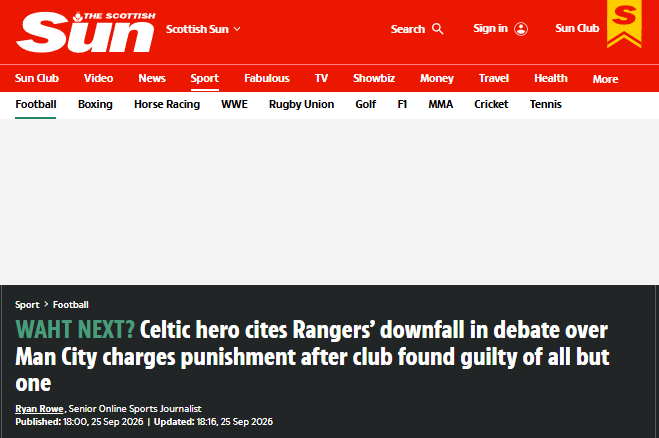
RANGERS’ demotion to the bottom tier could be a precedent for the punishment dished out to Manchester City, a Celtic icon has said. The Premier League giants have been found guilty on all but one of the 115 charges relating to breaches of financial rules. A Celtic hero now wonders if City will be met with a similar fate and kicked out of the EPL and forced into League Two, at the bottom rung of the EFL. He reckons a precedent was set when Rangers were sent tumbling down the leagues as punishment for their financial mismanagement.
Speaking to BOYLE Sports, who offer the latest football odds, Lambert said: “It’s really difficult as to what the ban is going to be set at, I think.
“The authorities must work out whether it is going to be a massive financial hit, or deduction with points or relegation to the bottom league, as with what happened to Rangers.
“But whatever happens, I think it’s going to snowball to a lot of clubs.” https://www.thescottishsun.co.uk/sport/16864655/celtic-hero-cites-rangers-downfall-man-city-charges-punishment/
Prof Naemeritus, John Robertson, Falkirk fan since his dad first took him to Brockville in around 1960, to see the great John White, after ‘falling away’ from ‘The Rangers’, in the days and weeks after starting work in a non-closed shop, US-owned plastics company (BXL) and discovering Catholics were human too, has wondered, in the longest of sentences as he is known for, if the current Man City scandal with its hidden payments is like the one where The Rangers were demoted to the lower leagues after fiddling the tax.
Knowing little of such matters, Robertson just asked SuperGrok AI:
Are there similarities in the cases of Manchester City’s current accusations of hidden payments and other offences against FA rules and the earlier case of Glasgow Rangers FC which was demoted to a lower league after tax offences?
Yes, there are notable similarities, though the cases differ in legal basis, scale, and how sanctions arose.Core similaritiesBoth involve undeclared or off-the-books payments to players and managers that were not fully reflected in official contracts or accounts submitted to football authorities.
- Rangers (c. 2001–2010): The club used Employee Benefit Trusts (EBTs). Money was paid into trusts and then issued as “loans” to players and staff (around £47 million in total). These were not treated as taxable salary. Official contracts registered with the Scottish FA omitted the extra payments; side letters guaranteed them. This breached SFA player-registration rules requiring all remuneration to be declared. https://www.taxjustice.net/wp-content/uploads/2015/10/Web-edition-Doing-SFA-for-Fair-Play-Main-report-updated.pdf
- Manchester City (alleged 2009–2018): Charges include failure to provide accurate details of player and manager payments (14 charges). Specific allegations cover extra payments to Roberto Mancini (via a consultancy with related-party club Al Jazira) and image-rights or other payments to players such as Yaya Touré that were not fully recorded in Premier League contracts. This is presented as hiding outgoings so they would not count against Financial Fair Play / Profitability and Sustainability Rules limits. https://www.nytimes.com/athletic/5762324/2024/09/16/manchester-city-charges-explained/
In both cases the extra money was routed through structures connected to the owners (Murray Group for Rangers; Abu Dhabi United Group and related UAE entities for City). Both clubs are accused of failing to give authorities a true picture of their finances. The practical effect alleged in each instance is a competitive advantage: more money available for wages without the full cost appearing in the official accounts or tax filings.
Key differences
- Nature of the offence: Rangers’ central problem was tax (HMRC viewed the EBT loans as disguised remuneration). The football-rule breach was secondary. City’s case is framed entirely around Premier League and UEFA financial-regulation rules (inflating sponsorship revenue from owner-linked companies and under-reporting costs). Tax authorities are not the primary complainant. https://www.ogier.com/news-and-insights/insights/glasgow-rangers-the-big-tax-case/
- How the club was punished: Rangers entered administration in 2012 over unpaid PAYE/VAT, then liquidation. The new company was refused a place in the top flight and started in the fourth tier. That outcome flowed from insolvency rules and league membership decisions, not a direct sporting sanction for the EBT scheme itself. A later SFA commission found registration-rule breaches but did not strip titles. City remains a going concern; any sanction (points deduction, fine, possible expulsion or title implications) would be a direct disciplinary outcome. Recent reports indicate an independent panel has found the club guilty of nearly all of the 115 charges, with sanctions still to be determined and an appeal expected. https://www.bbc.com/sport/football/articles/cw7v44ezry5go
- Timing and regulatory environment: Rangers’ scheme predates UEFA Financial Fair Play. City’s alleged conduct occurred after FFP and Premier League PSR were introduced, so the rules being tested are different.
In short, both stories feature hidden extra payments to playing and coaching staff, incomplete disclosure to the relevant football body, and owner-linked structures. Rangers’ case was driven by tax law and ended in corporate collapse and a forced restart in a lower division. City’s is a football-governance case about financial-reporting and spending-limit rules, with the sporting and financial consequences still unfolding.
Help Talking-up Scotland keep going

Crowdfunder at: https://www.crowdfunder.co.uk/p/help-talking-up-scotland-keep-going

Or by direct bank transfer to: JOHN WATSON ROBERTSON Sort Code – 08-91-04 Account – 12266421
Discover more from Talking-up Scotland
Subscribe to get the latest posts sent to your email.


Basically , rich guys attempting to ‘bend the rules’ to get an advantage over their poorer rivals .
We used to cal this CHEATING !
LikeLiked by 1 person
Academic shows he knows not of what he speaks. Rangers were not demoted (the Scottish authorities would never dare punish them), they went out of business (due to having to pay back years of dodging tax) and had to be reformed as a new company/club albeit with the same name. New clubs have to start at the bottom tier. Even so, the football authorities in Scotland tried to have them start at the top level but there was such outrage from football fans (except one club) they were forced to put the new club in at the bottom tier (of the top level, not lower where they should have been).
There is unfortunately, professor, one area where Scotland is worse than England and this is in religious and anti-Irish bigotry (though how much real religion is there is a moot point as hatred seems to survive real faith). It is focussed in particular around one football club and neither our football authorities nor our politicians have the guts to do anything about it (or the closely related phenomenon of orange marches).
LikeLike
‘Academic shows he knows not of what he speaks?’ Anonymouse reveals a chip or two?
LikeLike
“around 1960” for first seeing John White must have been 1958 or 1959, Professor John.
He signed for Spurs in October 1959.
I first saw him play at Hampden in 1962 when he swapped his blue jersey with Jimmy Greaves for the lap of honour after a 2-0 win.
LikeLiked by 1 person
I was only wee. 1960 was a guess. I don’t remember him either though he was known as a bit of a ghost?
LikeLiked by 1 person
And is 1960 not around 1959? Geez a break?
LikeLike
It’s said to be fans of his previous club, Alloa Athletic, who gave White his nickname due to his pale skin, slim frame, and knack for appearing out of nowhere.
But he became The Ghost of White Hart Lane, in more ways than one, tragically.
I only saw him play for Scotland, as I was considered “too wee” when Spurs beat Rangers 8-4 on aggregate in 1962 in two midweek games on their way to winning the European Cup Winners Cup the following year. My late father was a Rangers supporter, but failed to pass his preferences on to me, as I preferred Carlisle United in the 1960s and then Aberdeen from
the 1970s. I support St Andrews United these days.
And yet I did see White play at Hampden in a floodlit 5-1 win over Northern Ireland, the week before the second leg with Spurs at Ibrox was due to be played. The second leg was then fogged off and played the following month.
There was a rumour in Glasgow at the time that White didn’t see as much of the ball playing at inside right when Jim Baxter was left half. Baxter’s pal, Pat Crerand, at right half, preferred to pass to Baxter, and Denis Law at inside left scored most of the goals. Law scored four in that 5-1 game, and scored six in the next two home games I saw in 1963, against Austria and Norway.
In the days of 2-3-5 not 4-4-2.
LikeLike
Referencing the Professor’s time at BXL and the comment from fellow anonymous above:
My extended family, as far as my handed down knowledge reaches, has comprised every facet of Scottish social and religious schism (though the so welcome non-white and Islamic contributions, themselves old and uncommon for their time, are admittedly still tiny even after a number of generations). This goes back for at least 125 years and the early years
would have beenwere traumatic. As a child I came to realise that some of the tradespeople in my parents’ house were actually relatives I had never known. For the most part the core family cemented well across the divides and the self-ostracised parties would flicker in and out usually in the form of totally unexpected gifts and kindnesses at times of celebration or sorrow. When my Roman Catholic mother stayed on her knees praying all night on 2nd January 1971, long after it became clear that stairway 13 was the focus of the Ibrox disaster and continued to pray long after my father completed his phonecalls confirming that our ‘hidden’ football supporting family members were home safely, it had a profound effect on me. As did common assault and spitting in the street for being ‘other’. As did having the letters St. in front of my school name (did no-one realise that there are non-denominational schools whose names begin with those letters?). Even at university, even at high professional level open and appalling prejudice continued. How could professionals who swear by the Declaration of Geneva, however dated (https://www.wma.net/wp-content/uploads/2018/07/Decl-of-Geneva-v1968-1.pdf), behave like this? My late wife had a polar opposite story to mine. It was horrifying, during ‘the Troubles’, to think that we might have relatives who were harming, maiming and killing each other. Even as teenagers we had become secular and agnostic and our kids were raised that way albeit with enough religious exposure to make up their own minds. We had an ironic laugh when the Succession to the Crown Act 2013 was passed meaning that our children, if they had been subject to a surreptitious Roman Catholic baptism (https://m.youtube.com/watch?v=CAYcCb0KTJI), and even if they subsequently became converts to the Church of England, would be banned from becoming monarch due to the ‘taint of popery’ https://parallelparliament.co.uk/debate/2013-01-28/commons/commons-chamber/succession-to-the-crown-bill (e.g. 17:15). This applies to no other religion, conversion to the Church of England would remove any disbarment. Roman Catholicism, uniquely, remains legally enshrined as the lowest regarded religion in the UK. Only Roman Catholic apostates and especially those surreptitiously baptised as Roman Catholics, rank lower. As of 2013!!!LikeLike