

Help Talking-up Scotland keep going

Crowdfunder at: https://www.crowdfunder.co.uk/p/help-talking-up-scotland-keep-going

Or by direct bank transfer to: JOHN WATSON ROBERTSON Sort Code – 08-91-04 Account – 12266421
By Mark E. Saunders of “The Scottish Minuteman” https://www.facebook.com/profile.php/?id=61575625542197
Scotland is regularly described as having the highest drug-death rate in Europe.
Although there is an argument to be made that this comparison is based on a false equivalence, today has been no different.
And as a quick-fix, Reform UK MSPs are scapegoating and supporting calls for the abolition of the Scottish Parliament.
But what exactly would abolishing Holyrood achieve?
Scotland’s drug problem did not begin with devolution.
It began decades before it.
During the 1980s and 1990s, Scotland developed a particularly large population of heroin users. Many lived in communities hit by poverty, unemployment and deindustrialisation.
For some, heroin became a way of escaping from a world before devolution. A world created when Scotland was entirely governed at a UK level.
Some people reading this will remember those days.
The days when entire communities, families and friends were thrown under the economic bus.
That history matters.
But it doesn’t explain everything that is happening today.
Because the times have changed.
And, more importantly, the production and supply of drugs have changed.
Today’s drug-death crisis is not simply the continuation of the heroin epidemic of the 1980s and 1990s.
The drug supply has become increasingly unpredictable.
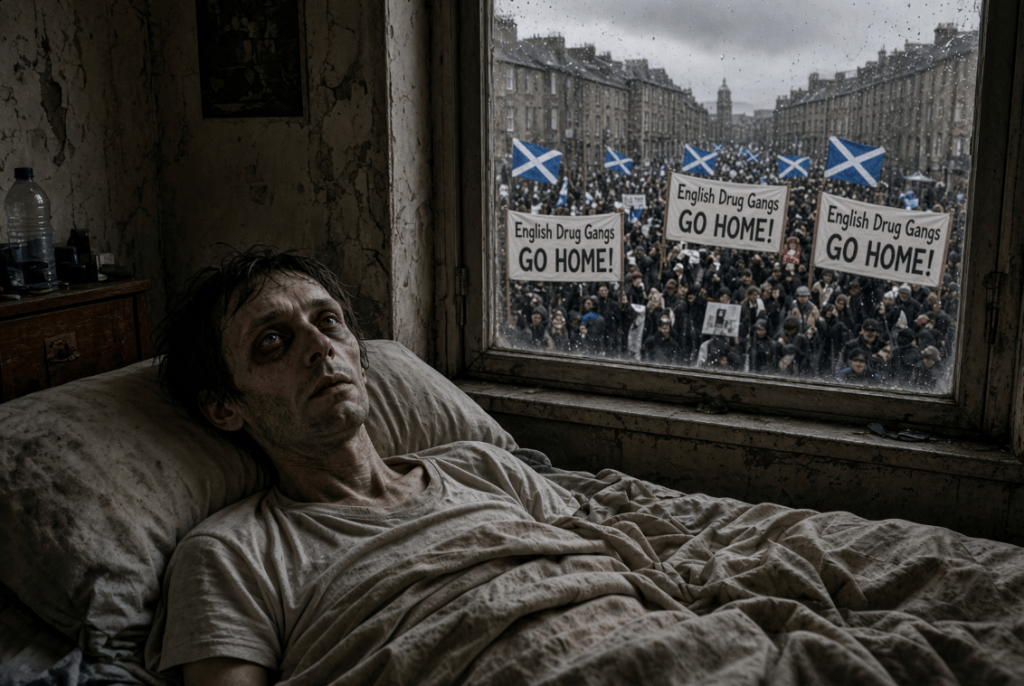
The criminal drug gangs of London and Liverpool have targeted a pre-existing condition in Scotland, turning addiction into a highly profitable and deadly business.
People are now dying after taking combinations of artificially concocted substances, often without knowing exactly what they are taking.
So the problem has changed.
Shouldn’t the response change with it?
And that is where Holyrood matters.
Why would we respond to a changing drug problem by abolishing the Parliament that allows Scotland to develop its own response?
The UK’s main drug-control legislation remains reserved to Westminster and criminalises possession and control of controlled drugs. Scotland, within its devolved powers, has increasingly pursued a public-health approach to drug harm.
So perhaps the answer isn’t to abolish Holyrood.
Perhaps devolution in Scotland, or better still, Scottish independence, may yet prove to be part of the real cure.
Which brings me back to Reform UK.
When Reform UK MSPs call for the abolition of the Scottish Parliament, I have one very simple question.
Other than continuing to show their disdain for a Scottish voice:
Why?
If the problem existed before devolution, and the production and supply of drugs have changed since then, how does abolishing devolution solve it?
That’s a considerably more complicated question than:
“Scotland has a drug problem. Abolish Holyrood.”
But perhaps complicated doesn’t mean difficult to understand.
Perhaps it just means Reform UK politicians need to stop shouting:
“STOP THE BOATS”
and start shouting:
“STOP THE GANGS.”
Surely even Reform UK politicians in Scotland can understand that.
Help Talking-up Scotland keep going

Crowdfunder at: https://www.crowdfunder.co.uk/p/help-talking-up-scotland-keep-going

Or by direct bank transfer to: JOHN WATSON ROBERTSON Sort Code – 08-91-04 Account – 12266421
Discover more from Scotland's First and biggest Rebuttal Service -Talking-up Scotland
Subscribe to get the latest posts sent to your email.


The population of England in 2026 is estimated to be approximately 58.8 million people, according to data from the Office for National Statistics.
Scotland’s population was estimated at 5,545,500 as of mid-2025 by the National Records of Scotland (NRS), marking a slow growth of less than 0.1% from the previous year
Maybe I am being stupid but using these two figures how is it that Scotland has more recorded drug deaths than England I doubt that MSM will look into that,anything to do down Scotland like this headline in the Mail.
surge in deaths, Swinney STILL backs soft touch approach SNP leader raising a white flag in war on drugs
LikeLike
If the number cant be read it is 5,545,500
LikeLike
Reform are adopting the prerogative of the harlot throughout the ages – power without responsibility. The are doing what their media masters do.
LikeLike
“Reform UK MSPs are scapegoating and supporting calls for the abolition of the Scottish Parliament” – and so place drugs policy solely under the responsibility of the Westminster government and specifically the Home Office? That’s their plan?
Nobody would deny Scotland has a serious drugs problem but if this is the proposition then it seems reasonable to ask Reform this: when will the UK government act to replicate in England and Wales the downward trend in drug deaths being seen in Scotland?
The last release of statistics for England and Wales (in October 2025) shows no similar downward trend (albeit the in-year death rates in the population are for now still much lower than in Scotland).
Some key points from ONS (October 17, 2025) ‘Deaths related to drug poisoning in England and Wales: 2024 registrations – Deaths related to drug poisoning in England and Wales from 1993 to 2024, by cause of death, sex, age and substances involved in the death.’
– 5,565 deaths related to drug-poisoning were registered; this is the highest number since records began in 1993 and 2.1% higher than in 2023 (5,448 registered deaths). The rate has increased every year since 2012. It is now over double the rate recorded in 2012 (46.5 deaths per million) (my emphasis)
– 195 deaths involved a nitazene, which is almost four times higher compared with 2023
– Cocaine deaths rise for the 13th consecutive year – there were 1,279 deaths involving cocaine registered in 2024, which was 14.4% higher than the previous year (1,118 deaths) and eleven times higher than in 2011 (112 deaths)
– the highest drug-poisoning death rate was seen in the North East (167.6 deaths per million and 429 registered deaths). This region has seen the highest rate for the past 12 years. The lowest rate was seen in the East of England (66.3 deaths per million, 421 registered deaths) – (I suggest this is a huge regional difference within a country whose government has ALL the levers of relevant power.)
– the largest increase in the rate of drug-poisoning deaths was recorded in London, with 76.5 deaths per million and 662 deaths (i.e. in 2024), compared with 58.1 deaths per million and 500 deaths in 2023. This represents an increase of 18.4 deaths per million between 2023 and 2024.
– ‘Information on the specific drugs involved in a death is not always available, therefore figures on drug misuse are often underestimated – the proportion of drug-related deaths for which the ONS holds no information on the specific substances involved has been increasing over time. As such, caution is advised in the interpretation of these statistics’
‘In 2024, 1,192 deaths (21.4%) registered in England and Wales had no drug type recorded on the coroner’s death certificate. In these cases, the record may only mention general terms such as “drug overdose” or “multiple drug toxicity”.
This is not about talking up Scotland! Of course there is much more to do to prevent drug deaths here – hopefully in future with a more helpful, supportive stance taken by the UK Home Office.
But why do Reform – and the BBC – never give the rising death tolls in England and Wales anything like the attention given to a falling trend in Scotland? Or does Reform – and the BBC in Scotland – have an agenda other than drugs policy?
And to repeat something I wrote btl on TuS earlier this month:
‘Back on July 4, 2024, the UK-based charity, Transform (aka the Drugs Policy Foundation) reflected on Westminster’s 14 years of drugs policy failings on its website under the headline ‘A NEW UK GOVERNMENT… WHAT NEXT FOR DRUG POLICY?’. This is its assessment:
‘As the Conservative government departs after 14 years of largely disastrous drug policy management in the UK, few tears will be shed in drug policy circles. Outcomes have been generally terrible; Drugs-related deaths have doubled, illegal drugs are cheaper and stronger than ever before, drug markets have become more violent and exploitative, prisons are overflowing, and pressures on underfunded drug services are reaching breaking point.’
And: ‘.. it’s been an unrelentingly grim mix of drug war posturing, negligence, and denial. Debate on progressive policy and law reform has been completely shut down, despite accelerating progress around the world. And, even in the face of an unprecedented drug death crisis, policy has been defined by a profound hostility to evidence based harm reduction measures proven to save lives.’
Commenting on the incoming Labour government, Transform states: ‘.. the previous Labour government had an almost equally dismal record on drug policy, and has been consistently weak in opposition. Concerningly, despite the urgency of the still-worsening overdose crisis – the drugs issue has barely featured in the election debate for Labour or Conservatives, with ‘tough on law and order’ showboating the preferred default.’
And finally, Transform comments on the SNP: ‘The SNP have been useful advocates of pragmatic drug reform, even if delivery in Scotland has been underwhelming, often stymied by legal constraints imposed from Westminster.
LikeLiked by 1 person
Scotland’s drug problem began before the 80s.
Heroin addiction was contained because doctors could prescribe substitutes such as Diconal which meant users could survive without resorting to criminal gangs and dealers. But in the1971 Misuse of Drugs Act Diconal was heavily restricted, Then AI tells us:
As with Prohibition in America, as soon as a drug is proscribed the Mafia moves in to reap the profits.
Also, in the late1970s and 80s the oil boom took off in Scotland. Fishing communities in the North East found themselves swamped by heroin as the drug dealers knew there were huge profits to be made. Local doctors couldn’t cope and drug deaths spiralled as heroin, which was virtually unknown in previous decades, flooded the market.
I’ve quoted an old woman in Fraserburgh before:
Of course, the decimation of the fishing industry after joining the EU (then after leaving it) and during the Thathcer reforms have made living conditions worse.
All this is governed by Westminster and on their charge sheet.
LikeLiked by 1 person