

Help Talking-up Scotland keep going

Crowdfunder at: https://www.crowdfunder.co.uk/p/help-talking-up-scotland-keep-going

Or by direct bank transfer to: JOHN WATSON ROBERTSON Sort Code – 08-91-04 Account – 12266421
From the Guardian today:
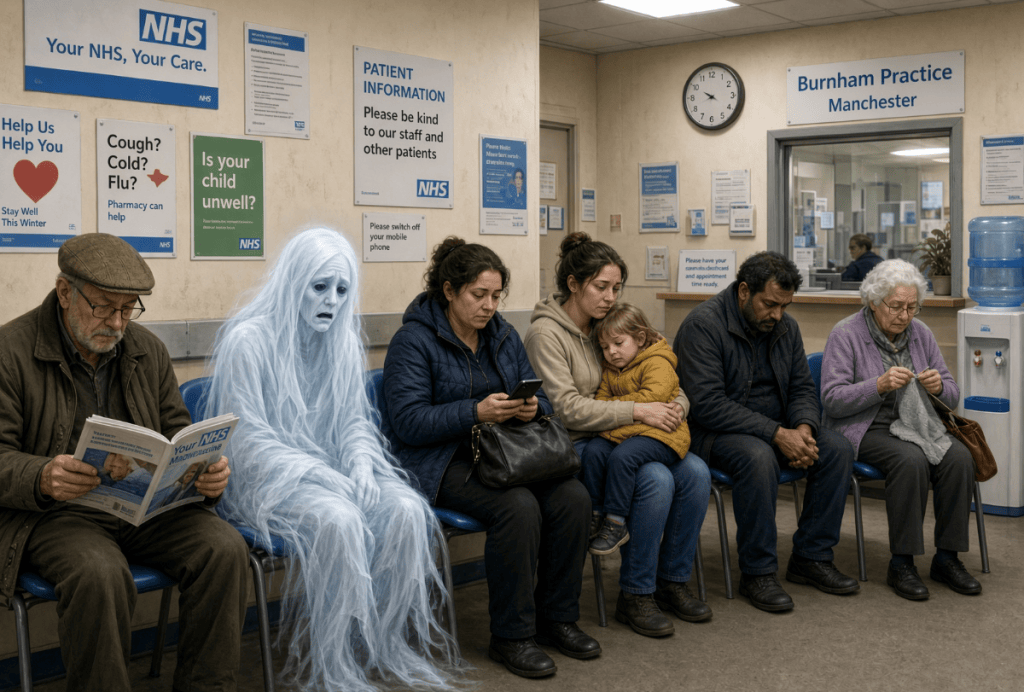
‘Ghost patient’ policy wrongly removing at-risk people from GP lists, doctors say – An NHS policy to remove “ghost patients” from GP lists is inadvertently leaving some of the poorest people in England without vital healthcare, analysis has found.
Under previous NHS rules, inactive patients at risk of being removed from their GP practice were given six months to respond to outreach. But under NHS England’s accelerated list validation timeline, introduced last October, patients now have only three months to reply. https://www.theguardian.com/society/2026/sep/23/nhs-england-ghost-patient-policy-wrongly-removing-vulnerable-people
What are the main risks:
Broken long-term condition management. No registered practice means no recall for blood pressure, HbA1c, spirometry, smear follow-up, DMARD monitoring, or mental-health reviews. Disease control drifts until the person fights back onto a list.
No named clinician when something new appears. Chest pain, a breast lump, suicidal ideation, a child safeguarding concern — the first door is often the GP. If that door has closed without the patient knowing, they delay, use A&E, or do not present.
Screening and immunisation falling through. The stated aim of cleansing is that invites go to real residents. The health cost of getting it wrong is that a real resident is deleted and then does not get the invite at all until they re-register.
Highest risk in the groups least able to repair the error. People in deprivation, temporary housing, language barriers, cognitive impairment, severe mental illness, or old age are both more likely to miss the three-month letter and more likely to be harmed by a gap in treatment. The disproportionate list fall in the poorest practices is a proxy for that clinical pattern, not only a funding pattern.
On purely patient-health terms, the distinctive danger of England’s approach is wrongly interrupting care. Scotland’s slower rule does not create a matching distinctive danger of wrongly continuing care, because a true ghost is not receiving that care in the first place.
Help Talking-up Scotland keep going

Crowdfunder at: https://www.crowdfunder.co.uk/p/help-talking-up-scotland-keep-going

Or by direct bank transfer to: JOHN WATSON ROBERTSON Sort Code – 08-91-04 Account – 12266421
Discover more from Talking-up Scotland
Subscribe to get the latest posts sent to your email.

