

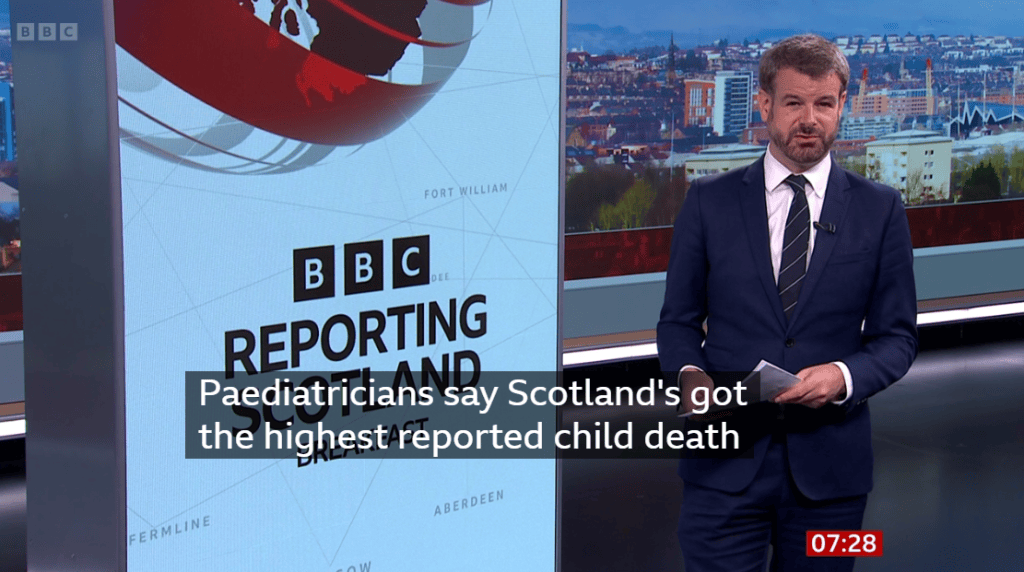
rate of any UK nation.
Help Talking-up Scotland keep going

Crowdfunder at: https://www.crowdfunder.co.uk/p/help-talking-up-scotland-keep-going

Or by direct bank transfer to: JOHN WATSON ROBERTSON Sort Code – 08-91-04 Account – 12266421
It’s true, 10.1 deaths among 1 to 15s in 2024, compared to 8.5 in England, 6.4 in Wales and 10.0 in Northern Ireland. It’s been like this for decades.
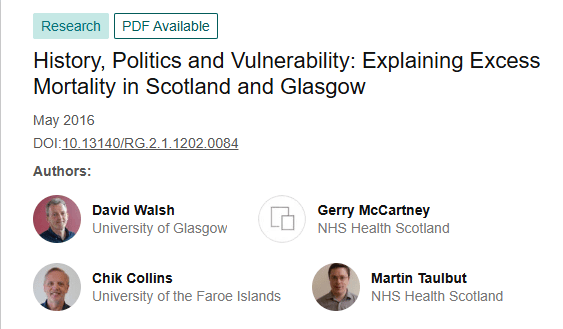
Why? These guys knew 10 years ago:
The RCPCH report itself states that social and economic disadvantage in early childhood is closely linked to higher child mortality.
What follows is based on the research published by the above researchers, comparing Glasgow with Liverpool and Manchester.
The long-standing “Scottish effect.” Even after researchers adjust for current deprivation, Scotland (and Glasgow in particular) has higher deaths compared with similar English cities or England & Wales as a whole. Studies attribute this to historical overcrowding, more damaging patterns of deindustrialisation and urban change, lagged effects of past poverty, and how local government responded to 1980s UK economic policy. That vulnerability appears early in life.
How local government responded to 1980s UK economic policy?
The researchers’ findings are a damning indictment of Scottish Labour and confirm the that many of us on the pro-independence left, that rather than fighting Westminster for us, they enjoyed power and just ‘minded the shop’ for UK governments, especially Labour ones. Building a hospital next to sewage works for other interests shows their ongoing contempt for the sheeple of Scotland.
They compare Glasgow, Liverpool and Manchester:
The shared shock.
The newly elected Conservative government in 1979 accelerated deindustrialisation, cut support for council housing, tightened local-government finance, and used higher unemployment as part of a wider policy mix. Those policies hit all three cities hard. The researchers’ argument is not that Glasgow uniquely suffered the policies, but that its local response did less to cushion an already more vulnerable population.
Liverpool: confrontation and mobilisation.
After Labour took control in 1983 (with a strong Militant presence, but a broader left coalition), the council refused to implement the full scale of cuts. It delayed setting a legal rate, built thousands of new council homes, froze rents, saved and created jobs, and ran a highly public campaign against Westminster. That produced mass participation — workplace meetings, large demonstrations, one-day strikes — and a visible argument about the city’s needs. The researchers’ synthesis treats this period as having two lasting effects: more resources went into housing and poverty at a critical moment, and the conflict itself politicised and bound communities together (“social capital”). That is described as a protective factor relative to Glasgow.
Manchester: delayed then negotiated regeneration.
Manchester also resisted co-operation for several years. After the Conservatives’ third general-election win in 1987 it switched to working with central-government urban programmes. The researchers characterise this as slowing some of the damage rather than amplifying it.
Glasgow: conciliation plus a different regeneration model.
Glasgow District Council was Labour-run almost throughout the century and in the 1980s. It did not take the path of open confrontation. It breached spending guidelines and used “creative accounting” to protect some jobs and services, but it rejected a Liverpool-style stand-off. Early priority went to inner-city gentrification, commercial development and a business-oriented regeneration model. Peripheral estates — where many of the poorest households had already been concentrated by earlier slum-clearance and New Town overspill — received less attention on poverty and living conditions. The same research programme notes that Glasgow had already invested less per capita in repairing its public housing stock and had built more high-rise and large peripheral estates than the English comparators. Combining that inherited housing landscape with a 1980s strategy that favoured the city centre over those estates is what the authors say “potentially exacerbated” the UK-level shock.
Help Talking-up Scotland keep going

Crowdfunder at: https://www.crowdfunder.co.uk/p/help-talking-up-scotland-keep-going

Or by direct bank transfer to: JOHN WATSON ROBERTSON Sort Code – 08-91-04 Account – 12266421
Why this is treated as part of a longer chain.
The 1980s response sits on top of earlier Scottish Office regional policy (1950s–70s): socially selective New Towns that moved skilled workers and industry out of Glasgow, leaving a more unbalanced remaining population, plus historically worse overcrowding. By the time the 1980s policies arrived, Glasgow’s population was already more vulnerable. A conciliatory, city-centre-first local strategy then did less than Liverpool’s (and, to a degree, Manchester’s) to offset that vulnerability. Excess mortality in Glasgow relative to the two English cities widens from the early 1980s onward — the same decade as these divergent local strategies.
Why do the local government actions in the 1980s still matter in Glasgow today?
They still matter because they helped set the physical and social landscape that today’s children are born into. The 1980s did not kill 1–15-year-olds in 2024. They helped decide who lived where, what kind of housing and services those places had, and how resilient the city was when later shocks arrived.
Can the SNP Scottish Government be criticised for not dealing with this after nearly two decades in power?
There’s always something any government can be criticised for but Glasgow City became an SNP city only in 2015 after almost 100 years of Labour.
The SNP’s child poverty policies have done this staggering thing:
Compare child poverty rates in Glasgow with Liverpool and Manchester
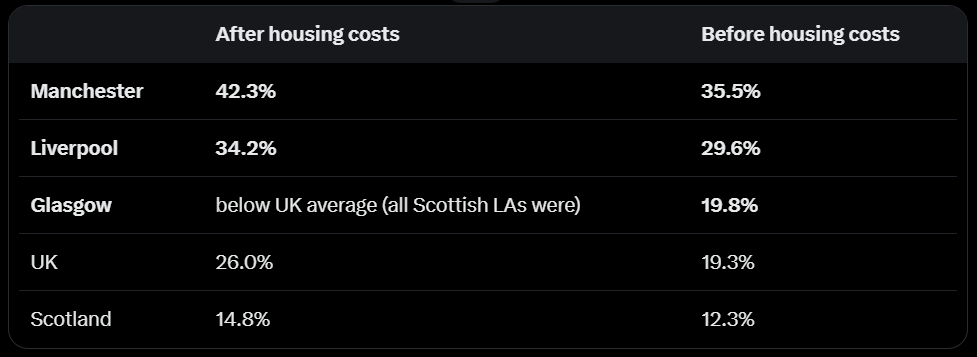
Sources:
https://liverpool.gov.uk/council/key-statistics-and-data/headline-indicators/deprivation/
https://www.jrf.org.uk/pdf/15483
Help Talking-up Scotland keep going

Crowdfunder at: https://www.crowdfunder.co.uk/p/help-talking-up-scotland-keep-going

Or by direct bank transfer to: JOHN WATSON ROBERTSON Sort Code – 08-91-04 Account – 12266421
Discover more from Scotland's First and biggest Rebuttal Service -Talking-up Scotland
Subscribe to get the latest posts sent to your email.


Simply put :
Westminster Government is bad for your children’s health .
Just say ”No” – you know it makes sense !
LikeLike
It really makes me angry that so called Scottish papers and local papers gloat about these figures and say how much better England is in all respects,with Findlay being one of the worst of the so called fair Union.
LikeLike
Should have added BBC Scotland the worst.
LikeLike