

Help Talking-up Scotland keep going

Crowdfunder at: https://www.crowdfunder.co.uk/p/help-talking-up-scotland-keep-going

Or by direct bank transfer to: JOHN WATSON ROBERTSON Sort Code – 08-91-04 Account – 12266421
From West Coast Today, 17 September 2026, the above and:
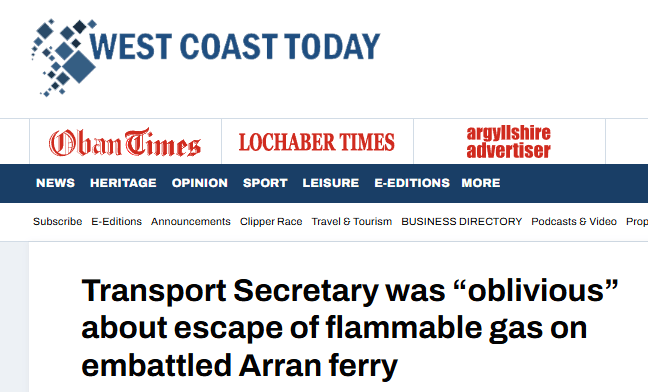
The new Arran ferry, MV Glen Sannox, leaked methane while carrying more than 80 passengers, just months after entering service.
and:

be…..?
I’ll leave you to answer that, below.
BBC Scotland 10 September 2026:
A faulty valve on a CalMac ferry led to a sudden and uncontrolled release of highly flammable methane gas last summer, BBC Scotland News has learned.The operator’s investigation found that 700kg of the gas – enough to fill a four-bedroomed house – was vented from the side of MV Glen Sannox over the space of 12 minutes while it was carrying 82 passengers from Arran to the mainland.
So much methane was released that some of it was sucked into a ventilation intake, setting off gas alarms in the ship’s generator room.While the risk of explosion is believed to have been low, CalMac described it as a “critical failure” in the gas fuel system and said lessons had been learned.
The propulsion systems for Glen Sannox were designed, supplied and commissioned by Finnish firm Wartsila, a world leader in liquefied natural gas (LNG) engines, who worked as subcontractors to the Ferguson Marine shipyard. Details of the incident have not previously been made public and have only emerged after a freedom of information request from BBC Scotland News. https://www.bbc.co.uk/news/articles/c1mv50enz09o
This would, in other countries, be an astonishing amplification of a very low risk event.
I’ll deal with the: While the risk of explosion is believed to have been low, CalMac described it as a “critical failure” comment first.
Methane will explode only in the 5% to 15% but alarms will go off at 1% methane (20% gas vapour concentration) and 2% (40%) will lead to shutdown, nowhere near the explosive range. https://www.classnk.or.jp/hp/pdf/rules/amendments/e-Amendments/16.12.27/411_part_gf_e.pdf
Was there a shutdown automatically triggered by 40% LEL 2% methane cloud? No, engineers shutdown manually. so the risk of explosion was essentially zero.
Returning to the incident overall, this is closer to a layered safety system catching a component failure than to an uncontrolled disaster. A valve failed open and dumped a large volume of methane overboard. Gas was drawn into ventilation spaces and set off further alarms, and the crew isolated the leak by hand. Methane is lighter than air, so most of it dispersed rather than accumulating to explosive concentrations. An expert quoted in the piece said the detectors and automatic fuel shut-off appear to have done their job. https://www.bbc.co.uk/news/articles/c1mv50enz09o
A valve can fail open and still not produce a catastrophe if later safety layers work, as they did.
Finally 82 passengers on 3 June 2025? 82? Summer? The MV Glen Sannox can take 852, more than 10 times as many!
Sheesh! That’s a monstrous subsidy provided by the Scottish taxpayer, via that SNP Government, that some islanders never stop moaning about.
Help Talking-up Scotland keep going

Crowdfunder at: https://www.crowdfunder.co.uk/p/help-talking-up-scotland-keep-going

Or by direct bank transfer to: JOHN WATSON ROBERTSON Sort Code – 08-91-04 Account – 12266421
Discover more from Talking-up Scotland
Subscribe to get the latest posts sent to your email.


The fuel costs saved will be £Billions. Spend £millions to save £Billions. Major ferries cost £10,000 to berth overnight.
LikeLike
Have you read about the deaths in Jersey? https://www.bbc.co.uk/news/articles/c5wyzexzzx4ko
Safety is treated so badly, and people go on about ‘Elf & Safety’ and laugh – we need to change the attitude to safety.
Carbon monoxide (CO) is a product of combustion when insufficient oxygen reaches the flame from carbon-based fuels (gas, coal, wood, diesel, petrol etc). Less than 2% of CO in the air can kill in under three minutes and CO cannot be sensed using human senses. Low levels over a period of time can cause brain and neurological injuries. Yet there is no specific duty on the gas emergency service to test for CO, let alone record the parts per million or provide that to those exposed for their medics.
Independent registered charity CO-Gas Safety has been pointing this out for over 30 years.
Ofgem has within the last few years provided funds to test homes that are on or eligible for the Priority Services Register but testing is only in tiny numbers. Ofgem has not required a report to be provided to Ofgem that is publicly available.
British Gas doesn’t seem to offer a paid for service so people can find out if they are being exposed to CO or not. We have asked many of those employed by BG on Linked In. In any case you don’t have to be poor to die of CO. Zoe Anderson, (daughter of multimillionaire Chris Anderson of TED talks) died of CO aged 24 in 2010 in the family home in Bath, after a registered gas safe engineer installed a new gas boiler.
The WHO guidelines are no more than 3.5 parts per million of CO averaged over 24 hours. AI will rely even more on data. What about situations where there is no or little or misleading data?
Stephanie Trotter, OBE
LikeLike