

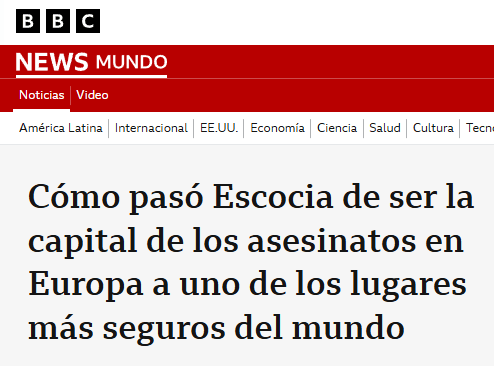
From the BBC’s Latin America service and on the BBC Future site but kept away from the main BBC UK site, far less BBC Scotland, the above, and:
Help Talking-up Scotland keep going

Crowdfunder at: https://www.crowdfunder.co.uk/p/help-talking-up-scotland-keep-going

Or by direct bank transfer to: JOHN WATSON ROBERTSON Sort Code – 08-91-04 Account – 12266421
How Scotland went from being the murder capital of Europe to one of the safest places in the world – In the early 2000s, the likelihood of experiencing an assault in Scotland was more than three times higher than in the United States. However, when Scottish authorities began to address violent crime as a public health issue, the figures plummeted, and the nation now ranks among the safest in the world.
It was no ordinary court day.
On October 24, 2008, at the Glasgow Sheriff Court (the main local judicial body in Scotland for civil and criminal cases), there were no jurors, no witnesses, and no defendants in the dock.
Instead, facing the judge—who was dressed in full official attire—were 85 members of rival gangs from the East End of Glasgow, Scotland’s largest city.
For decades, the area had been plagued by youth gangs fighting over territory, organized crime, and drug and weapon clashes, which made knife attacks almost a daily occurrence.
Despite their ongoing disputes, the gang members remained silent as they listened, one after another, to various speakers.
A mother recounted how she saw her son’s unrecognizable face after he suffered, at the age of 13, a machete attack linked to gangs.
An American basketball player recalled how he lost his brother to gun violence. Doctors and surgeons described brutal lacerations and permanent deformities.
“If I had been the chief of police [of Strathclyde Police], I probably wouldn’t have allowed us to do that,” reflects Karyn McCluskey, co-founder and former director of the Scottish Violence Reduction Unit (SVRU).
This specialized group created by the police in 2005 and expanded to a national initiative the following year by the Scottish government was responsible for the unusual scene of that day.
“They must have thought we were crazy,” she comments. “That day we had police horses in the courthouse and boats sailing up and down the River Clyde because it was a really risky initiative. But there was some permissiveness in trying to do something.”
Something that seemed to work. Members of the gangs present were given a phone number they could call later for support if they wanted to leave violence; after ten similar sessions attended by 473 young people, nearly 400 of them made the call.
The intervention in the courthouse was the first of what are called Scotland’s “voluntary referral sessions,” part of the country’s efforts to curb the record numbers of violence plaguing the nation, especially Glasgow.
Between 2003 and 2005, the city recorded the highest homicide rate in Europe.
The United Nations declared Scotland the most violent country in the developed world: Scots were nearly three times more likely to suffer an assault than Americans.
Newspapers constantly reported on gruesome murders and bloody gang fights.
In the following decade, the homicide rate fell by 56% in Glasgow and by 38% across Scotland.
Violent crimes in general decreased by almost a third nationwide between 2006 and 2015.
Today, the number of homicides in Scotland is at its lowest level in over 20 years.
Figures for serious assaults and attempted murders have seen a similar decline.
While the statistics hide the individual stories of tragedy and horror that accompany any violent crime, this is a radical and notable change.
Currently, Scotland occupies a middle position among European countries in terms of homicides, with per capita rates lower than those of countries like Sweden, France, or England and Wales.
How did a nation once plagued by knife crime, gangs, and murders achieve such a decisive change?
In summary, it changed its way of perceiving violence as a problem: it stopped considering it exclusively a matter of criminal justice and began to approach it from a public health perspective as well.
“Scotland had [in the early 2000s] the image of a tough, hard-drinking man, as well as a specific reputation for gang activity and knife crime that dated back generations, to the knife-wielding gangs of the 18th century,” explains Will Linden, deputy director of the SVRU and one of its first employees.
In 2003, Linden was working as a police analyst under McCluskey—then head of Intelligence Analysis for Strathclyde Police—when his department was asked to prepare a report on how to reduce homicide figures.
“Upon analyzing the data, we realized that most homicides occurred almost by chance,” Linden comments.
“They were not planned or linked to organized crime; generally, it was just a couple of people getting into a fight where one pulled out a knife and stabbed the other.
“We started to see that you couldn’t design a strategy to address homicides without analyzing violence as a whole, going beyond mere police action.”
The crisis in Glasgow was so severe that the then-police chief, William Rae, gave McCluskey and her colleague John Carnochan—deputy chief of the Criminal Investigation Department—essentially a free hand to try to solve the problem.
Rae created the team that would eventually become the Violence Reduction Unit (SVRU) within the police force, though operating on its fringes; this allowed the police to claim successes while simultaneously distancing themselves from failures.
“We had some leeway and were allowed to fail,” McCluskey notes.
“There was a conviction that, in the face of such a terrible situation, it was necessary to reinvent everything.”
Since its inception, the SVRU adopted a public health approach to violence, characterizing it more as a disease than as a crime.
They chose to focus on prevention and intervention rather than simply reacting after an incident has occurred.
McCluskey compares this approach to that of measles: treating those already infected, vaccinating high-risk groups, and working to prevent contagion within the community as a whole.
It was a key decision for subsequent success.
In its simplest form, a public health approach to addressing violence begins with data collection to identify and understand the problem, before examining the factors that put people at risk and those that protect them.
Almost two-thirds of all violent acts affect just 1% of the population of Scotland.
Risk factors include being a young man living in a socially disadvantaged area, as well as unemployment, poverty, and growing up in an unstable family environment.
On the other hand, factors that seem to protect against violence include continuity in education and maintaining strong relationships with parents.
BBC Future, English version at: https://www.bbc.co.uk/future/article/20260626-how-scotland-changed-the-way-it-tackled-violence
Help Talking-up Scotland keep going

Crowdfunder at: https://www.crowdfunder.co.uk/p/help-talking-up-scotland-keep-going

Or by direct bank transfer to: JOHN WATSON ROBERTSON Sort Code – 08-91-04 Account – 12266421
Discover more from Talking-up Scotland
Subscribe to get the latest posts sent to your email.


BBC Scotland has never knowing praised the Scottish Government – and never will !
It’s where Good News about Scotland goes to die !
LikeLiked by 1 person
I recall attending a presentation by the Violence Reduction Unit staff in its early years. It was at a seminar at Glasgow University. The principles behind the philosophy were explained.
During questions they were asked why this was not reported to any great extent in the Scottish media. The questioner talked about the hostility shown by much of the media to the Special Unit at Barlinnie Prison. Essentially the media wanted long retributive sentencing and ‘tough’ action against ‘thugs’. Given the philosophy and practices which had been explained it was surprising that the media were not fulminating about this approach.
The member of the VRU answering said that the Chief Constable and other senior figures in the Criminal Justice Service had had one-to-one meetings in their private clubs with editors and other media executives with whom they had established friendly relationships of sorts and had asked them to tell their baleful hacks to go lightly on reporting the unit. Otherwise…… information which was often leaked to the media to give them ‘exclusives’ would dry up.
Some years later, after I had retired and was involved in promoting cycling and safe cycling routes we were asked if we would lead a charity bike ride from Glasgow Royal Infirmary along the Forth and Clyde Canal and Union Canal to Edinburgh Royal Infirmary to raise funds for rehabilitative projects set up by the VRU. I was pleasantly surprised by those who participated in the ride – medical staff, police officers, lawyers (both prosecution and defence), victims of violence, rehabilitated violent offenders. There were 60/70 people on the ride. We were met at Falkirk by the Chief Constable. It was clear that there was significant support for the project by people in powerful positions.
This ride was not reported in the media.
LikeLiked by 4 people