

Help Talking-up Scotland keep going

Crowdfunder at: https://www.crowdfunder.co.uk/p/help-talking-up-scotland-keep-going

Or by direct bank transfer to: JOHN WATSON ROBERTSON Sort Code – 08-91-04 Account – 12266421
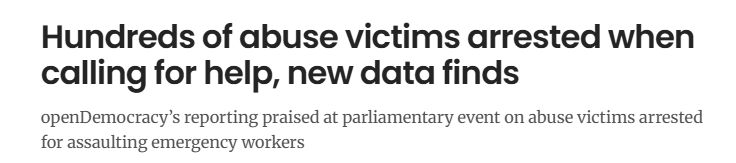
From OpenDemocracy, three days ago, the above headline and:
Domestic abuse victims in England and Wales are facing arrest when calling the emergency services for help, according to new data published by Women in Prison.
The charity asked more than 500 women in the criminal justice system about their experiences of domestic abuse, with nearly a third (29%) saying they were arrested when the police or emergency services were called to a domestic incident, even when they were the victim of abuse. The offence of assaulting an emergency worker, which was made a crime in 2018, was a major driver of arrests.
There is only one comparable event recorded in Scotland where a woman in Troon called police about a domestic incident; officers arrived nine hours later; she lashed out and struck an officer. She pleaded guilty and was admonished (a very low-level disposal). https://www.ayradvertiser.com/news/23991698.troom-woman-hit-police-nine-hour-wait-admonished/
Why are cases in England Wales being ‘driven’ by a 2018 act?
The 2018 Act does this by creating a specific, easy-to-charge, relatively serious offence that sits right on top of the moment when a distressed victim and police collide.
Why that captures abuse victims – Typical scene described in the reporting:
- Woman calls 999 because her partner is abusive.
- Officers arrive. The abuser is often calm and coherent; she is frightened, angry, or in a trauma response.
- Officers treat the louder, more agitated person as the problem, or they try to separate/restrain her.
- She struggles, lashes out, spits, or strikes an officer while being held or put in a car.
That single act now fits the 2018 offence perfectly. It does not require serious injury. Spitting or a slap is enough. Because the charge is more serious than ordinary common assault, it is more likely to be recorded, prosecuted, and to produce a conviction that then blocks housing, work and contact with children. https://www.legislation.gov.uk/ukpga/2018/23/section/1
Why this is not happening in Scotland:
Scotland did not adopt that 2018 Act. It already had the Emergency Workers (Scotland) Act 2005 and common-law assault. Those tools exist, but they were not packaged as a new, high-profile, either-way “assault emergency worker” charge with the same charging culture and sentencing uplift that arrived in England and Wales in 2018–2022. https://www.legislation.gov.uk/asp/2005/2 (Section 1)
This distinction is not being reported in Scotland’s media. They’re too busy praying for a drug death increase next Wednesday.
Help Talking-up Scotland keep going

Crowdfunder at: https://www.crowdfunder.co.uk/p/help-talking-up-scotland-keep-going

Or by direct bank transfer to: JOHN WATSON ROBERTSON Sort Code – 08-91-04 Account – 12266421
Discover more from Talking-up Scotland
Subscribe to get the latest posts sent to your email.

