https://www.crowdfunder.co.uk/p/help-talking-up-scotland-keep-going JOHN WATSON ROBERTSON Sort Code – 08-91-04 Account 12266421
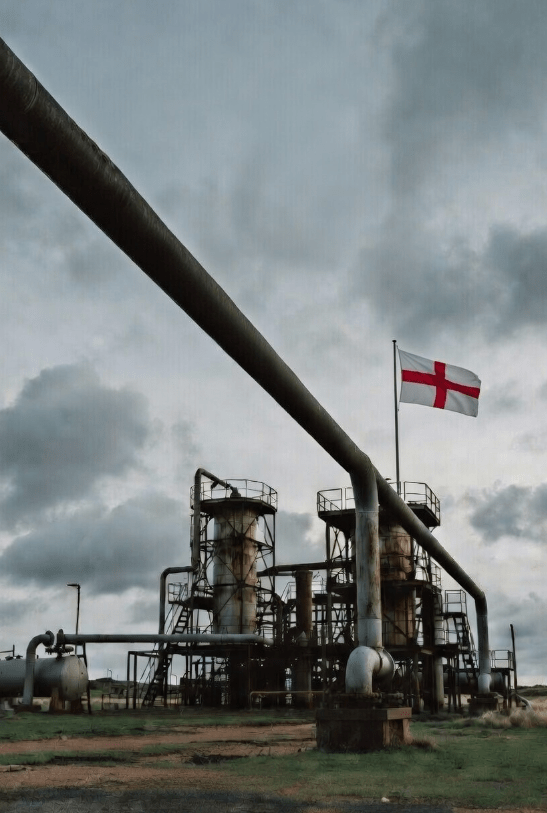
Latest increase – Scots taxpayers to pay first £120 million instalment to keep old English steelworks in business and another £100m to save old English oil refinery so that it can replace Scottish oil refinery to refine oil almost entirely from Scottish waters
Or by direct bank transfer to: JOHN WATSON ROBERTSON Sort Code – 08-91-04 Account – 12266421
Labour has been urged to lay out a credible plan for the future of British Steel, as the government spending watchdog warned of the “startling” costs of keeping the struggling manufacturer in business with no end in sight.
British Steel was taken into public ownership in July to protect “the future of steel production”, 15 months after the government stepped in to prevent the closure of its steelworks in Scunthorpe and the loss of 4,000 jobs.
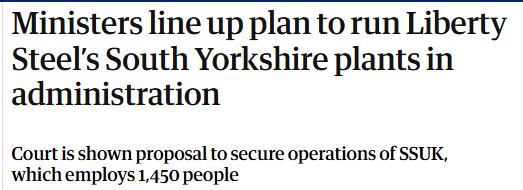
The Guardian today has the above with an increased estimate of costs from £1bn to £1.5bn since March this year.
As the implementation for the Scottish Budget in 2026/2027 looms, we can reflect on a few hundred million that we don’t have because it’s being used to subsidise our de-industrialisation.
There’s no estimate in the article of the cost to the Treasury of the above commitment but hundreds of millions must be the starting point for a steel mill of that size and labour force. Grok estimated £929 000 000 per year.
Where will that money come from? A devolved budget for England? As you know, no such thing. It will come from the wider UK tax revenue, Scots are responsible for around 10% of so we’ll be paying around 10%, hidden no doubt within the reduced 2026 settlement of the budget for Scotland, of the above nearly £1 billion.
Update – the latest prediction is not £1.5bn.
Scotland no longer produces crude steel and merely recycles old steel, at Dalziel in Motherwell.
Or by direct bank transfer to: JOHN WATSON ROBERTSON Sort Code – 08-91-04 Account – 12266421
The above news on steel follows this on oil, from 6 July 2025:
British taxpayers could be on the hook for more than £1 billion following the collapse of the Lindsey oil refinery in North Lincolnshire.
HMRC is said to be owed £250m in unpaid taxes, while the facility’s decomissioning costs could be up to £3bn.
The refinery is at risk after its owner, State Oil, filed for insolvency on Monday. The Official Receiver has reached a deal with the commodities trading giant, Glencore, that will ensure supplies of crude oil to the refinery.
Ministers have pledged to provide “short-term funding” to cover the operating costs of the facility as a sale process and potential wind-down gets underway.
The urgency of ministers to save the refinery has caused anger north of the border as the government did not make any attempt to underwrite the costs of the Grangemouth plant which has now closed. However, these concerns have been mainly on social media, with little comment coming from the SNP on the issue.
To save an English oil refinery so that it can replace a Scottish oil refinery to refine oil almost entirely from Scottish waters, the Scottish taxpayer must contribute, pro rata with one tenth of the UK population around, one tenth, £100m?
Add the billions Labour has already given to Tata Steel to keep some of its work in Wales going, there’s a pattern here and it’s all bad news for Scotland.
3 thoughts on “Latest increase – Scots taxpayers to pay first £120 million instalment to keep old English steelworks in business and another £100m to save old English oil refinery so that it can replace Scottish oil refinery to refine oil almost entirely from Scottish waters”
You write “there’s a pattern here and it’s all bad news for Scotland”.
Guess that’s how it’s always going to be, well at least as things stand for now , or is it actually going to be how it will be forever in our future within Scotland ?
That is, the state of things to come for all of our lifetime in Scotland?
So , as some peeps within Scotland like to say on that subject – Ho Hum !
From the Aberdeen-based Energy Voice news website (September 18): ‘‘Shameful’: GB Energy to allocate 6% of £30m community fund to Scotland’.
‘The announcement that as little as 6% of GB Energy’s recently revealed £30 million community energy scheme (sic) has been branded “shameful” by one Aberdeen MSP.
‘Under-secretary of state in the Department for Energy Security and Net Zero, Martin McCluskey, revealed that only £1.8m from the new initiative would be allocated north of the border. ‘
To this, Donside MSP Jackie Dunbar (SNP) said: “Scotland is home to 30% of UK renewables generation and 82% of UK oil and gas production, yet we given just 6% of GB Energy cash – the Labour Party is ruining our premier energy industry while dishing out pocket change to energy-rich Scotland. (my emphasis)
“Shameful token gestures won’t cut it when people in energy-rich Scotland are seeing their bills rise £1000 higher than the Labour Party promised while our energy jobs are being lost at an industrial scale.”
In the same article, on GB Energy we also learn this: ‘As of May, it was understood that around 124 people were employed by the firm. Since then, GB Energy has been on a recruitment drive as it launched its search for senior positions such as chief financial officer. At the time of writing, GB Energy is recruiting for seven positions, all of which are set to be based in either Aberdeen or Edinburgh.’
And what has the Unionist press been saying about GB Energy’s job creation track record in Scotland so far? From the Scottish Daily Express on August 20: ‘GB Energy row as a third of workforce refuse to relocate to Scotland amid SNP high taxes – The Scottish Tories slated the failed promises of the UK Labour Government when it comes to GB Energy as it has brought very little jobs to Aberdeen.’ (I think the Express – or the Tories – meant to say ‘few’ not ‘little’ jobs!)
The Express reports: ‘A huge row has broken out after it was revealed that more than a third of workers employed by Labour’s flagship GB Energy company have refused to relocate to Scotland. The organisation is headquartered in Aberdeen but even the outgoing chairman Jürgen Maier is not based there full time.’
And: ‘.. the number of employees is down massively on the promised “1,000 or more jobs” when the publicly-owned energy company was initially announced, with only 132 workers registered, two years after the General Election.’
On the jobs creation promise: ‘But this has never materialised, with GB Energy employing only 53 permanent workers, 31 short-term staff and a further 48 on secondment. According to the Times, of the 132 employees in total, 46 – a little more than a third of the head count – live in England, Wales or Northern Ireland rather than Scotland.’
Who’s going to relocate on a short-term contract or a secondment? The tax ‘dig’ in the Express’ headline is a distraction: the key point is that GB Energy is not living up to Labour’s election promises to Scottish voters. Anyone surprised?




You write “there’s a pattern here and it’s all bad news for Scotland”.
Guess that’s how it’s always going to be, well at least as things stand for now , or is it actually going to be how it will be forever in our future within Scotland ?
That is, the state of things to come for all of our lifetime in Scotland?
So , as some peeps within Scotland like to say on that subject – Ho Hum !
Liz S
LikeLiked by 1 person
SCOTLAND SHOULD NEVER EVER PAY ANY MONEY TOWARDS
ENGLISH PROBLEMS
LikeLike
O/T but only slightly!
From the Aberdeen-based Energy Voice news website (September 18): ‘‘Shameful’: GB Energy to allocate 6% of £30m community fund to Scotland’.
‘The announcement that as little as 6% of GB Energy’s recently revealed £30 million community energy scheme (sic) has been branded “shameful” by one Aberdeen MSP.
‘Under-secretary of state in the Department for Energy Security and Net Zero, Martin McCluskey, revealed that only £1.8m from the new initiative would be allocated north of the border. ‘
To this, Donside MSP Jackie Dunbar (SNP) said: “Scotland is home to 30% of UK renewables generation and 82% of UK oil and gas production, yet we given just 6% of GB Energy cash – the Labour Party is ruining our premier energy industry while dishing out pocket change to energy-rich Scotland. (my emphasis)
“Shameful token gestures won’t cut it when people in energy-rich Scotland are seeing their bills rise £1000 higher than the Labour Party promised while our energy jobs are being lost at an industrial scale.”
In the same article, on GB Energy we also learn this: ‘As of May, it was understood that around 124 people were employed by the firm. Since then, GB Energy has been on a recruitment drive as it launched its search for senior positions such as chief financial officer. At the time of writing, GB Energy is recruiting for seven positions, all of which are set to be based in either Aberdeen or Edinburgh.’
Impressive employment creation? Aye right!
Source: https://www.energyvoice.com/renewables-energy-transition/604008/shameful-gb-energy-to-allocate-6-of-30m-community-fund-to-scotland/
And what has the Unionist press been saying about GB Energy’s job creation track record in Scotland so far? From the Scottish Daily Express on August 20: ‘GB Energy row as a third of workforce refuse to relocate to Scotland amid SNP high taxes – The Scottish Tories slated the failed promises of the UK Labour Government when it comes to GB Energy as it has brought very little jobs to Aberdeen.’ (I think the Express – or the Tories – meant to say ‘few’ not ‘little’ jobs!)
The Express reports: ‘A huge row has broken out after it was revealed that more than a third of workers employed by Labour’s flagship GB Energy company have refused to relocate to Scotland. The organisation is headquartered in Aberdeen but even the outgoing chairman Jürgen Maier is not based there full time.’
And: ‘.. the number of employees is down massively on the promised “1,000 or more jobs” when the publicly-owned energy company was initially announced, with only 132 workers registered, two years after the General Election.’
On the jobs creation promise: ‘But this has never materialised, with GB Energy employing only 53 permanent workers, 31 short-term staff and a further 48 on secondment. According to the Times, of the 132 employees in total, 46 – a little more than a third of the head count – live in England, Wales or Northern Ireland rather than Scotland.’
Who’s going to relocate on a short-term contract or a secondment? The tax ‘dig’ in the Express’ headline is a distraction: the key point is that GB Energy is not living up to Labour’s election promises to Scottish voters. Anyone surprised?
LikeLike