

Help Talking-up Scotland keep goin
Crowdfunder at: https://www.crowdfunder.co.uk/p/help-talking-up-scotland-keep-going
Or by direct bank transfer to: JOHN WATSON ROBERTSON Sort Code – 08-91-04 Account – 12266421
By Mark E. Saunders of “The Scottish Minuteman” https://www.facebook.com/profile.php/?id=61575625542197
“It is in truth not for glory, nor riches, nor honours that we are fighting, but for freedom alone, which no good man gives up but with his life.”
— The Declaration of Arbroath, 1320
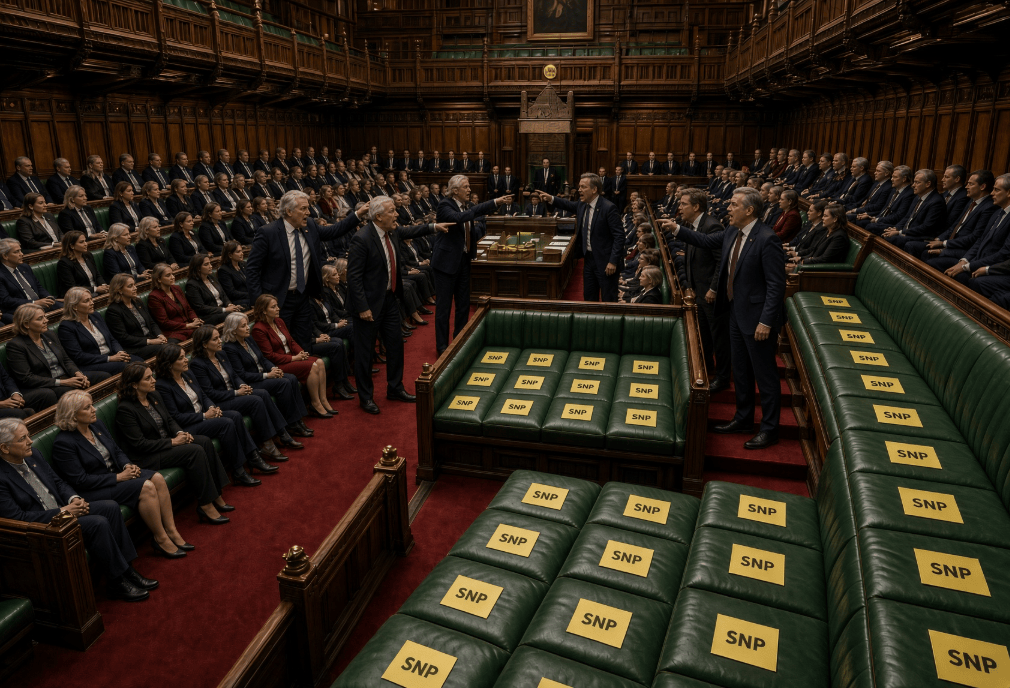
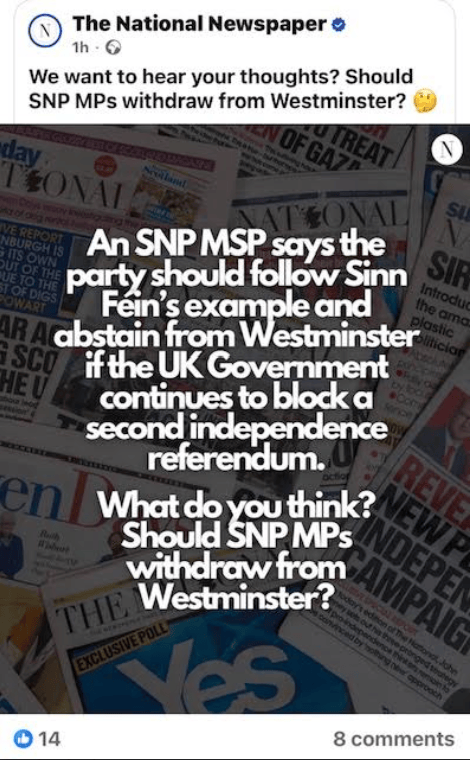
Is the moment fast approaching when Scotland needs to stand up — by sitting out?
At the very moment Scotland returned the largest independence-supporting majority in the history of the devolution settlement, the Prime Minister of the United Kingdom chose to ignore the democratic significance of that result. Instead, he busied himself answering the existential “threat” levelled at the UK’s political class by Reform UK.
But what if the UK Prime Minister continued to ignore the mandate Holyrood once again possesses to demand another referendum on Scotland’s constitutional future?
Imagine then that, in response, the Scottish Government declared the next UK general election to be a de facto referendum on independence — and that every pro-independence MP campaigned not on being elected to join the British Establishment, but only on Scotland’s right to choose its own future.
In such an election, there could be no ambiguity of purpose. Candidates standing on a de facto referendum platform would not be seeking election to participate in the ordinary machinery of Westminster politics, nor to quietly take their place on the green benches of the British Establishment.
If Westminster dismissed the very concept of a de facto referendum and continued to refuse to outline the legitimate constitutional route by which a nation of the United Kingdom could democratically choose to leave the Union, what then?
Would Scotland simply accept the will of Westminster, with a nation’s elected representatives boarding trains to London and carrying on as before?
Or would the time have come to draw a line in the constitutional sand?
At what point does participation in a system cease to be democracy and become merely the performance of consent?
Would the time have come for Scotland’s MPs to stop lending legitimacy to a Parliament that refuses to hear them?
A complete Westminster boycott would be a dramatic step. But it would also be a clear one.
Scotland’s elected representatives would be saying that they no longer consent to participate in the day-to-day business of a Parliament that refuses to recognise Scotland’s democratic mandate.
That day may be approaching much faster than many realise. And every supporter of Scottish independence — whether an elected official, a party member, or simply an ordinary citizen — may soon have to begin preparing for that possibility now, not after the moment arrives, but well before it reaches that point.
If that moment is approaching, then those seeking selection as pro-independence candidates at the next UK general election must also begin treating that possibility seriously now. Not after the campaign begins, not after Westminster refuses once again to listen, but before the constitutional confrontation arrives.
Any candidate asking to represent the independence movement in a future de facto referendum election should understand the moral weight of what they are seeking.
They may soon be asking the Scottish electorate not merely for votes, but for a democratic mandate whose consequences they must be prepared to uphold.
Whether comfortable with that responsibility or not, preparation can no longer be postponed.
Sinn Féin has long shown the way — its MPs refuse to take the oath to the Crown, do not collect Westminster salaries, yet still serve their constituents. Offices, staff and community surgeries remain fully funded under parliamentary expense rules designed for representation, not attendance.
Their absence is not neglect; it is principle.
For the SNP, a complete Westminster boycott would carry the same message — that Scotland no longer consents to be ruled by a Parliament it did not elect.
But a Westminster boycott would not mean abandoning constituents.
Constituents would still be represented by the MPs they elected. Each MP’s local office would remain open and financed through the Independent Parliamentary Standards Authority, which pays for staff, rent and community work. Voters would continue to receive help, advice and advocacy — just without the daily pantomime on the green benches.
There would, of course, be fierce criticism from much of the British political and media establishment. Yet constituents would still be represented — and represented well.
Partial gestures would not do. A symbolic walkout for the television cameras, only to return to the green benches the next day, would change nothing. Only a united, full withdrawal could make the world sit up and take notice, potentially forcing renewed international scrutiny of Scotland’s constitutional status and the democratic legitimacy of the Union.
As for income, MPs who abstain would voluntarily forfeit their £100,000 Westminster salary but would not be left unable to serve. Westminster already permits members to hold multiple outside roles and sources of income. The SNP itself could establish a modest internal stipend — as Sinn Féin does — ensuring participation is open to ordinary people, not only the independently wealthy.
Public service should never depend upon London’s pay cheques.
A collective boycott would send a signal that could not be ignored. It would be reported from Edinburgh to Edmonton, from Wishaw to Washington — a peaceful, democratic act of disobedience declaring that Scotland’s consent has been withdrawn.
The world would understand that Scotland’s elected representatives had stopped pretending this union is voluntary.
Of course, it would face pushback. Some MPs would fear the optics or the financial sacrifice. Others would argue that absence equals silence.
Yet true silence comes from staying in a room where no one listens.
The courage to walk out together would speak louder than any speech ever could.
Such a move would be bold, disciplined and deeply symbolic: Scotland’s representatives refusing to legitimise a system designed to silence them. It would prove that the machinery of Scottish democracy — constituency offices, local advocacy and public service — can function independently of Westminster.
It would not be retreat.
It would be the moment Scotland stood up — by sitting out.
Mark E Saunders, 18th May 2026
Help Talking-up Scotland keep goin
Crowdfunder at: https://www.crowdfunder.co.uk/p/help-talking-up-scotland-keep-going
Or by direct bank transfer to: JOHN WATSON ROBERTSON Sort Code – 08-91-04 Account – 12266421
Discover more from Talking-up Scotland
Subscribe to get the latest posts sent to your email.


Yes in a heartbeat. SNP should have rejected Westminster many years ago. Listen to the people who live here. Scotland is being stripped of its assets at an alarming rate & it will only get worse if we do nothing. It worked for Sinn Fein so why not Scotland??
LikeLike
Absolutely not! So long as Scotland is denied its right to choose (referendum) then I want our elected SNP representatives remaining in Westminster to be a constant daily thorn in the UK Gov’s side.
LikeLiked by 1 person
Thing is, even if the SNP MP’s stayed away from the English parliament, the asset stripping would not stop and could get worse. Might the English lot have been quite content for Sinn Fein to boycott WM, not so much if it were Scotland, much more to lose by accepting an SNP boycott and much to gain by demonising and further undermining the SNP, and the Scottish parliament via their complaint British nationalist media etc.
It’s a tough one and I am for one undecided on this..hmm.
LikeLike
If all Scottish and Welsh nationalists joined the N.Irish nationalists in boycotting Westminster it would have the same effect as their attending parliamentary sessions – Zero !
It should be clear to all that WE ( Celtic nations ) do not matter to the English Parliament ; We do not have any discernible influence on their deliberations on what is best for ”the country”- and that ”country” is England !
The laughable Cameron diktat ”English votes for English Laws ” after the 2014 referendum suggested that England was being dictated to by non-English MPs ! Ha ! Ha ! As if !
Scottish MPs who want to make a difference by voting in Westminster debates are deluding themselves . Whatever England wants , England gets !
So , let’s have all SNP MPs removed from the English Parliament immediately !
LikeLike
Yes the English nationalists are not daft are they. In 2014, Cameron, ‘lead us don’t leave us’ boo hoo, the English nationalists still spout their lies lies lies.
No thanks!
LikeLike
I felt this after the 2015 general
election, when 56 of the 59 Scottish MPs were SNP.
Sadly, if there is to be a snap general election (as some of the right-leaning newspapers seem to be warning their readers just now) I fear the SNP will again be a sideshow.
If the SNP campaigned on the basis that they then intended to abstain, the mainstream media and opposition parties would have “a field day”.
Abstention from Westminster remains a core, actively maintained feature of Sinn Féin’s strategy for its Northern Ireland MPs, and it continues to carry some political weight, though its significance is now more symbolic and identity-based than a direct route to a united Ireland.
I contrast this with the period 1917-1919 when by withdrawing elected representatives, Sinn Féin denied Westminster the appearance of Irish consent and undermined its claim to legislate for Ireland, its very legitimacy.
Scotland now has its legitimate parliament and some (but not enough) devolved powers to legislate and govern.
LikeLike
GET OUT OF THIS CORRUPT PARLIAMENT IN ENGLAND
THEY WILL ALWAYS CORRUPT SCOTLANDS PUSH FOR INDEPENDENCE
LikeLike
If all Scottish and Welsh nationalists joined the N.Irish nationalists in boycotting Westminster it would send a powerful statement of intent. As would fighting in court for restoration of their Westminster salaries to at least highlight their abstention. Donate the remainder over national median wage to the cause of independence if the case is won. And their counterparts in the Senedd and at Holyrood could also take only the National median wage to show solidarity with their constituents (and donate the remainder). Huge statement of intent. Won’t happen 😢
LikeLike
Scotland is constantly ignored
The time has come to boycott the cesspit that is Westminster
LikeLike