

Help Talking-up Scotland keep goin
Crowdfunder at: https://www.crowdfunder.co.uk/p/help-talking-up-scotland-keep-going
Or by direct bank transfer to: JOHN WATSON ROBERTSON Sort Code – 08-91-04 Account – 12266421
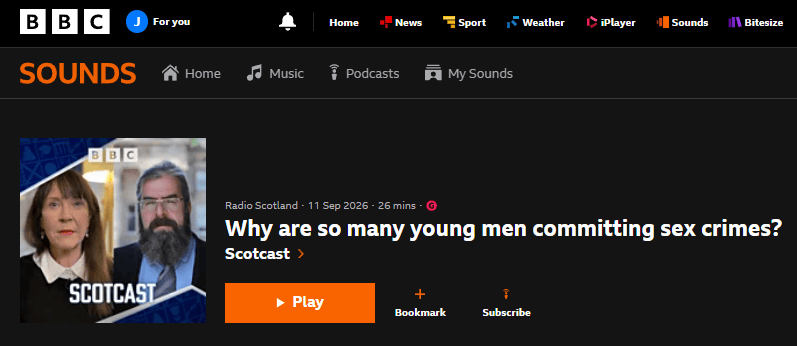
From BBC Sounds yesterday, the above, and:
Sexual crimes recorded by Police Scotland are at their highest level since 1971. With the Scottish Government preparing to recognise misogyny as a “distinct form of prejudice and abuse” in law, we speak to Karyn McCluskey (pictured left), formerly of the Scottish Violence Reduction Unit, and criminal defence lawyer Tony Lenehan KC (pictured right).
I’m not of course questioning the importance of reducing violence against women but it remains important to make sure this kind of media coverage is not another frenzied scare story lacking informative value.
First, recorded sexual crimes have increased in Scotland but these figures are not a clean measure of prevalence and, rather, may be due to better recording, new offence categories, more victims coming forward and a growth in non-contact online offences. https://cy.ons.gov.uk/peoplepopulationandcommunity/crimeandjustice/bulletins/sexualoffencesinenglandandwalesoverview/latest
Peer-reviewed research evidence?
1.Scottish historical prosecution data (pre-1971) suggests high under-recording due to narrow legal definitions (e.g., marital rape not criminalized until the 1990s) and stigma.
https://openaccess.city.ac.uk/id/eprint/27811/1/1-s2.0-S0277953620307930-main.pdf
2. In the 1970s, reporting was far lower due to stigma, weaker support services, narrower laws (e.g., no recognition of many non-stranger or online-equivalent behaviours), and less awareness. Police-recorded sexual crimes were much lower then despite likely higher actual incidence for equivalent acts. Modern rises are heavily driven by better reporting, historic disclosures, cyber offences (non-existent in 1971), and broader offence categories. https://nij.ojp.gov/topics/articles/has-rape-reporting-increased-over-time
3. Victim surveys like the Scottish Crime and Justice Survey (SCJS) and Crime Survey for England and Wales (CSEW) are less affected by reporting behaviour and provide the best long-term trend data:
- SCJS data in Scotland shows the prevalence of serious sexual assault since age 16 at around 3.6% of adults in recent combined years (e.g., 2018-20), similar to levels seen in 2008-09. https://www.rapecrisisscotland.org.uk/resources-stats-key-info/
- CSEW trends for adults in England aged 16-59 show sexual assault prevalence fluctuating with some increase over the past 10 years after earlier declines, but nothing approaching the tripling seen in police-recorded data. https://www.ons.gov.uk/peoplepopulationandcommunity/crimeandjustice/articles/sexualoffencesprevalenceandtrendsenglandandwales/yearendingmarch2025
- Direct 1970s victim survey data is limited but the overall pattern across decades shows that recorded rises far outpace any survey-measured increases in incidence. Broader violent crime (including non-sexual) has fallen dramatically since the 1990s peak.
Second, BBC Scotland, why Scotland? BBC England, Wales and Northern Ireland have no current reports on this and yet:
Help Talking-up Scotland keep goin
Crowdfunder at: https://www.crowdfunder.co.uk/p/help-talking-up-scotland-keep-going
Or by direct bank transfer to: JOHN WATSON ROBERTSON Sort Code – 08-91-04 Account – 12266421
Discover more from Talking-up Scotland
Subscribe to get the latest posts sent to your email.


BUT NOT A MENTION FROMbbc Scotland
on their TRUTHFUL COMMENTS
LikeLike
Sexual crime is more discussed and reported. Once it was totally hidden even by victims. Considered shameful. ‘Blame the victim’ prevailed. Now it is more openly discussed and criticised as unacceptable. More reported.
The conviction for rape is notoriously low. The victim is often cross examined to intimidate. Problem there is often no witnesses. It becomes one persons word against another. No meaning No. There is more education in schools. Some victims report later. The abuser can be still convicted.
LikeLike