

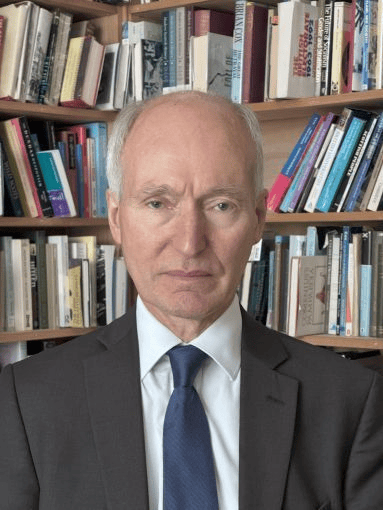
Not just posing in front of books but higgledy-piggledy ones?
Help Talking-up Scotland keep goin
Crowdfunder at: https://www.crowdfunder.co.uk/p/help-talking-up-scotland-keep-going
Or by direct bank transfer to: JOHN WATSON ROBERTSON Sort Code – 08-91-04 Account – 12266421
Regulars here will know that we’ve been reacting, often angrily, to Prof Paterson’s attempts to shame Scottish schools, based on the skills he picked up in his own early research into barley crop yields, bull testicles and other agricultural products.
I won’t re-tread these today.
I have another reason to question his motivations, that I’d forgotten about these 13 years since I did quantitative research into BBC/STV reporting of the referendum campaign and found, a 3 to 1 bias at BBC Scotland and a 3 to 2 bias at STV against the Yes campaign.
In January 2014, it was published online by Newsnet Scotland and went ‘viral’, with around 100 000 hits in one week. It’s still there at: https://newsnetscotland.com/8598-broadcasters-favouring-no-campaign-according-to-new-academic-study/
What, for some reason, I have forgotten to mention much is that at the end of 2013, I had sent the study to the editor at Scottish Affairs, an Edinburgh University ‘research’ journal of modest status. I had previously published there – Naming the First Minister: Scottish Adolescents’ Knowledge and Perceptions of Political Decision-Making Processes – in 2004 at: https://www.euppublishing.com/doi/10.3366/scot.2004.0053 I remember that all of our subjects could name PM Tony Blair but not one could name the First Minister of Scotland though one came close with ‘Jack McGoogle!’
As I remember and this gets a bit sketchy, I spoke to ‘a man’ at Scottish Affairs, who said they might publish my research but only after the referendum so as not to influence it (!), I think. At the time, I’d never heard of Lyndsey Paterson but he was, I’ve checked, editor at the time. Realising then, that even had it been published in Scottish Affairs, it would’ve taken months and only a few hundred would ever have read it, I decided to go online with it.
Paterson’s early career (1980s) early career included, epidemiological research in medicine, work as a statistician for the Agricultural Research Council and a lectureship in actuarial mathematics and statistics at Heriot-Watt University.
His published work in that period was in statistical methodology, especially the design and analysis of experiments. Examples include:
- “Circuits and efficiency in incomplete block designs” (Biometrika, 1983)
- A 1987 Biometrics paper with A.E. Ainsley and H.D. Patterson on predicting the efficiency of incomplete-block trials (a collaboration with the well-known agricultural statistician H.D. Patterson)
He moved to Edinburgh’s Centre for Educational Sociology in 1989, as a Research Fellow. https://registryservices.ed.ac.uk/sites/default/files/2024-07/e-Senate%2014%20-%2028%20September%202022%20-%20Agenda%20and%20Papers.pdf
So, no undergraduate study of education, no teaching qualification, no experience of teaching at any level, no experience of teacher or curriculum development, no postgraduate qualification in education, no leadership role in education, no doctoral supervision in education, no research ethic leadership….SFA!
You have to say WTF does he think he is, telling us how to develop curricula and run schools?
WTF do I think I am?
For nearly 40 years a schoolteacher, a teacher education lecturer, Associate Dean for Quality Assurance, research methods lecturer, PhD supervisor and Faculty Research Ethics Chair
Angry? Me? Too right.
Help Talking-up Scotland keep goin
Crowdfunder at: https://www.crowdfunder.co.uk/p/help-talking-up-scotland-keep-going
Or by direct bank transfer to: JOHN WATSON ROBERTSON Sort Code – 08-91-04 Account – 12266421
Discover more from Talking-up Scotland
Subscribe to get the latest posts sent to your email.


Well said , John. He was a former colleague of mine and I found him extremely opinionated about things he had little or no experience of.
As a lecturer in Primary Mathematics, I got into a ‘discussion’ with him on the teaching (not the learning) of mathematics and what we should be doing in our classrooms. Thankfully his ideas were long abandoned along with slates and lochgellies.
LikeLiked by 2 people
Angry? Me? Too right.
I agree with you what right has a numpty like that to comment on SE except for BBC to use him to scream SNP rubbish.
I would like to see you go head to head with him but not on biased BBC
LikeLiked by 3 people
Head to head?
LikeLike
I used to box. Retired undefeated (never selected) as recently as 1965.
LikeLiked by 2 people
I would like to throw this one in the mix.
Scenario,If there is a vote in the whole of Ireland for unification but Ulster votes no but the Republic votes yes will Ulster have to follow just as Scotland had to do? Just a thought.
LikeLiked by 1 person
Look, Prof Paterson maybe has some Walter Mitty idea that he knows all there is to know about Pisa scoring. We know and BBC Scotland certainly know that its his own fantasy on believing to be some form of expert.
What is worse, is that he seems to be the only Walter that BBC Scotland can get for the money.
Bet you he is a whizz on Bulls Testicles right enough.
Stephen McKenzie
LikeLike
Another professor (Prof Paul Frijters) has joined in the analysis of England’s 2025 PISA results. Following the tone of the title of his piece (below), Frijters does not mince his words!
Frijters, P. (September 12, 2026) ‘The 2025 PISA Results, Part 1 – Lies, damn lies, and English education statistics’.
See: https://www.scienceandfreedom.org/articles/the-2025-pisa-results-part-i/?feed_id=473&_unique_id=6aa4792c64a5a
Well worth a read!
In his bio, Frijters is described as follows: ‘a long-time Professor of Economics, among the top 1% most cited economists and the 2009 “best economist under 40” as voted by the Economic Society of Australia. He worked as a Professor at the University of Queensland and the London School of Economics (LSE) for over 10 years. He is currently working in Saudi Arabia alongside a visiting emeritus professorial position at the LSE.’ His article focuses on the data not on education policy.
LikeLiked by 1 person