

Help Talking-up Scotland keep going
Crowdfunder at: https://www.crowdfunder.co.uk/p/help-talking-up-scotland-keep-going
Or by direct bank transfer to: JOHN WATSON ROBERTSON Sort Code – 08-91-04 Account – 12266421
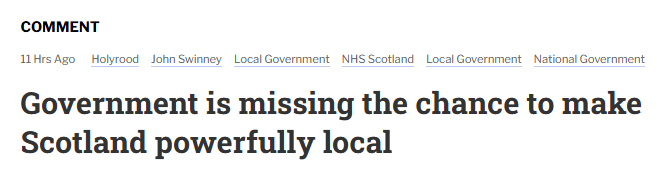
Lesley Riddoch in the National yesterday, with the above and:
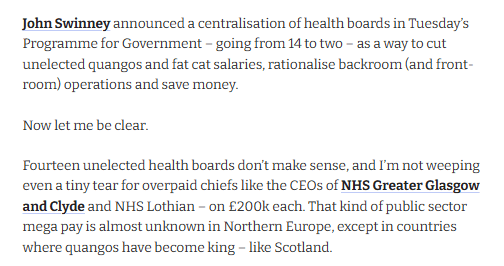
Leaving aside her invitation to ‘islanders’ to make me ‘walk the ferry gang plank’ after I questioned their awareness of just how much the SNP Government has done for them, I still trust Lesley Riddoch as an honest and constructive, not to mention, very articulate, critical friend of the SNP. I have my own concerns on the SNP leadership, especially on foreign affairs, but if you work to destroy them you will regret it and destroy the only organised and powerful force that will take us over the line to independence.
I’m not suggesting that she has joined the huffy-boot brigade of former Yes campaign champions who now spend all their time attacking the SNP, in revenge for not been given the respect and influence they just know they’re entitled to.
However, as with the ferries, now on NHS re-structuring, is she not drifting toward knee-jerk opposition to anything they do? Wings has well-demonstrated the business sense in such a move.
Her argument is long and complex, beyond my time and attention to detail, so a few big comments must suffice.
Before I get to the obvious comparisons with Norway and Denmark, the astonishing and unique decision by Glasgow City council to build a giant new hospital full of the immuno-compromised, right next to, and downwind of, 20 stirred ponds and tanks of raw sewage sludge, show that you need size and diversity in a health board to make sure that a narrow party clique with links to business and organised crime do not put the interests of the latter before that of a tame electorate.
On care, she bemoans its centralisation and missing a chance to let smaller local groups manage that. She must have met or read of a different set of people. The complexity of the issues involved, often science-based, and the need to articulate the system with the NHS, requires highly-trained and qualified professionals with no political agenda, to run that. ‘Powerfully local’ is a romantic dream risking lives.
So, Swinney suggests two mainland boards and one more for the islands, 3.
Norway with a similar population but a larger more challenging area of land has 4.
Denmark with a similar population and a comparable area, has 4.
Let’s see what happens.
Help Talking-up Scotland keep going
Crowdfunder at: https://www.crowdfunder.co.uk/p/help-talking-up-scotland-keep-going
Or by direct bank transfer to: JOHN WATSON ROBERTSON Sort Code – 08-91-04 Account – 12266421
Discover more from Scotland's First and biggest Rebuttal Service -Talking-up Scotland
Subscribe to get the latest posts sent to your email.


Health Boards full of unionist cronies. They have not got a clue. In charge of one of the biggest budgets. £22Billion + social care. A third of government spending.
Lesley Riddoch is very articulate but can be misguided.
Norway and hut ownership. Scotland has a right to roam. People can roam where ever they like in reason. Anyone in Scotland could buy an acre of land £7,000. Build a hut. Or a group can. People in Scotland do not want to. The6 can roam wherever they want. Get a B&B, a hotel or a tent. Cheaper than a hut
LikeLike
There are substantial pressures to reform Scotland’s public services and for multiple reasons – to enhance effectiveness, efficiency and economy, and to ensure financial sustainability and also enhanced equity. The Scottish Government’s proposed reduction in the number of health boards in Scotland – to two plus an islands’ board? – follows a proposal in the Labour Party in Scotland’s last manifesto which also proposed a reduction, though to what number and for where I can’t recall. (Of course, such is the nature of how we in Scotland are governed, the severity of the financial pressures facing the Scottish Government and our public services like health and social care could change overnight subject to decisions of the Westminster government and its judgement on England’s public spending needs, by a relaxation of Westminster’s artificial ‘fiscal rules’.)
There are inevitable trade-offs between ‘centralisation’ on the one hand and the opposite, the distribution of powers and responsibilities to smaller bodies operating at more local levels.
There are scaling issues concerning the possession of sufficient organisational capacity and capability to consider; there are issues around the public acceptance of resulting diversity – greater potential for a ‘post code lottery’ – when shifting along the spectrum from the centralised to the local.
And whilst there may well be an initial attraction in the ‘local’ to gain (perceived) improvement in democratic accountability, there may also be subsequent (and inevitable?) moves in order to enhance capacity/capability for the local to form more or less formal, larger partnership groupings which introduce other layers of organisation without direct democratic control. In short, getting the RIGHT – the optimal – structure is non-trivial.
Intuitively, two mainland plus one islands health boards seems problematic to me but I have yet to read the justification for this choice. Again intuitively, I would have ‘plumped’ for four strategic boards – roughly for (i) Highlands and Islands; (ii) South of Scotland/Borders; (iii) West Central Scotland; (iv) East Central Scotland.
The Norway case noted in the main blog post is interesting. What follows is from a health systems review by The Commonwealth Fund (May 2026) Norway International Health Care System Profiles (https://www.commonwealthfund.org/sites/default/files/2026-05/2026_Country-Profiles_Norway.pdf )
‘Responsibility for health care is divided between national, regional, and municipal governments. The national government plays an active role and is responsible for providing equal access to care regardless of socioeconomic status or geographical location.‘
‘The Ministry of Health and Care Services (Helse- og omsorgsdepartementet, or HOD) is the central government body responsible for the overall planning and regulation of health care services. It sets national health policy goals and develops the National Health and Hospital Plan, which is updated every four years. The Norwegian Directorate of Health (Helsedirektoratet) reports to the HOD, implements its policies, and is responsible for developing national clinical guidelines and licensing health personnel. The Ministry of Digitalisation and Public Governance (Digitaliserings- og forvaltningsdepartementet) leads digitalization efforts in health care.
‘The four regional health authorities (Regionalt helseforetak, or RHF) are responsible for specialist care. The RHFs manage 20 hospital trusts and finance and oversee hospital services. They work to ensure that specialized care aligns with national policies while addressing regional needs.‘
‘Municipalities play a role in the delivery of primary care, rehabilitative care, nursing services, and public health initiatives — the last, often in cooperation with Norway’s counties, which also help oversee the coordination of care. Counties serve as administrative appeal bodies for municipal decisions concerning health services. Municipalities organize and provide essential services, which are funded through a combination of municipal taxes, central government grants, NIS contributions, and patient copayments. Municipalities also manage programs focused on disease prevention, mental health, and social well-being.‘
‘Although the health system is well-resourced overall, there are persistent challenges related to workforce shortages and coordination.’ (my emphasis)
‘In March 2024, the government adopted the National Health and Cooperation Plan 2024–27 which outlined objectives for future reforms, including workforce development, improved care coordination and integration, and shorter wait times.’
‘Most public hospitals are concentrated in the highly populated southeastern region. Access to health care in sparsely populated northern and rural areas, however, can be challenging. For instance, in the county of Nordland, hospitals within a single trust can be more than 500 kilometers apart.’
According to Wikipedia, there are 15 administrative regions, called counties in Norway. These counties are subdivided into 357 municipalities (as of 2024). The municipality is governed by a municipal council of directly elected representatives. The mayor is indirectly elected by a vote of the municipal council.
According to Wikipedia: ‘Municipalities are undergoing continuous change by dividing, consolidating, and adjusting boundaries. In 1930, there were 747 municipalities in Norway. As of 2024, there are 357 municipalities. …. The consolidation effort has been underway since the work of the Schei Committee in the 1960s.’
From a quick online search it appears that over time the number of municipalities has been reducing through consolidation/merger and the number of counties in recent times has fluctuated up and down.
LikeLiked by 1 person
Norway has 4 regional boards. Scotland would have 3.
Norwegians pay a small contribution. A limit then it is free – rest of the year.
Norway have a soveign fund. Scotland’s revenues and income are governed by Westminster. Limited fiscal autonomy, to decide how much is spent, and what on. Devolution limited powers. Unequal and unfair.
Norway limits alcohol consumption. Alcohol consumption a threat to public health
LikeLike
stewartb’s contributions are always well reasoned and his 4 regional board suggestion has merit though many subtleties will likely be trampled. However I sense a political action on the part of the Scottish government to distance itself from multiple board controversies. Also the only reason health board administrations function at all is because of a small number of crucial mid to upper level managers, usually with a degree of power but also some form of real clinical experience who skilfully negotiate between their former clinical colleagues and make the required noises to the upper brass who are working to a political agenda sometimes almost entirely divorced from clinical reality. When these crucial roles disappear the ‘system’ may functionally collapse. Most worryingly of all, board level decisions about IT have gradually become centralised nationally and any crucial software decisions still made at board level are about to disappear e.g. many boards are using Netcall’s ‘Patient Hub’ appointment management software, which has only been in place for a short number of years but will now be replaced with the national ScotAccount/MyCare.scot/National Digital Platform schema which openly states online (always look for the ‘privacy pages’) that patient data may be accessible to “other UK public sector organisations, such as the Home Office” and “law enforcement agencies such as Police Scotland or the National Crime Agency”. The newly formed Public Services Delivery Scotland (PSD, by merger of NSS and NES) had, when I last looked, only one (non-exec) board member with any semblance of IT qualification. I suspect not so much a Scottish government choice of dystopia as sheer inability to negotiate meaningfully with the multinational (mainly US) companies now moving to complete control of all Scottish public data systems. These companies are also behind the push for BESS and ‘AI’ hyperscale datacentres and Scotland’s entire data ecosystem is now effectively owned and controlled by mainly foreign multinationals. The health board centralisation is simply the political manifestation of this level of citizen control, fronted by outmanoeuvred and naïve (by US standards of rapaciousness) Scottish politicians. For examples of real patient or citizen centred systems at a much lower cost and no ‘big tech’ look to Flanders or Estonia.
LikeLiked by 1 person
AI can detect heart disease and cancers in people not suffering symptoms.
LikeLike