

Help Talking-up Scotland keep going
Crowdfunder at: https://www.crowdfunder.co.uk/p/help-talking-up-scotland-keep-going
Or by direct bank transfer to: JOHN WATSON ROBERTSON Sort Code – 08-91-04 Account – 12266421
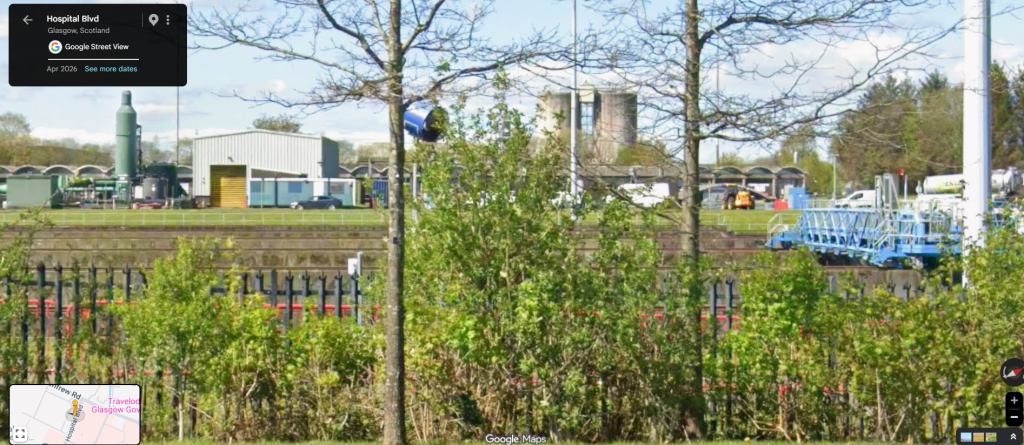
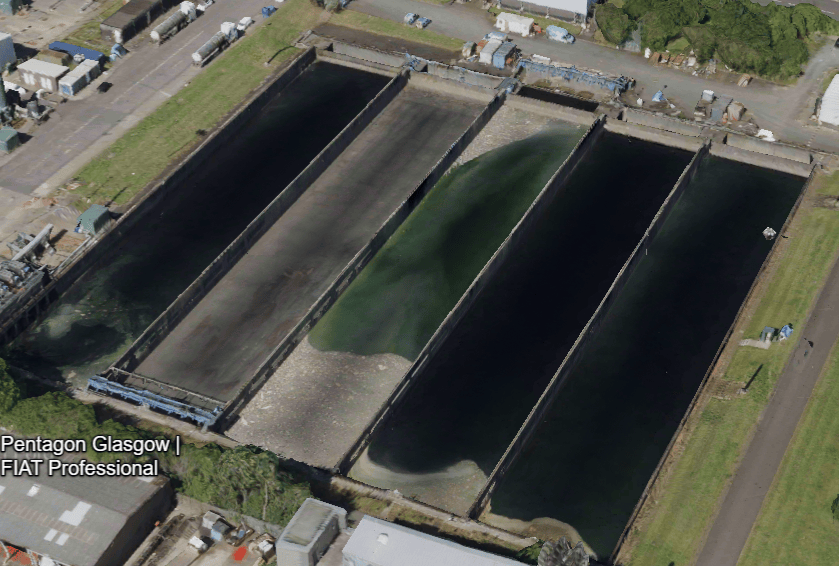
The view above of five large open-topped raw sewage tanks, from the viewpoint in the red arrow below.
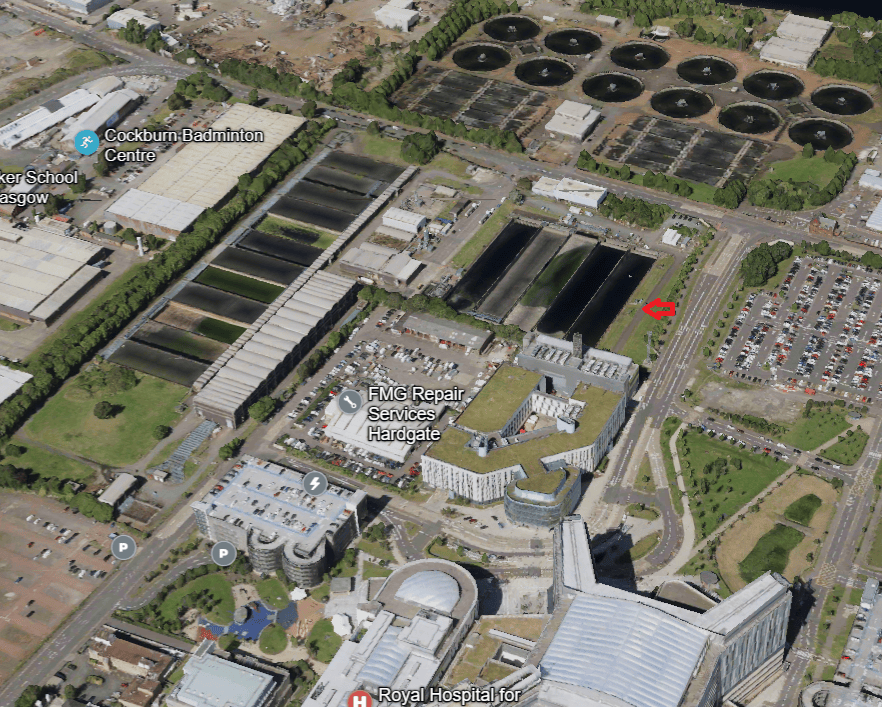
To the left, the viewer sees a large building with the moss green flat roof – labs, testing. A wee wall attempts to protect it from sewage bioaerosols containing more bacteria and fungi which travel around 100m, than anyone could list here. To the left again, at the bottom of the image, the main hospital entrance and in the semi-circular, the hospital for children where cancer deaths were blamed by some on fungal contamination of water supply and drainage because the SNP hadn’t made sure it was properly maintained and all the pigeon poo cleared up.
Moving clockwise, 14 or so narrow grey roof panels covering the tanks where the sewage first arrives on site to be separated from objects that cannot be treated and which are taken away to landfill by lorries, and behind them, another twelve open-topped sewage storage tanks upwind of the wards.
Help Talking-up Scotland keep going
Crowdfunder at: https://www.crowdfunder.co.uk/p/help-talking-up-scotland-keep-going
Or by direct bank transfer to: JOHN WATSON ROBERTSON Sort Code – 08-91-04 Account – 12266421
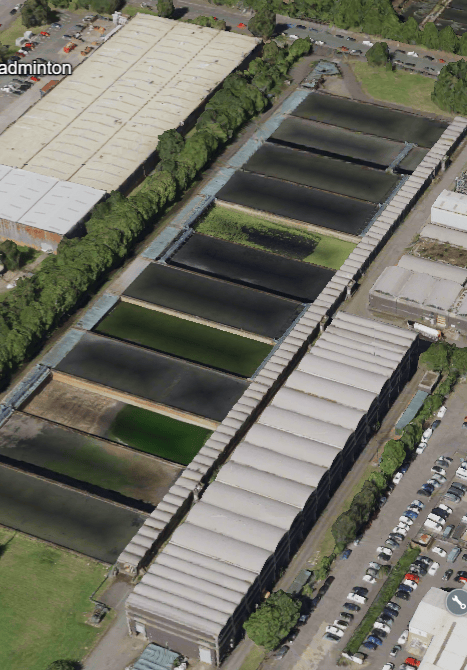
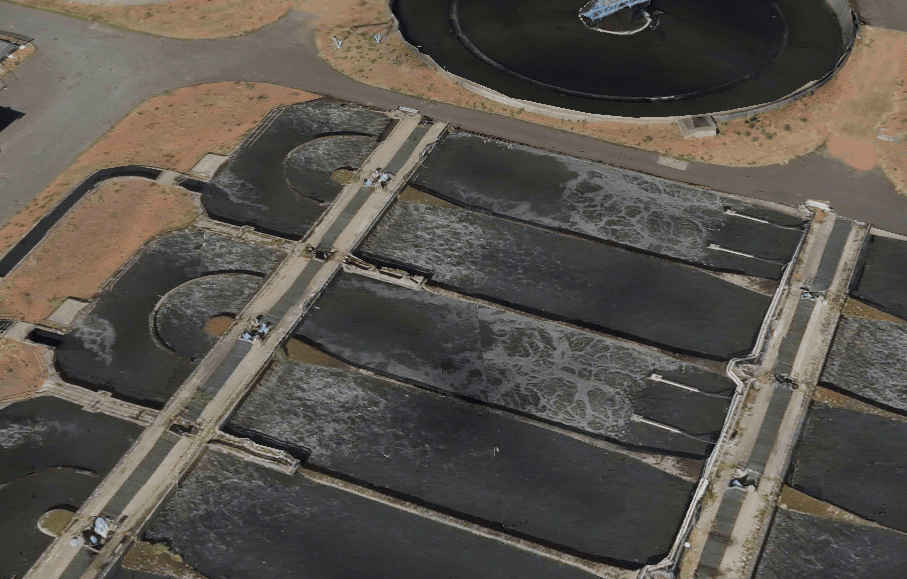
Moving away from the hospital building and under what is Renfrew Road, 24 smaller, still open air, ponds.
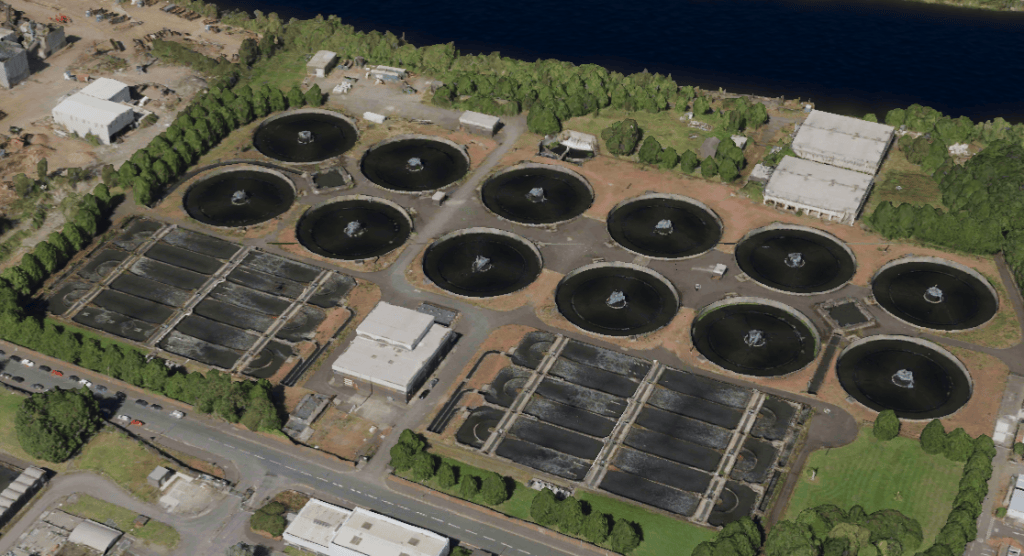
Lots of movement, lots of air pollution:
Finally 12 huge circular, stirred open-air ponds.
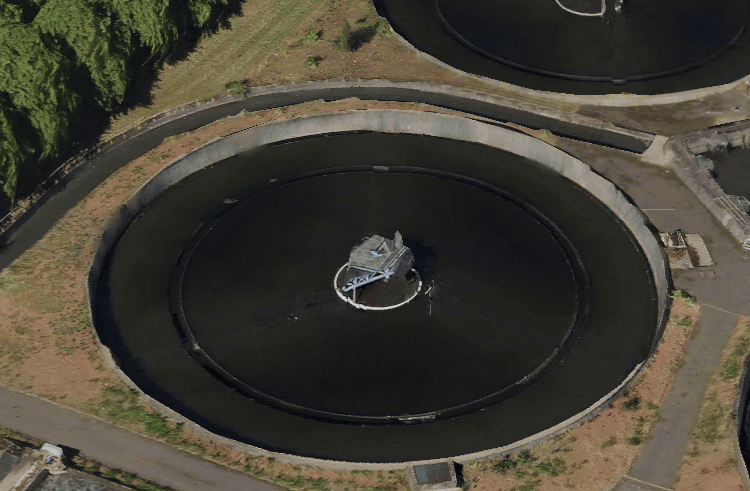
Have they been covered? The furthest away from the hospital with the least toxic contents, just before being pumped into the river and they cover them?
In total around 50 ponds or tanks, most open-air and stirred, full of millions of litres of raw sewage, some leaking into the ground and almost all polluting the air for hundreds of metres around, especially when the main westerly winds blow.
Who in their right mind ever thought this was a good site for a hospital? It reminds me of those mafia series where scared officials give them the waste disposal contracts and they dump all manner of stuff into rivers and lakes.
When NHS Forth Valley decided to build a new super-hospital, they moved it even further away and still upwind. There’s no trace of debate in media from the time. I guess nobody tried to make them do something stupid like build it near Skinflats so they could build nice 4 bedroom houses in Larbert, handy for commuting to Glasgow or Stirling?
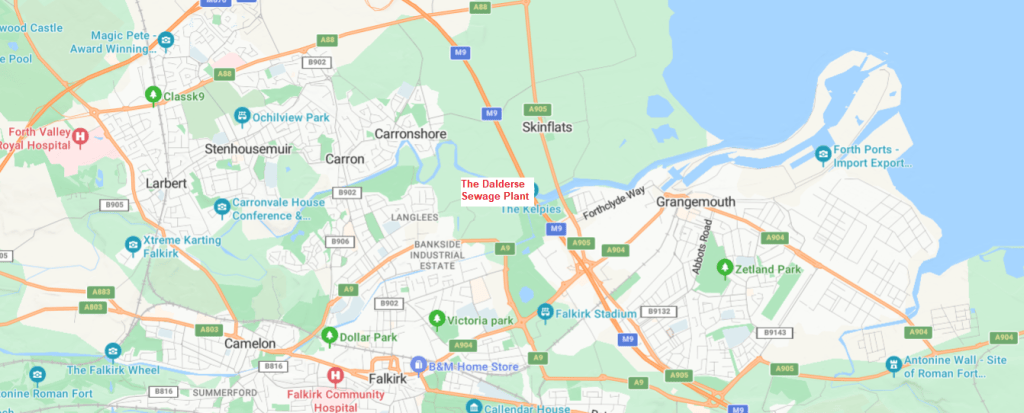
I can’t believe this. Can you? It’s mental.
Help Talking-up Scotland keep going
Crowdfunder at: https://www.crowdfunder.co.uk/p/help-talking-up-scotland-keep-going
Or by direct bank transfer to: JOHN WATSON ROBERTSON Sort Code – 08-91-04 Account – 12266421
Discover more from Scotland's First and biggest Rebuttal Service -Talking-up Scotland
Subscribe to get the latest posts sent to your email.


I think it’s worse than mental – it’s criminal. A public inquiry is called for.
LikeLiked by 3 people
Yep, 100%
LikeLiked by 1 person
AI-generated answer. Please verify critical facts.
Identified microbes in raw sewage at Shieldhall Sewage Works
At the pre-sedimentation and primary sedimentation stage, the microbial community is fundamentally different from the aeration tank.
There is no selection or cultivation here — the community is essentially the raw influent load arriving from the sewer network. The environment is stratified: aerobic at the surface, anoxic in the mid-zone, and anaerobic in the sludge blanket.
Bacteria (~99%+ of total cell count)
Fecal / enteric (dominant in raw sewage):
Anaerobes (sludge blanket / anoxic zone):
Facultative / versatile:
Dominant phyla in raw influent: Firmicutes (faecal), Proteobacteria (enteric), Bacteroidetes (faecal), Actinobacteria
Key point: Nitrifiers (Nitrosomonas, Nitrospira) are negligible at this stage — they are slow-growers requiring stable, well-aerated conditions and are only established in the aeration tank.
Protozoa
Pathogenic (faecal origin — the main public-health concern at this stage):
Free-living (naturally present in raw sewage):
Free-swimming ciliates (early-stage, high-organic indicator):
Note: The bacterivorous stalked ciliates (Vorticella, Epistylis, Zoothamnium) and rotifers that dominate the aeration tank are absent or very rare at this stage — they have not yet colonised.
Fungi
Yeasts:
Moulds (filamentous):
Fungi are present at low levels in raw sewage and become more significant in the anaerobic sludge blanket where they contribute to hydrolysis of complex polymers (cellulose, hemicellulose).
Viruses
Enteric viruses (faecal origin — a major pathogen group at this stage):
Bacteriophages:
Phage counts in raw sewage typically range from 10³ to 10⁶ PFU/mL, making them the most abundant viral group.
Metazoa
Nematodes (faecal origin):
Rotifers (low abundance at this stage):
Oligochaetes:
Tardigrades:
Algae
Very low abundance at this stage due to high turbidity and low light penetration. Where present (near the surface):
Dunaliella spp.
Chlorella spp.
Scenedesmus spp.
LikeLike
AI-generated answer. Please verify critical facts.
From AI
At Shieldhall Sewage Works, no microorganisms are deliberately added from an external source. The plant uses the activated sludge process, which relies on naturally occurring microorganisms already present in the wastewater.
These populations are cultivated and maintained in situ through aeration and recycling of return activated sludge (RAS).
The key microbial groups working in the aeration tanks are:
A typical activated sludge floc is roughly 95% bacteria, 4% protozoa, and 1% metazoa.
The process is essentially a controlled, aerated “composting” of the organic load, with the microbial community self-sustaining as long as the operator maintains the right food-to-microbe ratio (MLSS) and dissolved oxygen levels.
Here’s a detailed breakdown of the microorganisms found in each group in the aeration tank:
Bacteria (~95% of biomass)
Floc-forming / carbon-removing (aerobic heterotrophs):
Nitrifiers (ammonia → nitrate → nitrite):
Filamentous (floc structure / can cause bulking):
Dominant phyla: Proteobacteria (27–49%), Bacteroidetes (19–37%), Chloroflexi (3–17%), Acidobacteria (2–14%)
Protozoa (~4% of biomass)
Amoebae (early-stage / start-up indicator):
Flagellates (early / shock loading indicator):
Ciliates – free-swimming (mid-stage):
Ciliates – stalked/sessile (mature sludge / high-quality effluent indicator):
Metazoa (~1% of biomass)
Rotifers (Monogononta & Digononta – mature sludge indicator):
Nematodes (old sludge / high SRT indicator):
Tardigrades (water bears – stress-tolerant):
Other:
Practical note for the operator: The relative dominance of these groups shifts with sludge age. Young sludge → amoebae & flagellates; mature sludge → stalked ciliates & rotifers; over-aged sludge → nematodes & tardigrades. A healthy, well-aerated system (DO > 1–2 mg/L) at Shieldhall would be expected to show Vorticella, Epistylis, Carchesium, Zoothamnium, Aelosoma, Arcella, and Monogononta rotifers as the dominant higher organisms.
LikeLike
Multiple species of Aspergillus found in presedimentation stage and in sedimentation tanks i.e. contiguous with QEUH campus on northern and western boundaries. Aspergillus is said to have been involved in two of the seven QEUH / RHCG deaths under investigation.
LikeLike
Dr Teresa Inkster emerges from the Scottish Hospitals Inquiry with merit https://www.hospitalsinquiry.scot/sites/default/files/2024-09/Dr%20Teresa%20Inkster%20-%20Witness%20Statement%20-%20Final%20-%20Glasgow%203%20hearings%20-%2009%20August%202024%20-%20Redacted.pdf (see page 50 onwards re culture and bullying). She also openly investigated the Cryptococcus Neoformans species found at the QEUH and implicated in two of the deaths along with independent colleagues from various universities in England and one from MIT / Harvard : https://www.microbiologyresearch.org/content/journal/mgen/10.1099/mgen.0.000537. Basically the Cryptococcus Neoformans infections were two different genetic isolates and not from any pigeon guano tested. I don’t think a sewage works source is excluded: https://www.sciencedirect.com/science/article/pii/S259017022200022X#s0055
LikeLike
Have just spent 2 hours on the above and getting nowhere. Too hard. Does this suggest with evidence bacterial infection from the sewage works into the wards?
LikeLike
Prefer precise references to AI but thought the lists for each of the sewage works would allow readers ro see the sheer scale of the problem. And allow cross reference to any future outbreak of infection. The multiple Aspergillus species in the waste transfer station are not fully defined and the precise species in the two patients who died form Aspergillus have not been stated either. So a definitive statement is impossible. The Cryptococcus Neoformans in the two patients who died are genetically distinct form each other and from the two isolates from pigeon guano – there is no common source. I think it is fair to say that a sewage source cannot be definitively ruled out. But again, not definitive. However your own theory (and it is just a theory) about staff being contaminated in the staff car park next to the ‘final five’ sediment ponds is worth considering. Tom Makin made the point that the necessary tests of dispersion from the waste (and I think he meant from across Renfrew Road 300m away) simply hadn’t been done by the time of his inquiry evidence. You’ll probably be dismissed but that’s as good a theory as any. I didn’t see my comments about published but it’s the same story…non-one knows where it came from, I simply tried to show that a sewage source is possible: Stenotrophomonas maltophilia involved in the death of two patients can not only be found in sewage works (https://www.sciencedirect.com/science/article/abs/pii/S1438463917304832?via%3Dihub) but can actually be artificially added as part of the waste treatment process (https://www.sciencedirect.com/science/article/abs/pii/S2213343725010012?via%3Dihub). Neither of these scenarios can be applied to Shieldhall. Finally Mycobacterium chelonae seems to be a common contaminant of any water or sewage system, the additional issue is the immunosuppression suffered by the patients. I’m not being of much help but if you want a simple statement the car park contamination theory is worth pursuing along with illustrative pictures (the latest ones are the best yet) and the aphorism, my dear John Watson, that when you have eliminated the impossible, whatever remains, however improbable, must be the truth.
LikeLike