

Help Talking-up Scotland keep going
Crowdfunder at: https://www.crowdfunder.co.uk/p/help-talking-up-scotland-keep-going
Or by direct bank transfer to: JOHN WATSON ROBERTSON Sort Code – 08-91-04 Account – 12266421
AI just tells you what you want to hear?
If it’s personal – how you should treat your wife or whether you have a good idea for a new business – yes, but if you ask it something it does not know is political and where there is published evidence – does the presence of a bad smell from a nearby sewage works in a hospital ward mean that the dangerous bacteria causing the smell is present too – it will tell you the truth, probably not.
Like almost everybody else on the issue of the siting of the Queen Elisabeth University Hospital near a monstrous sewage works in Glasgow, I have an agenda. I want to find reliable evidence that the Labour Party is to blame for infections because of their suspicious decision in the first place to site it there and they want evidence that the Hospital Board and the Scottish Government, by oversight, are to blame for not properly maintaining the site and allowing fungus to grow in the water supply and infect young cancer patients.
Grok AI would not side with me, pointing to speedy fall off in bacterial levels in short distances and quoting the site scientists in claiming it was air and water tight.
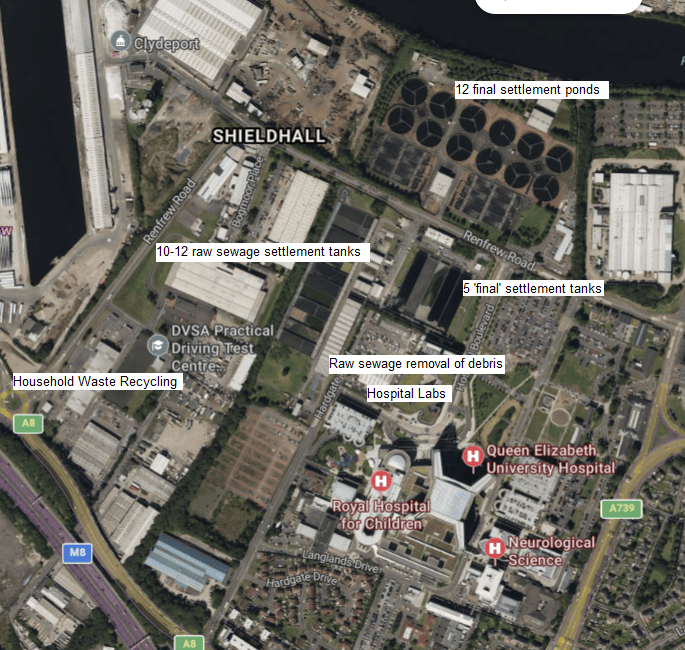
Even when I pointed to the proximity of the various sludge ponds to the Royal Hospital for Children, it doubts that ‘viable’ bacteria would reach it at distances of more than 100m.
I kept going, as you must with AI, because it has no agenda on this kind of issue. I suddenly had a thought about the car park, directly adjacent [5 metres at most] to the raw sewage removal and the 5 ‘final’ settlement tanks, and asked:
The hospital car park is very near the raw sewage ponds. Will staff, patients, family parking there not breathe in the bacteria laden aerosols and carry them on their bodies into the hospital
What might a human working for the health board or the Labour Party, now find and say to that? You know. Grok AI hs not been tutored on this, as it has on Gaza and Trump, finds the evidence and tells you directly what that says:
Yes. People using a car park right next to raw sewage ponds with surface aerators will be in one of the highest-exposure spots outside the works.
Breathing
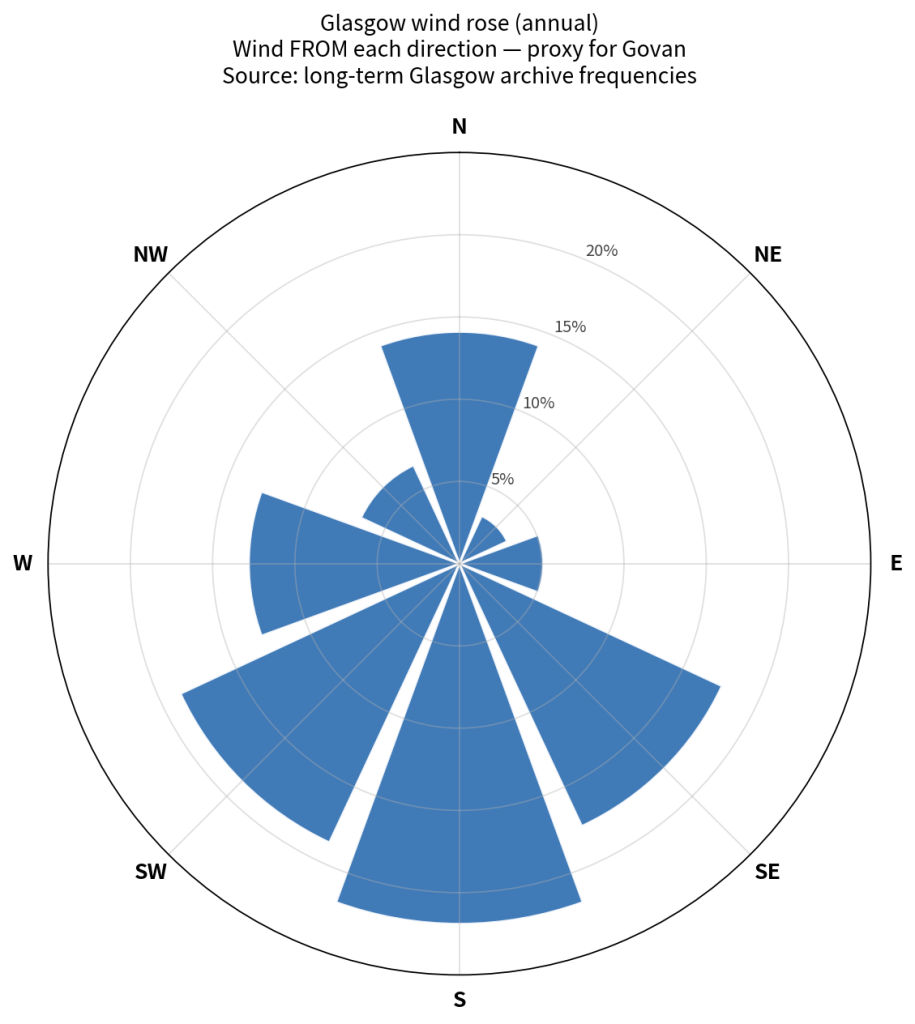
Surface aerators throw droplets and particles into the air. Close to the ponds those levels are at their peak. Anyone standing or walking in the car park for even a few minutes will inhale some of that aerosol, especially when the wind is blowing from the ponds toward the cars. That is ordinary outdoor exposure at a short distance, not a sealed indoor space, carrying it in.
Particles also settle on:
- clothes, hair and shoes
- car bodywork, door handles and interiors when doors are opened
- bags and wheelchairs
Those people then walk into the hospital. Some of what landed on them can come off again indoors. This is the same kind of transfer that happens with ordinary outdoor dust, pollen or traffic particles — except here a fraction of it originated in sewage.It is not the same as walking through a visible spray of untreated sewage. Concentrations drop with even a short extra distance and with rain (common in south-west Scotland), and most particles that stick to clothing are not highly concentrated live pathogens. But “very near the raw ponds” is exactly where you would expect both inhalation and some contamination of clothing and vehicles.
Practical implications:
- Staff and regular visitors who park there get repeated short outdoor exposures.
- Opening car doors and then entering the building creates a small pathway from the pond-side air into the hospital.
- Filtration inside the hospital reduces what stays airborne indoors; it does not stop what arrives on people and belongings.
A car park immediately beside surface-aerated raw ponds is a poor location if the aim is to keep sewage-related aerosols away from patients and staff. Moving parking farther downwind or putting a buffer (distance, planting, a building in between) would cut that pathway more than any attempt to make the hospital itself airtight.
How the wind blows around the QEUH:
Help Talking-up Scotland keep going
Crowdfunder at: https://www.crowdfunder.co.uk/p/help-talking-up-scotland-keep-going
Or by direct bank transfer to: JOHN WATSON ROBERTSON Sort Code – 08-91-04 Account – 12266421
Discover more from Talking-up Scotland
Subscribe to get the latest posts sent to your email.


Your statement that people going from the QEUH car park into the hospital building with particles and airborne bacteria on their clothes deriving from the proximity of the car park to Shieldhall Sewage Works, reminds me of a story given high prominence by BBC Scotland during the Covid restrictions.
BBC Scotland, like most of the media were hostile to COVID restrictions because they had been enacted by the ‘SNP’ Government.
The story derived from a consultant in a discipline which was not public health who had ‘spoken to a BBC presenter at a private dinner party’. She claimed the Covid regulations were not being adhered to because when she entered the building no one had told her to use the hand wash which was prominently available near the entrance. There were large notices instructing people to use the handwashing before entering. All staff had been instructed to use hand wash. All members of the public were instructed to do so via media messaging. There were security staff on duty. But this doctor was in high dudgeon because someone had not instructed her personally to use handwash.
This non-story was politicised as ‘top doctor slams government health procedures.’
LikeLiked by 3 people
Worth developing- do you remember which doctor?
john
LikeLike
From “exile”
I wrote to the Prof about this at the time, but unfortunately can’t find the email. I heard an early morning interview by Johnnie Beattie with the consultant, in which he referred to having met her at a dinner party.
LikeLike
IIRC the Household Waste facility is actually an incinerator which also emits a plume of contamination downwind of the hospital.
Unbelievable than any sane person would locate a hospital in that vicinity.
LikeLike
Compliments regarding the car park contamination observation…think it might be ‘staff only’ but the point remains of carriage elsewhere (hospital staff means everywhere). Intended to check and (reluctantly, I rarely use Google or Grok) looked on streetview and my horror was renewed. The image dates confusingly varied from 2014-2026. Follow Hospital Boulevard through to Hardgate Rd and look straight ahead at the massive presidimentation plant and travel down Hardgate Rd along the extensive multi-storey length. Travel back along Hospital Boulevard and look between the lab/mortuary building (look for ‘no entry’ signs) and the most distal hospital building, intended for lab vehicles and see how close the ‘Pre-sed’ building is. And just in front of that last hospital building the fun really begins…you are right next to the tanks of shit. Then the pavement takes an inward bend so you are even closer. They’re trying to screen it with bushes but the horror that Prof R describes as contaminating the car park is just outwith touching distance. Then turn left into Renfrew Rd and travel past the entrance to Shieldhall Waste Water Treatment Works across Renfrew Rd (the processing site) before reaching ‘Gate 3 Shieldhall Waste Transfer Station’ where you can see the hospital loom over the sewage buildings right next to it. They say that digital scent technologies are on the way…https://www.google.com/maps/@55.8641643,-4.3405989,10a,75y,205.46h,93.24t/data=!3m7!1e1!3m5!1sJpDe3BtS8Al0ceHJciKt4w!2e0!6shttps:%2F%2Fstreetviewpixels-pa.googleapis.com%2Fv1%2Fthumbnail%3Fcb_client%3Dmaps_sv.tactile%26w%3D900%26h%3D600%26pitch%3D-3.239999999999995%26panoid%3DJpDe3BtS8Al0ceHJciKt4w%26yaw%3D205.46!7i16384!8i8192?entry=ttu&g_ep=EgoyMDI2MDgzMC4wIKXMDSoASAFQAw%3D%3D No ‘AI Slop’ here Gregor McIntosh, it’s real! Please stay with us and fight this.
LikeLike
Thanks once more
Not being familiar with the site, I’m struggling to find these key images.
Could you capture them and send me them?
John
LikeLike