

From clear liability for a looming health disaster in 2001 to a media transferring the blame to an innocent party in 2017
Help Talking-up Scotland keep going
Crowdfunder at: https://www.crowdfunder.co.uk/p/help-talking-up-scotland-keep-going
Or by direct bank transfer to: JOHN WATSON ROBERTSON Sort Code – 08-91-04 Account – 12266421
By stewartb
The full transcript of this debate in the Scottish Parliament on 17 January 2001 can be read here: https://www.parliament.scot/chamber-and-committees/official-report/search-what-was-said-in-parliament/meeting-of-parliament-17-01-2001?meeting=4278&iob=28854
What is abundantly clear from the record is substantial cross-party discontent with the nature of and response to the public consultation undertaken by the health board regarding options for the proposed new south Glasgow Hospital, including in particular its location. The issues concerning location included but went much further than proximity to a sewage plant!
The government reply to the debate was given by Labours’s Deputy Minister for Health and Community Care, Malcolm Chisholm MSP. Addressing the Chamber, the minister noted:
“.. as we have said on numerous occasions, decisions affecting local communities are best taken by those who provide the services locally in partnership with those who use the services. Therefore, it would be inappropriate for me to become too embroiled in the details of the Glasgow situation.“ Now there’s a line present Scottish Government ministers would get away with – aye right!
I believe the health minister at the time was Labour’s Susan Deacon MSP. The BBC News web site had this article dated 26 December, 2001: ‘Scottish politics review 2001 – January to March‘. In it we learn of another choice remark made by a Labour health minister: ‘Health Minister Susan Deacon had less luck in dealing with NHS doctors. The physicians and opposition parties aimed a barrage of criticism in her direction after newspapers alleged that she accused doctors of “sniping from the sidelines”!
(And off-topic, from the same BBC Scotland article, something I did not know: ‘The New Year was barely days old when a political identity crisis grabbed the headlines and caused untold grief for Henry McLeish who was just two months into the job of first minister. One of his most trusted lieutenants – Minister for Parliament Tom McCabe – had apparently suggested that the Scottish Executive could change its name to the Scottish Government in a bid to clear up any confusion over its responsibilities.’
And: ‘The Scottish National Party (SNP) seized gleefully on the statement and used it to press further claims for independence amid mutterings of disquiet in the ranks of London Labour. After much embarrassment the issue was finally put to bed when Henry McLeish insisted that the executive was a government and did not need a name change to justify this.’)
Help Talking-up Scotland keep going
Crowdfunder at: https://www.crowdfunder.co.uk/p/help-talking-up-scotland-keep-going
Or by direct bank transfer to: JOHN WATSON ROBERTSON Sort Code – 08-91-04 Account – 12266421
Discover more from Talking-up Scotland
Subscribe to get the latest posts sent to your email.


I am stepping aside a little from the main thrust of this series of postings about the decision to locate what is now the QEUH on the former Southern General Hospital site, which is juxtaposed to the large Shieldhall sewage works.
What struck me reading the transcript of the debate was that the Scottish Parliament was conducting itself in the deliberative non-partisan way which was intended, when the electoral system was established and designed to make it difficult for any single party to attain a majority of seats. This meant that there would have to be negotiation and temporary alliances amongst members of different political parties to explore things more deeply and to reach consensus.
There was courtesy and respect amongst members, acceptance of valid points made by members irrespective of party. There was a preparedness to step away from dogma and ‘party purity’ and seek to find a common good. Yes, there were barbs, such as from Ms Elder, but they were asides and a bit of debating flummery.
Since 2007 much of that has changed, with the Labour Party in particular becoming oppositionist in practice as exemplified by people like Jackie Baillie, Johan Lamont and Iain Gray. We saw in that Parliament how people like Annabel Goldie and, even, Wullie Rennie were able to reach deals with Alex Salmond’s government. But, post 2012, when the SNP confounded the electoral system by attaining a majority, the consensus building approach fell away.
Although in subsequent Parliaments no party has achieved an overall majority, with the increasing number of seats being gained by the Greens, who favour independence, we have had a pro-independence majority and a fragmented unionist opposition who are all largely oppositionist, either little in common other than to oppose and blame.
Blaming is now the main strategy of all the opposition parties. It is unconstructive and it seems unlikely that the kind of consensual debate we had about the siting of the South Glasgow hospital will take place in the near future.
Tory support has split with the growth of Reform and we have a battle between right wing nastiness. Labour is shrinking because its oppositionism has meant it has never seriously thought constructively since 2007. And its leadership contest, with the misogynistic exclusion of Monica Lennon, is a debate between the two cheeks of Jackie Baillie’s arse.
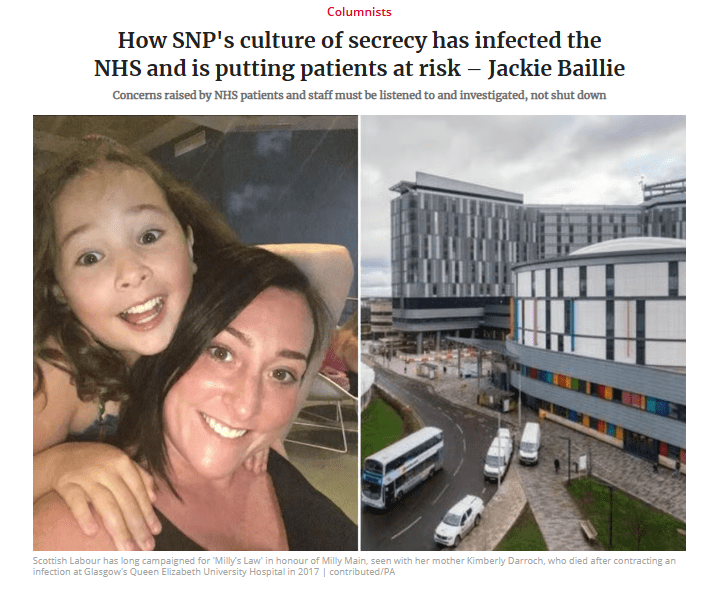
Millie Main and the water supply has been the tragic distortion and paucity of Labour thinking, in seeking to blame the child’s death on the SNP. What the revelations about the siting of the hospital show is that if anyone, other than the biochemistry of cancer, is to blame for her death it is members of the Labour Party within Glasgow City Council in the early years of this century. And, yet, Jackie Baillie continues to blame because she has no other policy.
LikeLike