

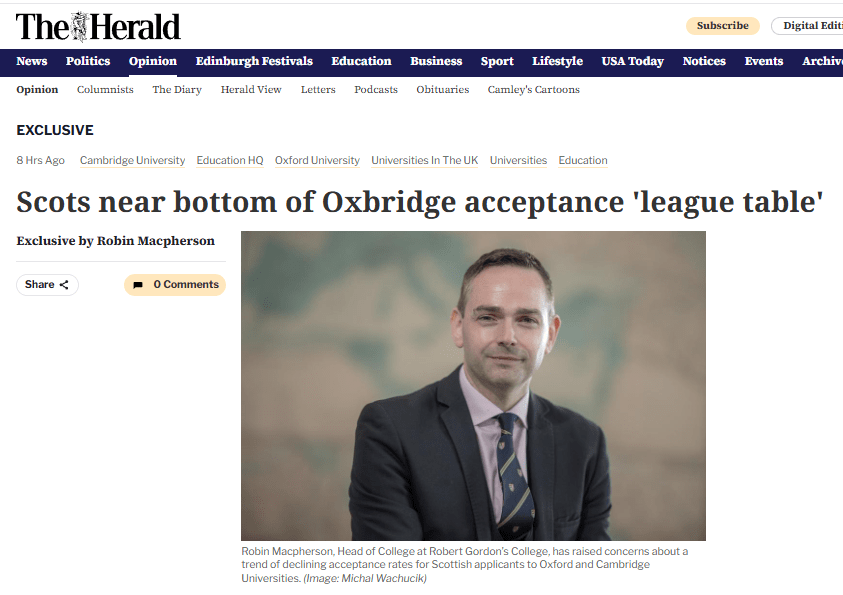
In the Herald education supplement today, the above, from a fee-paying school head, is titled – Alarm as Oxbridge places for Scots fall’
Help Talking-up Scotland keep going
Crowdfunder at: https://www.crowdfunder.co.uk/p/help-talking-up-scotland-keep-going
Or by direct bank transfer to: JOHN WATSON ROBERTSON Sort Code – 08-91-04 Account – 12266421
Thanks to Ian McAnulla for alerting us to this:
In the New York-owned Herald today, the above and:
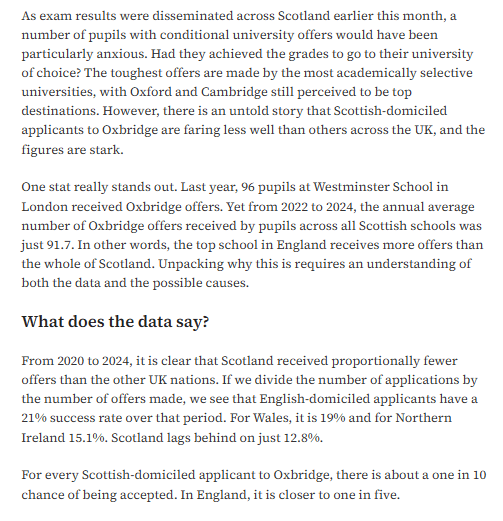
While it may be no surprise that success rates are higher in England, more important would be any change in the rate over time. The same analysis notes that in 2016 the combined Oxbridge offer rate for Scottish applicants was 18.4% and the acceptance rate 15.2%; both have fallen by around five percentage points. Applications from Scotland have risen over that period (from under 500 a year to around 800), so the drop is in conversion rather than in the number of people applying.
This is statistically significant and warrants investigation for some. Not only have acceptances fallen but they have done so against increased applications.
According to the Herald, commentators point to curriculum divergence (Scotland’s Curriculum for Excellence versus England’s more knowledge-rich National Curriculum), reduced availability of Advanced Highers, and weaker preparation for Oxbridge-style admissions tests and interviews as contributing factors. It’s difficult to question this interpretation but more important by far, for me is the question why should we care?
The historical dominance of Oxbridge graduates across the institutions of the UK and in Scotland, is not to be encouraged but fought against. If fewer young Scots are entering Oxbridge, then good!
I’m more concerned about this:
Oxbridge’s outsized role in Britain’s elite pipelines concentrates opportunity among people who already start with advantages, and that pattern has been slow to change. Only about 7% of the population attend private schools, yet they remain heavily over-represented at Oxford and Cambridge and even more so in later elite jobs. Offer rates among applicants are still higher for private-school pupils than for state-school applicants at Oxford. A handful of schools continue to supply a disproportionate slice of places. Regional imbalance is large: London and the South East dominate applications and admissions.https://elitistbritain.suttontrust.com/
Downstream, Oxbridge still feeds power. Sutton Trust Elitist Britain Work (2019 and 2025) finds people in top roles are about 21 times more likely than the general population to have gone to Oxford or Cambridge. The private-school-to-Oxbridge pathway remains the single strongest route into the elite; those who take it are estimated to be around 38 times more likely than average to reach those positions. Senior judges, permanent secretaries, many FTSE chairs, newspaper columnists and a large share of cabinet ministers over decades have been Oxbridge-heavy. That has barely shifted in six years even as cabinets change. IFS analysis has also ranked Oxbridge poorly on overall social-mobility contribution precisely because they admit so few disadvantaged students. https://www.suttontrust.com/our-research/elitist-britain-2025/
Who is that 'leading academic?' Eh, wait, oh yeah, that guy the BBC complained about - Professor John Robertson, Former Teacher Education Associate Dean for Quality Assurance, Faculty Chair for Research Ethics, PhD supervisor, Education Lecturer, School Teacher. WTF does he know?
Help Talking-up Scotland keep going
Crowdfunder at: https://www.crowdfunder.co.uk/p/help-talking-up-scotland-keep-going
Or by direct bank transfer to: JOHN WATSON ROBERTSON Sort Code – 08-91-04 Account – 12266421
Discover more from Talking-up Scotland
Subscribe to get the latest posts sent to your email.


A well-argued piece.
The Herald is also arguing for more PUBLIC support for the PRIVATE sector education system! It seems socialism and redistribution is OK, as long as it is for the more affluent.
The Herald has always ‘slammed’ public sector education, despite 95% of the child population attending local Council schools. It always describes private schools as ‘top’ or ‘leading’. When I wrote to them about this terminology on several occasions none of my letters was published, but a journalist neighbour said that the editors and high heid yins were either privately educated or sent their children to private schools so the terminology used was policy. When I complained to BBC Scotland about its use of such terms, my complaint was rejected because they were being ‘fair and balanced’ by using such terms.
LikeLiked by 4 people
Why would pupils from Scotland choose to go to an institution where they will rack up incredibly huge fees when they could go to a Scottish university & have those fees covered instead?
LikeLiked by 2 people
Wales and Northern Ireland use the same A-level qualifications as England rather than having separate equivalent systems, which may explain why their acceptance rates are higher than Scotland’s?
LikeLiked by 1 person
3,000 privileged acceptance. 12% from Scotland. 250. Is that not acceptance rate per population difference. Oxbridge funded 22 to 1 of all other universities. Funded by all UK taxpayers. Scotland has to mitigate Westminster’s cut to Education funding. 2010 Tories cut £6Billion a year from Education funding. Over £90Billion.
LikeLiked by 1 person
Scottish curriculum gives more choice 5 Higher rather than 3 A Levels. More choice for pupils career choice. In Scotland pupils can do advanced Higher. Equivalent of ‘A’ Levels in sixth year.
LikeLiked by 2 people
Daughter of Ian Duncan & Susan Rice went to Robert Gordon’s refused a place at Oxford. They were not amused
LikeLike