

Help Talking-up Scotland keep going
Crowdfunder at: https://www.crowdfunder.co.uk/p/help-talking-up-scotland-keep-going
Or by direct bank transfer to: JOHN WATSON ROBERTSON Sort Code – 08-91-04 Account – 12266421
From the Scottish Government today:
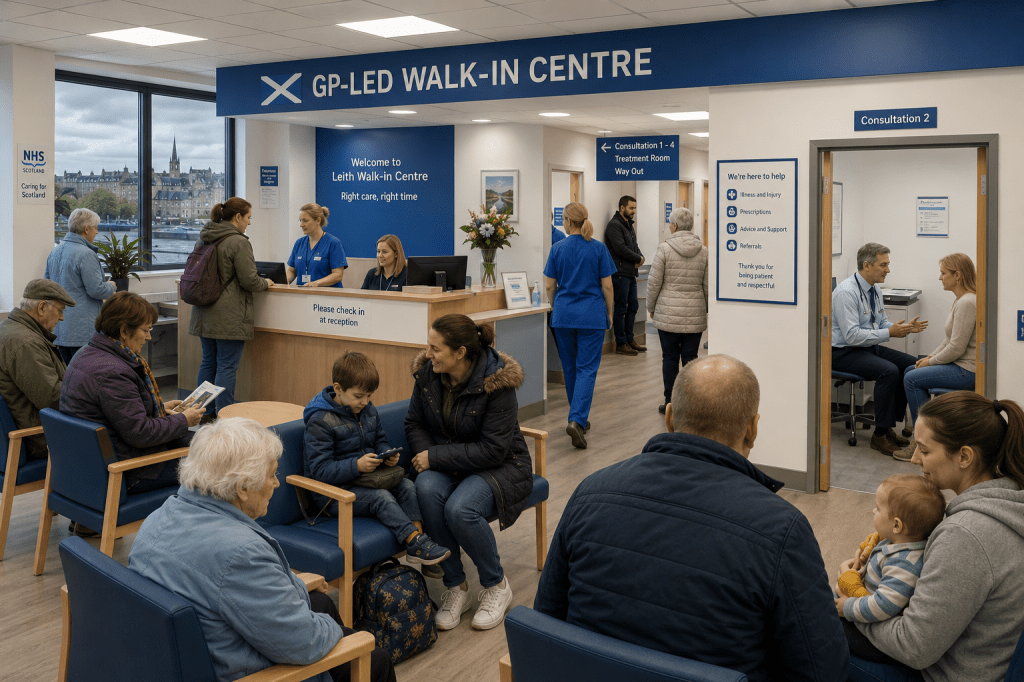
First Minister John Swinney has announced 24 more areas will benefit from new GP-led walk-in services across Scotland, bringing the number of centres planned or operational to 40.
Work is underway with health boards to establish new walk-in services for communities including Angus, Dumbarton, East Kilbride, East Renfrewshire, Edinburgh, Falkirk, Glasgow, Inverness, North Ayrshire, Paisley, Shotts, Tweeddale and West Lothian. Many will be able to open within a year.
Proposals are also in development for walk-in services in communities in Ayr, East Dunbartonshire, Glasgow, Glasgow North East, Glenrothes, Grangemouth, Inverclyde, Musselburgh, North Lanarkshire and Oban.
It comes as First Minister John Swinney marked the official opening of the 11th GP walk-in service in Buckhaven in Fife and announced an extension of the pilot programme until April 2029.
The GP walk-in pilot is testing new ways of accessing same-day care from GPs, Advanced Nurse Practitioners or other clinicians at a wider range of times. They have been designed to provide more choice for patients while helping to relieve pressure on wider NHS services.
https://www.gov.scot/news/new-gp-walk-in-services-announced/
We’ve already seen the wrong-headed opposition to this pilot:
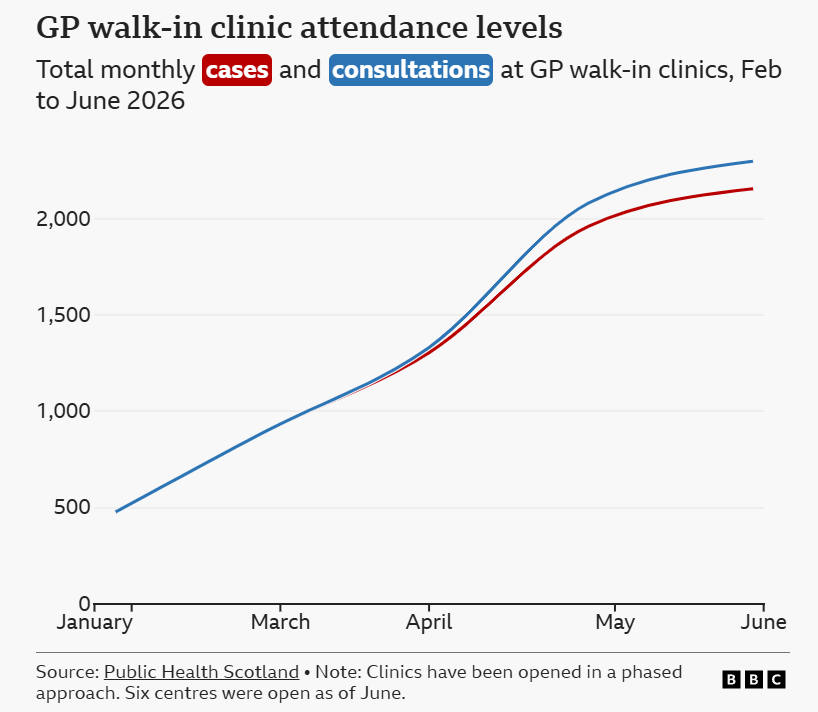
BBC Scotland, Aimee Stanton, 28 july 2026, claimed, despite revealing the above graph in their own report:
GP walk-in clinics see low attendance leading to accusations of failure – A series of walk-in GP clinics which the Scottish government said would end the “8am rush” for appointments have seen low attendance rates, first figures show.
and:
Dr Iain Morrison, chairman of the BMA’s Scottish GPs committee, said doctors had expressed reservations about the walk-in clinics when they were first announced – and it now looked like a case of “I told you so”. He told BBC Radio Scotland Breakfast (RSB): “In terms of any pilot it’s important to learn to fail fast.
“My concern is that we’re not going to learn to close this down when all the evidence suggests that it’s not working.
“It’s going to continue to be worked upon, potentially expanded, despite evidence crying out that it’s not having the impact that’s desired.”
He said it would appear the scheme was more about politics rather than practicality. Morrison said ministers should have learned lessons from a similar scheme introduced in England nearly 20 years ago which, he said, had failed to relieve pressure on other NHS services.
Source: https://www.bbc.co.uk/news/articles/crmrk48zd9ro
There is so much wrong in the above, so uneducated, so self-centred, so greedy.
First, a reasonable science-based length for a pilot this kind to be meaningful would be at least 12 months and preferably 24 or 36 months after the initial ‘ramp-up period.’ We are still in the ramp-up period with only 10 of the 16 planned centres so far open. https://pmc.ncbi.nlm.nih.gov/articles/PMC10354383/
Second, learning from the English scheme has limits given the increasingly diverging NHS systems in England and Scotland but, in addition, it is important not to accept the BMA Scotland’s review of the evidence, selected only to back-up their prior views and, shamefully ignoring the work of Professor Chris Salisbury of the University of Bristol who gold-standard research revealed critical positive findings.
Improved access for certain groups: Centres clearly improved access, particularly for young and middle-aged men (historically lower users of traditional general practice) and people seeking care for recent-onset minor illnesses/injuries. Users often attended on the first day of symptoms for reasons of convenience, speed, and no need for an appointment.
High patient satisfaction: Users were generally more satisfied with walk-in centres than with general practice consultations (e.g., adjusted differences of around 6–7 percentage points in satisfaction scores). Care was viewed as high-quality and appropriate by both patients and staff in many assessments. Waiting times were often short and consultation times longer than typical GP appointments.
Safe, appropriate care for minor issues: Quality of care was at least comparable to general practice for the problems presented; most users felt the attendance was appropriate. https://www.bristol.ac.uk/media-library/sites/primaryhealthcare/migrated/documents/wiceval.pdf
Later patient surveys of GP-led walk-in centres similarly found high satisfaction (86–93% highly or fairly satisfied) and that centres increased access to GP-type care, with many attending because of difficulty seeing their own GP (working hours, closed surgery, or preference for no appointment). https://pmc.ncbi.nlm.nih.gov/articles/PMC3637583/
There’s a simple message here for BMA Scotland and BBC Scotland – shut-up, wait and try to be ready to report accurately and fairly on behalf of the citizens and taxpayers you owe for your comfortable employment.
Footnote: Aimee Stanton’s portfolio seems to be mostly about events in Whakatāne, New Zealand, perhaps explaining her lack of knowledge of GP walk-in clinics? https://muckrack.com/aimee-stanton/articles
Might BBC Scotland employ someone competent?
As of 26 August, the Scottish Government stated that more than 10,500 walk-in cases had been seen, in only 11 centres, in the first six months since the first service opened in February.https://www.gov.scot/news/new-gp-walk-in-services-announced/
Judging by the end-June line graph, that’s a more than 100% surge in attendance.
Help Talking-up Scotland keep going
Crowdfunder at: https://www.crowdfunder.co.uk/p/help-talking-up-scotland-keep-going
Or by direct bank transfer to: JOHN WATSON ROBERTSON Sort Code – 08-91-04 Account – 12266421
Discover more from Talking-up Scotland
Subscribe to get the latest posts sent to your email.


sick to death of so-called professionals bleating. Anyone starting a small business knows that it takes a good twelve to eighteen months to get the word and achieve a steady flow of customers (in this case patients).
why don’t the applaud the Scottish Government for trying to improve the (already very good) SNHS.
oh yes, it’ll be that unionist bollox.
John Lawson
LikeLike
This is my lived memory of how it used to be: https://abetternhs.net/2013/05/10/true-history/ What we went through was wrong and also forgotten. But I’m ashamed of General Practice now…from doing everything…I’m not really sure what the point is of General Practice now…they probably don’t even see enough patients to gain the necessary experience. The Scottish Government is quite right to open walk-in clinics although from what I have seen of it GPs themselves seem to be doing the ‘walk-in’ job that they should be doing in the first place. Wonder how the money works! 40-60 patients queueing round the waiting room of a morning wasn’t going to be the best way to practise medicine but that’s how it was…but how could you live a few hundred yards away from the walk-in and demand that a doctor visit for relatively minor illness rather than wander in later and join the queue, people? That’s really why the old-time service ended! And muggins me…when I was unwell hospital Consultants known to me would fall over themselves to offer their private services free to a respected colleague (private hospitals would have charged for the facilities etc) but I couldn’t do it. How could I accept the admittedly generous largesse and have a different level of care from my patients? So while the genuinely generous Consultants carried on with their private domains I was fucked (medically speaking) by their “appointable” but inexperienced and unsupervised juniors. As are a lot of you….I’m old and done now, actually crying as I write this…
LikeLike
Yeah, let me mention my wife. We were both from ‘working class’ backgrounds. It was hard but you could do that in the 60s! I couldn’t afford a car as a student, didn’t even have decent clothes – I was working weekend and holiday jobs as well and gave all my money to my family, they were up against it. My trousers ripped once and I sewed them up (good at stitching-GRI trained!) And I was laughed at! Wife eventually became a hospital Consultant. We worked all day, all night when ‘on-call’, then all day again. Can you believe that? Potentially Friday morning through Monday evening. Think I once went 56 hours work without sleep (Sat morning – Monday evening). Wife covered my GP telephone calls (unwaged – costs £137million per year now for NHS24 telephone service). When she developed epilepsy with the medical condition that would eventually kill her I drove her around the various hospitals for emergencies she had to attend to at night. I once calculated that between us we had worked 209 hours in a week covering for each other while equally hard working colleagues were off sick (no wonder) or on holidays, winter clock change (so 169 hours) but the ‘normal’ working week was 40 hours worked in parallel…makes 209. You won’t believe it but it’s true…and all gone and forgotten. And we had kids…
LikeLike
Yeah, me again! Old man with a belly full of cancer, dutifully taking my pills washed over with a lovely Macallan (shhh…don’t tell, will probably puke later). Heavily qualified but not sure what to do. Let’s try psychiatry in one of Glasgows big old asylums in the 80s with up to 500 long term inpatients. During “out of hours” (i.e. all hours other than Monday – Friday 9am to 5pm) one young doctor would provide all inpatient medical/psychiatric care for the entire hospital, all medical/psychiatric care for the many new admissions negotiated with GPs and other emergency services including acute detentions under the Mental Health Act, and was under instructions to accept all telephone calls from members of the public asking for mental health advice and to see those who simply turned up at the hospital (total coverage of at least a quarter of Glasgow’s population). The shifts were 32 hours for weeknights (including the normal day shifts either side) or Sunday/Monday and 24 hours on the Saturday. (Or 56 hours Saturday morning till 5pm Monday, which rotas tried to avoid!). A small number of overnights off then repeat. Were we rich, working all those hours? Pay for “out of hours” was less than one third of normal salary rate (i.e. an overtime reduction of more than two thirds of basic salary for an incredible workload). The only direct support was a Consultant (unpaid/included in contract!) by phone, who could be relied on to attend in person for psychiatric complexities (the ‘juniors’ were much better at all of the basic medical work due to recent experience) and sympathetic nursing and other hospital staff, not least the hospital telephonist. The ‘out of hours’ community care was a very small team of CPNs (full pay so few numbers!), ‘out of hours’ GPs (also paid a pittance) and a solitary area social worker ‘on call’ (full pay) for mental health (MHO). And the Samaritans (who phoned the hospital about major concerns as well). Other hospital ‘junior doctors’ (including my soon-to-be wife) worked similar or worse hours but this is the only recollection I have of being the only doctor for up to 48 hours (with dayshift to follow) in a large hospital. How many workers does it take to cover all of that now?
LikeLiked by 1 person
Wow!
LikeLike
Looks like another attempt to sabotage something that is starting to be successful in Scotland. It has become normal for BBC Scotland and the MSM. Sad to say.
LikeLike
Thanks for the memories. Really appreciate it. Thanks for your service.
Scotland spends £22Billion on SNHS. + social care. 1/3 of the budget.
The Tories cut funding for the NHS for over ten years. Until Covid funded Covid 270Billion over two years. UK Gov Accounts.
Westminster spends £13Billion a year decommissioning nuclear. Over 10 years £130Billion. Wastes £Billion on HS2, Hickley Point etc. Borrowed Chinese money. Scotland has to pay back on the debt. Not borrowed or spent in Scotland.
Hope a clinic opens up here soon. Could do with it.
Government changing lifestyles and taking positive measures. Could make people healthier. MUP and rehab facilities help to keep people healthier. Child payment helps keep keeps people healthier. Health is linked to mothers health on conception.
LikeLiked by 1 person
I feel there’s TuS piece here if you’d like to to trim all this and write it?
John
LikeLike
Not sure if you mean the GP/hospital doctor story…it’s already well covered here: https://abetternhs.net/2013/05/10/true-history/ and here: http://peterenglish.blogspot.com/2013/04/peter-holden-responding-to-times.html?spref=tw. Junior doctor hours covered here: https://www.theguardian.com/artanddesign/2016/feb/05/thats-me-picture-gp-jackie-applebee-junior-doctors-protest-1989 and I did do a one-in-two when a third colleague was on holiday or ill i.e. Friday morning through Monday 6pm was 82 hours non-stop…sleep if you can. That would be 144 hours for one week and 78 the next to get a weekend off. The two of us would try to split that weekend horror show but that meant no weekends off at all. The average was 120 hours per week. Only 40 hours at full pay, the rest at 32% of standard rate. A fuller explanation is here: https://www.bmj.com/content/349/bmj.g6426. Some frontline Consultants still do week long shifts at time, just to get a semblance of family life. They might not get called out by their experienced ‘junior’ staff – just depends on severity of cases and occurrence of major incidents. There are ~450 Consultant neurosurgeons in the UK averaging £125,000 per year. At least 3000 professional footballers earn more, the top footballers making 2 to 3 times more in a week than the neurosurgeon earns in a year. As for top execs and business owners….. Something wrong somewhere.
LikeLike
Thanks
Must admit I’m not sure other than wondering if there is something there directly and simply in support of the walk-in centres project
John
LikeLike
Doctors in practice get paid per patient. More patients on their list more money they get. (Ghost patients) Plus other payments for certain (Gov) extended services. Covid jab etc. More for over seventy year old initiatives. Some Doctors will not like the scheme because they lose business. Even though it helps out the patients. Drs surgeries will not get the payment for the visit. Even though it helps the patients. From waiting so long because the Tories cut NHS essential funding for 15 years. Apart from Covid funding £270Billion over two years. UK Gov Accounts. They knew and epidemic was coming but were unprepared because of lack of funding for 15 years.
The results are longer waiting times now. Much of COVID funding was misappropriated. Defrauded £Billions which could have been spent on healthcare. Became a Tory slush fund. Mone etc. Still not in jail.
LikeLike