

Help Talking-up Scotland keep going
Crowdfunder at: https://www.crowdfunder.co.uk/p/help-talking-up-scotland-keep-going
Or by direct bank transfer to: JOHN WATSON ROBERTSON Sort Code – 08-91-04 Account – 12266421
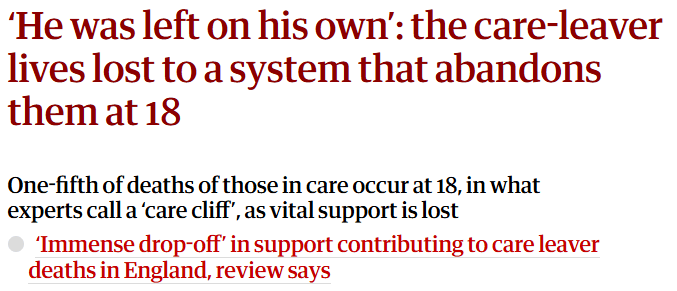
In the Guardian yesterday, the above and:
David’s death is one of a number examined in a landmark review into the deaths of more than 100 care leavers aged 18-24 in 2025. The review findings suggest the death rate of this cohort is about 3-4 times higher than the death rate of the general population.
One-fifth of all these deaths occurred at age 18, with experts saying a “care cliff” means young people experience an “immense drop off in support” as they transition from being a child to an adult.
The review said: “It is notable that there was no one in David’s life who was connected enough to notice his absence [when he died] and, in the end, it was neighbours who alerted the police. Those who knew David talked about him fondly, and he clearly made connections with a number of them in children’s services.
“They said that when he turned 19, all those connections fell away and he was left on his own.”
I hesitate to make comparisons with Scotland such a sensitive issue but do so only because were things worse in Scotland, they would not hesitate to damn us all to hell with accusations of betrayal of young folk. It only takes the school attainment gap to widen by 0.001% and they’re baying for blood.
So, does the system in Scotland differ from that in England, described by the Guardian?
Yes, Scotland’s system for care leavers differs in key ways from the one described in the article (which focuses on England and the “care cliff” of an abrupt drop in support around age 18).
Key differences in Scotland
Scotland has a distinct legal and policy framework under the Children and Young People (Scotland) Act 2014, plus ongoing work under “The Promise” (Sturgeon).
- Continuing Care: Young people who were looked after and accommodated on or after their 16th birthday and meet eligibility criteria can request to stay in their existing placement with the same support until age 21. This is intended to provide a more gradual transition rather than an automatic exit at 18. https://www.gov.scot/policies/looked-after-children/children-leaving-care/
- Aftercare support: Local authorities have a duty to prepare young people for leaving care and to provide advice, guidance, and assistance. Support must be offered until age 19 with discretion to go beyond 26 in some cases. This applies to those who left care on or after their 16th birthday, regardless of placement type. https://www.gov.scot/publications/childrens-social-work-statistics-looked-after-children-2023-24/pages/care-leavers/
- Financial and practical supports: These include setting-up-home grants, a Care Experience Bursary, council tax exemption for care leavers up to age 26, and a one-off £2,000 Care Leaver Payment for eligible young people leaving care or continuing care. This payment was co-designed with care-experienced people and is intended as additional help. https://www.gov.scot/news/helping-care-leavers/
- Broader ethos and recent changes: Scotland’s approach emphasises extended relationships and support through initiatives tied to The Promise. Recent legislation has included lifelong advocacy entitlements for care-experienced people and expansions of aftercare eligibility in some cases. Advocacy organisations such as Who Cares? Scotland provide ongoing support. https://young.scot/get-informed/support-for-care-experienced/
In terms of death rates, Scotland still has a tragic 2.7-3 times as high rate. https://pmc.ncbi.nlm.nih.gov/articles/PMC12505078/
In England, the rate varies between 3 and 4 times as high.
Help Talking-up Scotland keep going
Crowdfunder at: https://www.crowdfunder.co.uk/p/help-talking-up-scotland-keep-going
Or by direct bank transfer to: JOHN WATSON ROBERTSON Sort Code – 08-91-04 Account – 12266421
Discover more from Talking-up Scotland
Subscribe to get the latest posts sent to your email.

