

Help Talking-up Scotland keep going
Crowdfunder at: https://www.crowdfunder.co.uk/p/help-talking-up-scotland-keep-going
Or by direct bank transfer to: JOHN WATSON ROBERTSON Sort Code – 08-91-04 Account – 12266421
Why is this unacceptable propaganda?
From the First Minister 9 February 2026, responding to calls for a national review:
However, in order for any action to be effective, we must appropriately consider the relevance of these recommendations for our specific legislative, statutory service and regulatory landscape, and the scale of this specific form of organised gang-related sexual abuse of children and young people in Scotland.
I would firstly like to clarify that the recent case of child sexual abuse in Glasgow cited in your previous letter, which is now subject to a learning review, whilst horrendous, was of a different nature to the organised gang grooming observed in England and the cases reported in Baroness Casey’s recent National Audit.
Furthermore, Police Scotland have advised the Scottish Government that there are no current investigations in Scotland involving offences against children which would mirror the investigations described in Baroness Casey’s audit as being perpetrated by “grooming gangs”.
and:
In Scotland, all healthcare and education professionals already have a duty to report child abuse to social work or the police, including child sexual abuse and exploitation. A practitioner’s failure to report child abuse, including child sexual abuse and exploitation, could constitute a breach of their employment contract, lead to disciplinary action, or give rise to a claim for civil damages. Practitioners could also be struck off from social work, teaching, or medical registers for gross misconduct.
Not in Swinney’s response but an important factor, mentioned in the last line above – all care staff must be registered in Scotland but in the English report of the Independent Inquiry into Child Sexual Abuse October 2022:
There is no system of registration for the approximately 35,000 workers “mainly or solely providing care for children” (that is, in a care role) in England. In Wales (as well as in Scotland and Northern Ireland), children’s social care workers must register with a regulatory body. https://www.iicsa.org.uk/reports-recommendations/publications/inquiry/final-report.html
Full FM response at: https://www.gov.scot/publications/ukg-audit-on-group-based-child-sexual-exploitation-and-abuse-first-ministers-response/
Help Talking-up Scotland keep going
Crowdfunder at: https://www.crowdfunder.co.uk/p/help-talking-up-scotland-keep-going
Or by direct bank transfer to: JOHN WATSON ROBERTSON Sort Code – 08-91-04 Account – 12266421
Discover more from Talking-up Scotland
Subscribe to get the latest posts sent to your email.


It’s relentless isn’t it, but a sign of unionist desperation. Thanks for wading through this bilge so that we don’t have to.
I have contributed to the crowd funder because this daily service is an essential counter to the endless stream of unionist propaganda from almost every other outlet. I hope many others chip in as well so you can hire assistance or at least have a break!
LikeLike
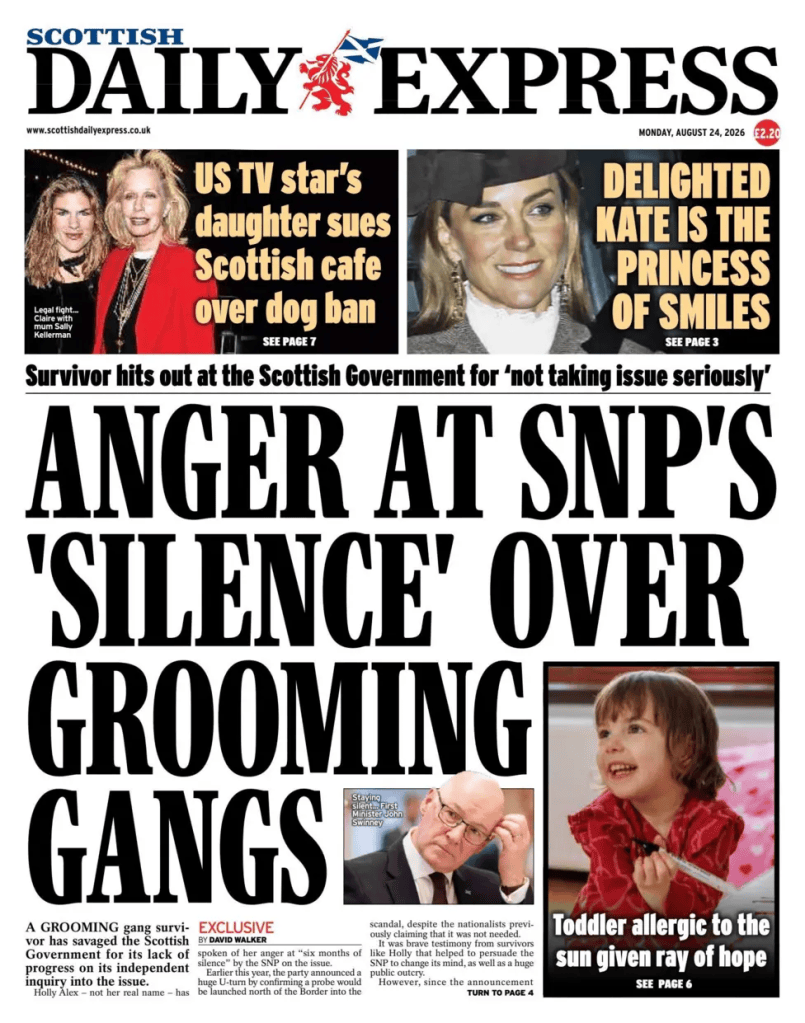
The 1999 inquiry — formally “The Report of the Edinburgh Inquiry into Abuse and Protection of Children in Care” — was commissioned in response to serious allegations of abuse of young people in Edinburgh’s residential care system.
A Scrutiny Panel was set up, chaired by a senior Tory figure, Cllr Tom Ponton, in whose name a report was submitted in October 2003. The Scrutiny Panel report states that its purpose was to review: “all the recommendations of the Edinburgh Inquiry into abuse of young people.”
Click to access the_edinburgh_inquiry.pdf
This title itself sets out the scope of the Inquiry: Abuse, Failures of protection, Children in residential care. It was a major investigation into systemic failures in Edinburgh’s children’s homes — including safeguarding, management oversight, staff conduct, and the protection of vulnerable young people.
The Scrutiny Panel reviewed 135 recommendations from the Inquiry, which was wide‑ranging and identified deep systemic problems.
The Inquiry was not about the grooming‑gang style activity described in the Holly Alex coverage (which occurred 2003–2007). However, it examined the same care‑home system (St Katharine’s, Northfield, and other council‑run units).
It identified safeguarding failures that later allowed external abusers to exploit girls in care. Many recommendations were intended to prevent exactly the kind of failures that later occurred.
In other words, the 1999 Inquiry was the first major warning about vulnerabilities in Edinburgh’s residential‑care system — vulnerabilities that clearly were not fully fixed.
Recommendation 135 set the requirement for an annual report on this subject by the Council’s CEO, effectively elevating it to a cross-Council priority. As can be seen from the Unison document below, this was seen by the workforce as an important receommendation.
Against recommendation 135, the Scrutiny Panel’s report said: “Progress has been reported in various forms including the Children’s Services Plan. It is considered that the recommendation is largely discharged. However, there has been no dedicated annual report as such. The Chief Executive has indicated his willingness to prepare the dedicated annual report before Christmas.”
At the Executive of the Council – 15 June 2004, the Chief Executive reported against recommendation 135 that: “Several reports were presented to the Council, advising members of actions taken (Council Reports 118, 119 and 121 in 1998/99 and 72 in 1999/2000) and, in light of these, an annual report, in terms of recommendation 135, was not considered necessary in the form of a stand alone document.”
The Executive noted the position on implementation of all recommendations and agreed that “further reporting on work concluded would be incorporated into mainstream reporting arrangements.”
So by June 2004, the Council had explicitly decided not to produce a stand‑alone annual report as envisaged by Recommendation 135. This returned the Council to the status quo ante, that EDC would treat existing scattered reports and the Children’s Services Plan as sufficient.
The promised dedicated annual report (of which Tom Ponton said, the Chief Executive “indicated his willingness to prepare before Christmas”) appears to have never been delivered as a stand‑alone document. Instead, in June 2004, the Chief Executive’s report to the Executive explicitly redefines Recommendation 135 as satisfied by existing, non‑dedicated reports, and this is accepted.
These decisions were made right at the beginning of the period in which Holly Alex and others continued to be abused in Edinburgh’s care homes.
Both the 1999 Edinburgh Inquiry and the 2003 Scrutiny Panel review took place while EDC was under single-party Labour control.
The 2004 Executive decisions (including the effective closure of Recommendation 135) and the 2003–2007 period of exploitation involving Holly Alex and other girls in care occurred under a Labour‑led administration, with the Lib Dems joining the administration from 2003 onward.
I wonder if any of the Labour and LibDem figures have ever faced challenge as to why, within four years of the 1999 Inquiry, they allowed the system to return to business as usual, and what that says about their real interest in safeguarding vulnerable children?
This is the Unison Briefing on the Inquiry outcome:
Report & Timescale
The 66 page Summary Report was presented to the Council on 4 February 1999. It has 135 recommendations. The full 300+ report is to follow and will include 80 ‘Lessons’ from the past. The Inquiry Team will lead a seminar on the report for councillors on 17 February, the report will then go to the Social Work Committee on 2 March and back to the full council on 4 March.
Context
Professor Marshall made it clear that the issue of protecting children was a corporate responsibility. If there was blame, it was corporate blame and that ‘laying blame was too easy an answer’ and a diversion from addressing how failures could be avoided in the future.
The Council should explicitly acknowledge its corporate responsibility to children looked after by them (Recommendation 1) and publicly acknowledge that there are risks involved (Recommendation 2) Staff should feel supported in implementing decisions arising from risk assessments. This corporate responsibility was underlined by the recommendation that the cost of the Inquiry should come from the Council as a whole, rather than the Social Work Department.
In her address to the Council, Professor Marshall said that a line should now be drawn under things and concentrate on implementing the recommendations. One of the recommendations is that there should be an annual review of implementation.
Disciplinary Action
The report says “…nothing we learned in the course of our inquiry would in our view merit disciplinary action against any current member of the City of Edinburgh’s Social Work department staff. It would be a poor consequence for individual staff members who co-operated so fully and frankly with us, including reflection on whether or not they might have acted differently, if an interpretation were made that they should suffer penalties which arose directly from that co-operation”.
Criticism
There is direct criticism of the police handling of a Dean House issue and of an APO giving a positive reference to McLennan without mentioning an investigation. There is general criticism of the way things had been handled in some cases but this is often set in the context of the process of the decision making, the absence of guidelines and the culture and knowledge at the time. It does however make it clear where things should have been handled differently at all levels and where action could and should have been taken.
Other allegations
The report mentions Chester Street and the fact that former residents contacted the inquiry to speak rebut allegations made and to comment highly on the care they received there. In relation to allegations of a ‘cover up’ in an anonymous letter, the report does not believe there was a deliberate cover-up but does say that some allegations against staff members should have been investigated.
A summary of 16 recommendations has gone out to Social Work stewards.
LikeLike
Read this in the ‘Edinburgh enquirer’, local independent news platform.
Looks like the cops weren’t too bothered and note, from North West England.
https://www.edinburghinquirer.co.uk/p/police-probe-neo-nazis-on-princes
LikeLike