


____________________________________________________________________________
Help Talking-up Scotland keep going.
Crowdfunder at: https://www.crowdfunder.co.uk/p/help-talking-up-scotland-keep-going
Or by direct bank transfer to:
MR JW ROBERTSON
Sort Code – 08-91-04
Account – 12266421
_____________________________________________________________________________
Above, how many of us have thought for some time of BBC Scotland News and its key role in suppressing the voices of those in the wider Yes campaign for Scottish independence. Here are those who have been rewarded for their part, with well-paid, secure employment, in lies about, amongst other topics, Scotland’s ferries, hospitals, schools and crime rates:
Today, they face, for them, an unexpected shock:
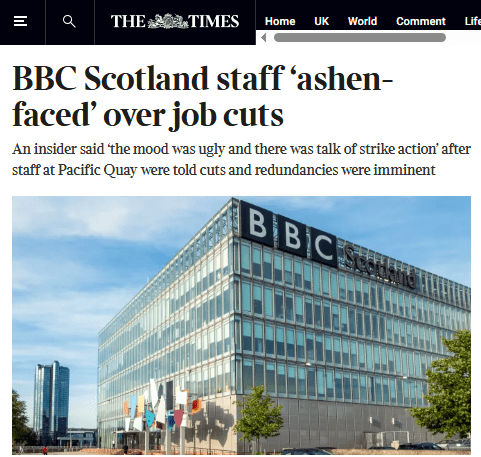
Should they have known this might come?
AI – Do those employees who lie on behalf of unethical employers tend to benefit the long term?
No, they generally do not benefit in the long term. Employees who systematically lie to protect or advance unethical employers often gain short-term advantages (job security, bonuses, promotions, avoidance of immediate conflict) but face compounding risks that erode those gains over time.Short-term incentives vs. long-term realitiesUnethical employers create environments where loyalty is measured by willingness to cover up problems, misrepresent facts, or enable misconduct. In the near term this can look rational: the employee keeps the paycheck, stays in the in-group, and may even be rewarded for “protecting the company.” Over longer horizons the picture changes:
- Reputation and network effects: Once an employee is known (internally or externally) as someone who will falsify information or stonewall scrutiny, their credibility collapses. Future employers, colleagues, regulators, and clients discount or avoid them. Professional networks and references become liabilities rather than assets.
- Legal and financial exposure: Lies that shield fraud, safety violations, discrimination, or other misconduct frequently become discoverable. Employees who participate can face personal liability, fines, criminal charges, or civil suits even if they were “just following orders.” Whistleblower protections and document trails have improved in many jurisdictions; the cover-up often becomes the more prosecutable act.
- Psychological and health costs: Sustained cognitive dissonance, fear of exposure, and erosion of personal integrity correlate with higher stress, burnout, anxiety, and poorer decision-making. These effects reduce long-run productivity and life satisfaction more than any temporary raise compensates for.
- Career ceiling and mobility: Organizations that rely on deception tend to be unstable. When scandals break, restructurings occur, or better-governed competitors emerge, the loyal liars are often the first discarded or the ones whose resumes raise red flags. Skills developed in concealment transfer poorly to high-trust environments.
Empirical patterns from corporate scandals (accounting frauds, product-safety cover-ups, regulatory evasion) repeatedly show that mid-level facilitators rarely emerge better off a decade later than peers who refused or exited early. The rare exceptions tend to be cases where the entire industry or jurisdiction remained captured by the same norms—an increasingly fragile condition in an era of greater transparency, litigation, and media scrutiny.
Research publications confirming the above?
Lasorsa, D. L., & Dai, J. (2007). “NEWSROOM’S NORMAL ACCIDENT?: An exploratory study of 10 cases of journalistic deception.” Journalism Practice, 1(2), 159–174.
This analysis of high-profile U.S. cases (including Jayson Blair at The New York Times, Stephen Glass at The New Republic, and others) applies normal-accident and disaster-incubation theory to newsrooms. It documents how organizational culture often overlooks early “flags” of deception during an incubation period, enabling the practice in the short term. Once revealed, the deceptions produced severe professional consequences for the individuals involved (firings, revoked awards, lasting stigma) and institutional damage. Related work by the same authors (e.g., on stereotypes and linguistic patterns in deceptive vs. authentic stories) further distinguishes fabricated reporting and underscores the eventual exposure risk. https://www.tandfonline.com/doi/abs/10.1080/17512780701275473
Reports from former totalitarian countries becoming democratic where regime loyalist journalists are abandoned?
Albania (post-1991)After the fall of the communist regime, the media system was dismantled in a relatively radical way. Most newspapers and magazines from the previous era were closed or renamed. In a very radical process, most journalists who had worked under the prior regime were suspended; only a few remained employed, mainly at the state broadcaster or in local media. New national dailies proliferated, and the old cadre was largely sidelined as the system opened. This is detailed in the collection Three Decades Later: The Media in South East Europe after 1989. https://journalift.org/wp-content/uploads/2021/09/Three-Decades-Later-The-Media-in-South-East-Europe-after-1989.pdf
East Germany (GDR / after 1989–1990 reunification)East German journalists—many of them SED party members (estimates around 85% in some accounts)—faced significant disruption. High-level positions in the restructured media were frequently taken by West Germans (“Wessies”), reflecting mistrust of those trained and selected under the old nomenklatura system. When former GDR journalists retained roles, they were often downgraded. Massive layoffs occurred as East German radio and television were integrated into West German public broadcasting structures; professional uncertainty was heightened by Stasi revelations. By the mid-1990s, the number of journalists with GDR experience had been reduced by over half in many accounts, and by around 2000 only about one-third remained active in the profession in some tallies. Academic analyses and interview-based studies describe resentment over “Besserwessis,” forced early retirements for older cohorts deemed too “corrupted,” and a shift in resource allocation that disadvantaged many East German practitioners. https://dl1.cuni.cz/pluginfile.php/1991869/mod_resource/content/1/East_German_media_in_transition_after_reunificatio.pdf
Post-WWII Czechoslovakia (Nazi collaborators; analogous pattern for totalitarian loyalists)After 1945, the Czech Journalists’ Union conducted an internal cleansing. A committee investigated roughly 400 journalists and imposed penalties on more than 200. Dozens were expelled from the union, barred from the profession (some permanently), or referred to national courts. This process was rigorous compared with France or the Netherlands; subsequent political developments reinforced long-term professional prohibitions for many of those punished. While this concerns Nazi-era collaboration rather than communism, it illustrates a parallel pattern of professional abandonment of regime collaborators in a democratizing context. https://www.researchgate.net/publication/320069805_Cleansing_among_Czech_Journalists_after_World_War_II_and_a_Comparison_with_the_Situation_in_France_and_the_Netherlands
____________________________________________________________________________
Help Talking-up Scotland keep going.
Crowdfunder at: https://www.crowdfunder.co.uk/p/help-talking-up-scotland-keep-going
Or by direct bank transfer to:
MR JW ROBERTSON
Sort Code – 08-91-04
Account – 12266421
_____________________________________________________________________________
Discover more from Talking-up Scotland
Subscribe to get the latest posts sent to your email.


Oh dear, the old expression “You reap what you sow” comes to mind. Well along with many other pithy sayings.
Extra voddie tonight to help me drown my sorrows 🙂
Stephen McKenzie
LikeLiked by 3 people
Good riddance to the lot of them, and good riddance EngBBC propaganda machine.
No thanks!
LikeLike
What a shameful charade. £6Billion a year for Westminster lies. Bye bye BBC Scotland. Take your trash with you. Pumping out rubbish. Everyone sees you.
LikeLiked by 1 person
Toodle-oo-the noo! …..dont hurry back….you wont be missed.
LikeLike
Regarding the image, I performed a reverse image search and found that it’s by Bruce McKinnon, a Canadian political cartoonist who drew it in response to allegations of sexual assault against Brett Kavanaugh around 2018.
LikeLike